

No Artificial Distinction in Common Offence: Chhattisgarh High Court Sets Aside Amit Jogi’s Acquittal in Jaggi Murder Case
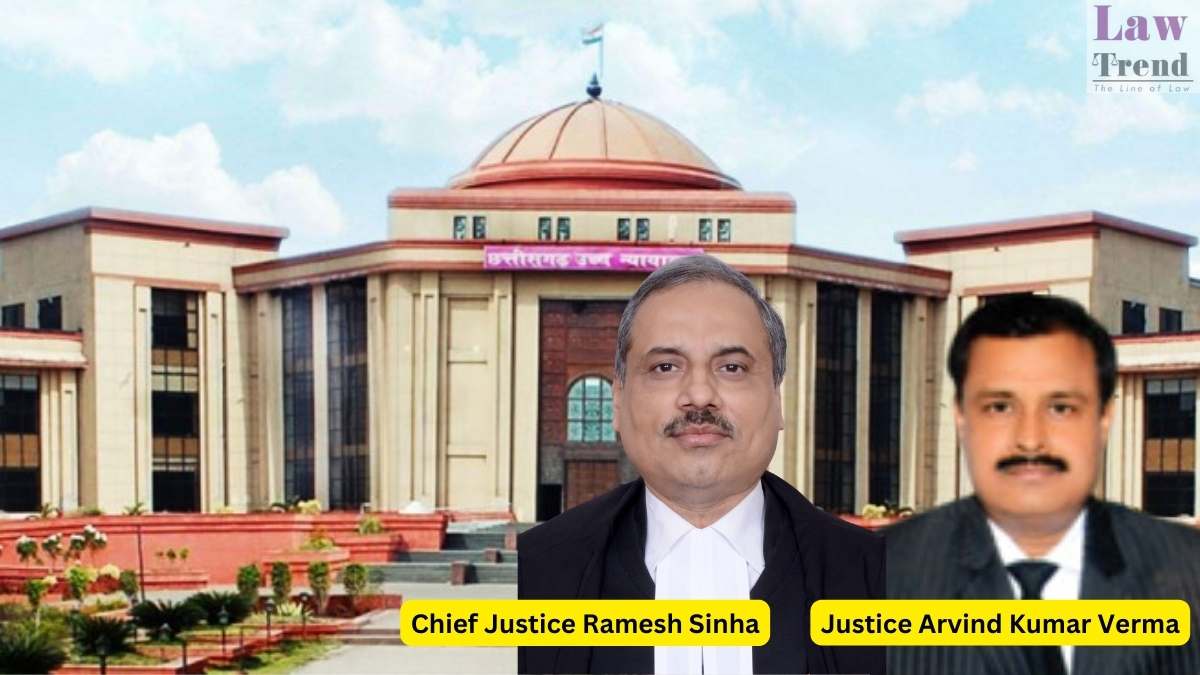

The High Court of Chhattisgarh has ruled that an artificial distinction cannot be drawn in favour of a specific accused when all are charged with participating in a common offence based on the same evidence. Applying this principle, a Division Bench comprising Chief Justice Ramesh Sinha and Justice Arvind Kumar Verma set aside the 2007 acquittal of Amit Jogi, son of former Chief Minister Ajit Jogi, in the 2003 murder of NCP leader Ram Avtar Jaggi.

The Court held Amit Jogi guilty under Section 302 read with Section 120-B of the Indian Penal Code (IPC) for criminal conspiracy to commit murder, sentencing him to life imprisonment.

Background of the Case

On June 4, 2003, Ram Avtar Jaggi, treasurer of the Nationalist Congress Party (NCP), was shot dead in Raipur. The Central Bureau of Investigation (CBI), which took over the case in 2004, alleged that the murder was a political conspiracy to sabotage a major NCP rally. The CBI identified Amit Jogi as the mastermind who orchestrated the crime through Chiman Singh (the assailant) and other associates.

On May 31, 2007, the Trial Court convicted 28 co-accused but acquitted Amit Jogi, concluding he was not part of the conspiracy. This acquittal was challenged by the CBI and the deceased’s son, Satish Jaggi.

Arguments of the Parties

Appellant (CBI and Complainant): Counsel for the CBI, Mr. Vaibhav A. Goverdhan, and for the complainant, Mr. Shri Singh, argued that the Trial Court erred by accepting the conspiracy evidence for 28 convicts while rejecting it for Amit Jogi. They relied on:

  • Conspiracy Meetings: Testimony of Reginald Jeremiah (PW-85) regarding meetings at Hotel Green Park and the CM House where Jogi allegedly proposed “finishing” NCP leaders.
  • Witness Corroboration: Statements from Siddharth Asati (PW-97) and Rohit Prasad (PW-126) regarding the presence of Chiman Singh and the planning of the “sabotage.”
  • Subsequent Conduct: Evidence of Jogi directing the payment of ₹5 lakhs to the assailant post-murder and the involvement of police officials in planting false accused to shield the real perpetrators.
READ ALSO  Young Advocates Must Volunteer to Assist Needy Litigants: Supreme Court Stresses Duty to Ensure Access to Justice

Respondent (Amit Jogi): Counsel Mr. Vikas Walia sought adjournments to study the voluminous record. The Court, however, noted the case was remanded by the Supreme Court with a request for expedited disposal and observed that the accused had sufficient time since the remand in November 2025.

Court’s Analysis and Observations

The High Court focused on the “Head Note” principle regarding common offences and the consistency of evidence.

On Artificial Differentiation: The Court observed that the Trial Court had “unnecessarily attempted to distinguish the role of accused-Amit Jogi from that of the other co-accused/convicts.” It stated:

“An artificial distinction cannot be drawn in favour of a particular accused when all are charged with participation in a common offence. Where the prosecution case rests on the same set of evidence against all accused, it would be impermissible to acquit one accused while convicting the others on that very evidence, unless a strong and compelling case for acquittal is independently made out…”

On the Mastermind Role: The Bench found that Jogi’s position as the son of the then Chief Minister placed him in a “commanding position.” The Court remarked:

“The orchestration of such a sophisticated and high-level organized crime… could not have been possible without the active involvement, guidance, and protection of a person wielding considerable influence and authority.”

READ ALSO  Chief Justice Ramesh Sinha Leads Virtual Bhoomipujan and Foundation Stone Laying Ceremony for Family Court Building in Bemetara District, Chhattisgarh

On the Evidentiary Chain: The Court held that the transaction of funds and frequent meetings at Batra House, Hotel Green Park, and the CM House established that Jogi was the “principal architect and driving force” of the conspiracy.

The Decision

The High Court declared the 2007 acquittal “palpably illegal, wrong, and perverse.”

Final Orders:

  1. Conviction: Amit Jogi @ Amit Aishwarya Jogi is convicted under Section 302 read with Section 120-B IPC.
  2. Sentence: Life imprisonment with a fine of ₹1,000 (additional six months RI in default).
  3. Surrender: Jogi must surrender before the Trial Court within three weeks.
  4. Revisions: ACQA No. 66/2026 was allowed; CRR No. 232/2008 seeking enhancement of other sentences was dismissed as infructuous following previous appellate affirmations.
READ ALSO  जब राज्य के पास व्यापार का विशेष अधिकार सुरक्षित हो तो उसके खिलाफ समान अधिकार का दावा नहीं किया जा सकता: छत्तीसगढ़ हाईकोर्ट

Case Details:

  • Case No.: ACQA No. 66 of 2026
  • Bench: Chief Justice Ramesh Sinha and Justice Arvind Kumar Verma
  • Date: April 2, 2026

Law Trend
Law Trendhttps://lawtrend.in/
Legal News Website Providing Latest Judgments of Supreme Court and High Court

Related Articles

Latest Articles

