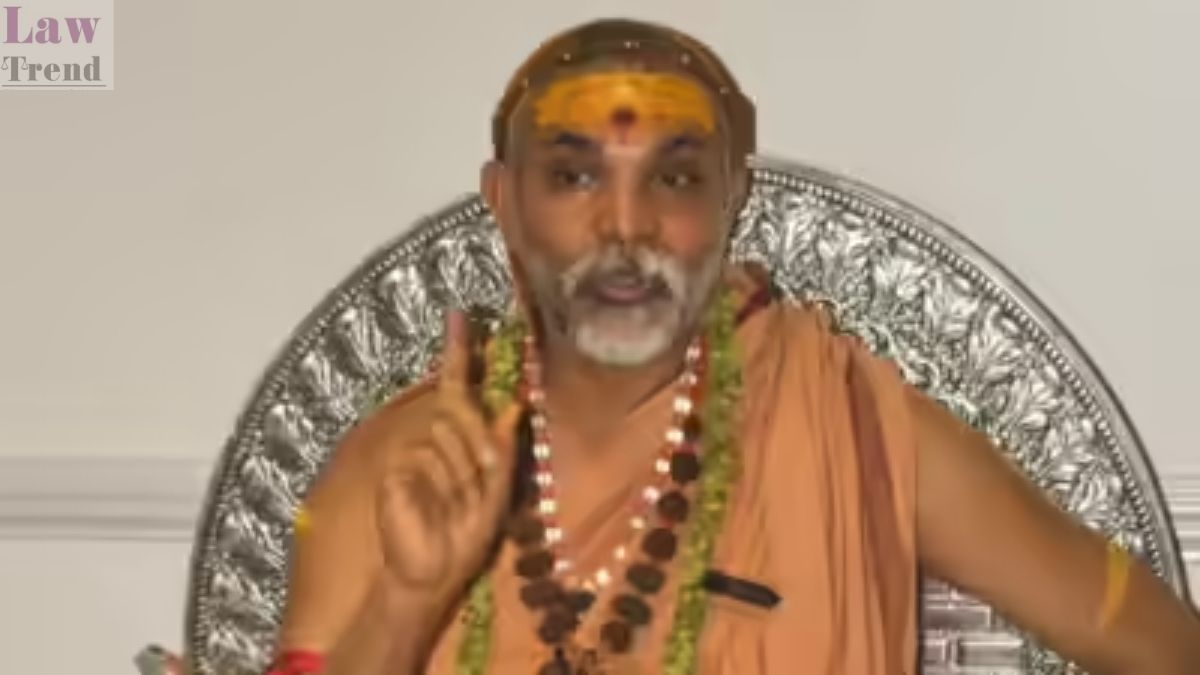
The High Court of Judicature at Allahabad has granted anticipatory bail to Swami Avimukteshwaranand Saraswati Jagatguru Shankaracharya Jyotishpeethadheeshwar and Swami Pratyakchaitanya Mukundanand Giri in a case involving allegations of sexual assault under the POCSO Act. Justice Jitendra Kumar Sinha, presiding over Court No. 69, observed that the factual matrix, including a delay in reporting and material improvements in statements, warranted the exercise of discretionary jurisdiction for pre-arrest bail.
Background
The case (Case Crime No. 58 of 2026) was registered at Police Station Jhunsi, District Prayagraj, under Section 351(3) of the B.N.S. and various sections of the POCSO Act (Sections 3, 4(2), 5(1), 6, 16, and 17). The First Information Report (FIR) was lodged following a direction from the Special Judge (POCSO) Act, Prayagraj, on an application filed by the first informant, Ashutosh Brahmachari, under Section 173(4) of the BNSS.
The allegations suggested that two minor boys were subjected to penetrative sexual assault during the Magh Mela (2026) and Mahakumbh Mela (2025).
Arguments of the Parties
Applicants’ Contentions: Senior Counsel Shri Dilip Kumar, appearing for the applicants, argued that the case was a result of false implication. He highlighted that the victims were institutional students at a school in Hardoi and never resided in the applicant’s ashram. The defense pointed out a significant delay in reporting, noting that while the informant claimed to have known of the incident on January 18, 2026, he filed a different police complaint on January 21 without mentioning these allegations.
“The allegations levelled against applicant no.1, who is highly revered Guru are with the intention to humiliate and harass him and to bring down his image in the public opinion,” the counsel stated. The defense also questioned the medical report, arguing that signs of oral sexual assault would not persist for 40 days as per medical jurisprudence.
State and Informant’s Opposition: The Additional Advocate General, Shri Manish Goyal, opposed the bail, citing the heinous nature of the offences. He raised a preliminary objection regarding the applicants approaching the High Court directly without first moving the Sessions Court. The State further contended that the applicants were influential and could intimidate victims, presenting a pen drive of media interviews given by the applicant as evidence of potential influence.
Counsel for the informant, Ms. Reena N. Singh, argued that custodial interrogation was necessary to recover electronic evidence and that Section 29 of the POCSO Act raises a presumption of guilt against the accused.
Court’s Analysis
On Maintainability: The Court addressed the preliminary objection regarding its concurrent jurisdiction under Section 482 BNSS (formerly Section 438 Cr.P.C.). Citing Ankit Bharti Vs. State of U.P. and Manjeet Singh Vs. State of Uttar Pradesh, the Court held that while the normal rule is to approach the Sessions Court first, the High Court can entertain applications directly in “special circumstances.”
The Court noted that since the FIR was registered on the order of a Special Judge (who holds the rank of a Sessions Judge), the case qualified as an extraordinary circumstance.
On Merits and Evidence: Justice Sinha scrutinized the timeline and nature of the allegations, making several key observations:
- Delay in FIR: There was a six-day delay in reporting after the informant allegedly learned of the crime. The Court found the informant’s excuse of being “busy in Pooja” insufficient, especially since he filed a different complaint in the interim.
- Inconsistent Statements: The FIR mentioned the incident occurred between January 2025 and February 2026 at Prayagraj. However, victim statements later included incidents from June 2024 in Madhya Pradesh and Uttarakhand.
- Age Discrepancy: Educational certificates showed one victim was already a major during the period mentioned in the FIR.
- Medical Findings: The Court observed that “no external injury has been found on the person of the victims” and noted that the doctor’s opinion—stating sexual violence could not be ruled out—lacked a conclusive basis.
- Unusual Conduct: The Court found it “unusual and not consistent with a normal course of human conduct” that the victims confided in a stranger (the informant) rather than their natural guardians.
On Section 29 POCSO Act: The Court clarified the legal standing of the presumption of guilt. Relying on the Delhi High Court’s judgment in Dharmander Singh @ Saheb Vs. The State, Justice Sinha held that:
“Presumption under Section 29 of the POCSO Act cannot be invoked at least before framing of charge by the learned Sessions Court.”
The Decision
The Court concluded that a case for anticipatory bail was made out. It directed that in the event of arrest, the applicants be released on a personal bond of Rs. 50,000/- with two sureties each.
The Court imposed several conditions, notably:
- The applicants must not tamper with evidence or threaten witnesses.
- The applicants shall not leave India without permission.
- Media Restraint: “The applicants, victims and the first informant are directed not to give any interview to the media regarding present case during pendency of the investigation / trial.”
The Court clarified that its observations were limited to the bail application and would have no bearing on the actual trial.
Case Details:
- Case Title: Swami Avimukteshwaranand Saraswati Jagatguru Shankaracharya Jyotishpeethadheeshwar And Another Vs. State Of U.P. And 5 Others
- Case No.: Criminal Misc. Anticipatory Bail Application U/S 482 BNSS No. 2198 of 2026
- Bench: Justice Jitendra Kumar Sinha
- Date of Order: March 25, 2026