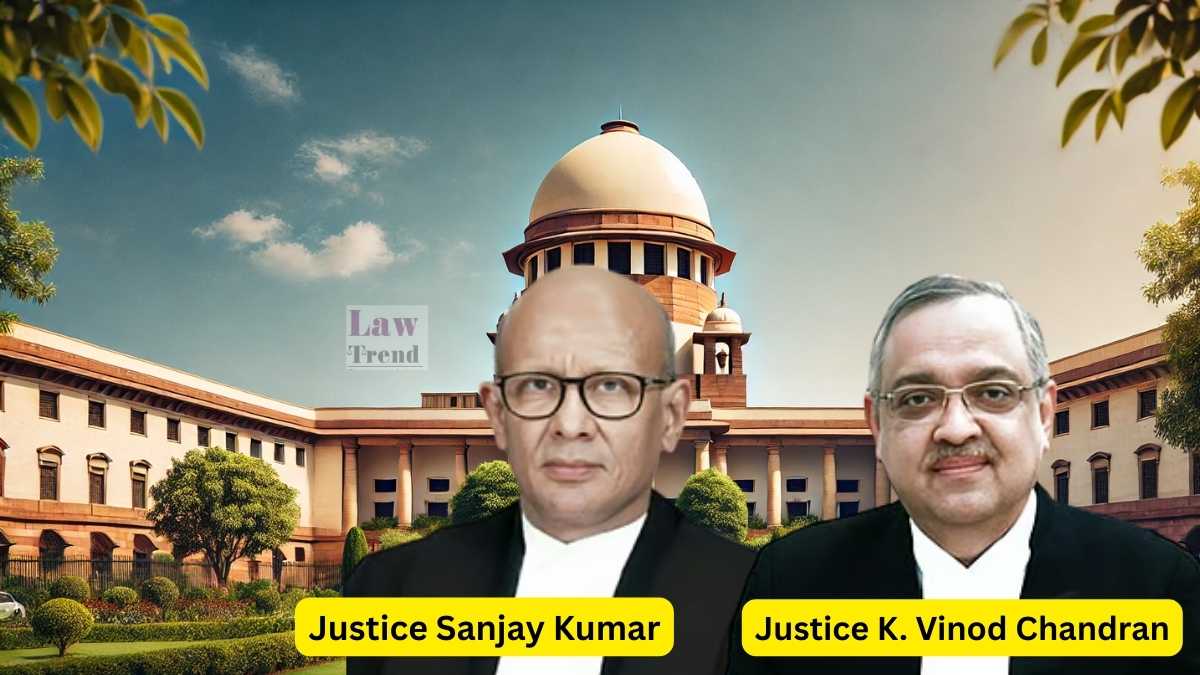
The Supreme Court of India has quashed an FIR registered under the Uttar Pradesh Gangsters and Anti-Social Activities (Prevention) Act, 1986, citing “glaring procedural irregularity” in the preparation and approval of the mandatory Gang Chart. The Court emphasized that when the liberty of an individual is at stake, statutory prescriptions must be followed scrupulously.
Background
The appeals were filed by Gabbar Singh, alias Devendra Pratap Singh, challenging the orders of the High Court which had declined to quash FIR No. 0125 of 2022. The FIR, dated May 28, 2022, was registered at Police Station Kotwali Nagar, District Bahraich, under Section 3(1) of the Uttar Pradesh Gangsters and Anti-Social Activities (Prevention) Act, 1986.
The prosecution alleged that the appellant was the leader of a gang involved in various illegal activities, including land grabbing, fraudulent land transactions, extortion, and criminal intimidation. The FIR was based solely on a ‘Gang Chart’ that listed several criminal cases pending against the accused.
Arguments of the Parties
The learned Senior Counsel for the appellant restricted the challenge to the procedure adopted under the Act of 1986 and the Uttar Pradesh Gangsters and Anti-Social Activities (Prevention) Rules, 2021. Relying on the precedent in Vinod Bihari Lal v. State of Uttar Pradesh (2025), the counsel argued that the Gang Chart transmitted to the Court lacked the necessary signatures and recommendations from the prescribed authorities.
Conversely, the learned Government Advocate for the State contended that the Station House Officer (Nodal Officer) had forwarded the Gang Chart to the Additional Superintendent of Police and the Court simultaneously. The State pointed to a version of the Gang Chart (Exhibit P4) which bore signatures and dates, arguing that the rules had been “complied scrupulously.”
Court’s Analysis
A Bench comprising Justice Sanjay Kumar and Justice K. Vinod Chandran examined the statutory requirements under Section 5 of the Act and Rule 16 of the 2021 Rules. The Court noted that a Gang Chart mandates:
- Clear recommendations from the Nodal Officer (SHO) and the Additional Superintendent of Police.
- Approval by the Superintendent of Police and the District Magistrate.
- A joint meeting between the District Magistrate and the Superintendent of Police to discuss the chart.
The Bench observed that the certified copy of the Gang Chart received from the jurisdictional Court was devoid of any signatures or recommendations. The Court rejected the State’s argument that the Nodal Officer could forward an unsigned chart to the Court before the process was complete.
“There is no prescription in the Rules for forwarding the Gang Chart to the Court, before it assumes the status of a Gang Chart under the Act and Rules… which process has to culminate with a joint meeting,” the Court observed.
The Bench further remarked:
“We fall back upon the principle that when a particular thing is to be done, it should be done in the manner stipulated; here statutorily prescribed, or not at all. Especially when at stake is the liberty of an individual, precious to all and possible of breach only in accordance with law.”
The Court also highlighted the “precarious nature of the law, which permits mere naming of a person, as a gangster and automatic condemnation,” noting that such “perilous consequences” require strict procedural adherence.
Decision
The Supreme Court set aside the High Court’s orders and quashed FIR No. 0125 of 2022. The Court clarified that this quashing is based solely on procedural grounds and does not prevent authorities from taking fresh action in accordance with the law.
Furthermore, the Court stated that it expressed no opinion on the underlying criminal cases mentioned in the Gang Chart, which must be “taken to its logical conclusion.”
Case Details
- Case Title: Gabbar Singh alias Devendra Pratap Singh Alias Rajesh Singh vs. State of U.P. and Ors.
- Case Number: Criminal Appeal Nos. of 2026 (Arising out of SLP (Crl.) No.17929-17930 of 2025)
- Bench: Justice Sanjay Kumar and Justice K. Vinod Chandran
- Judgment Date: March 20, 2026