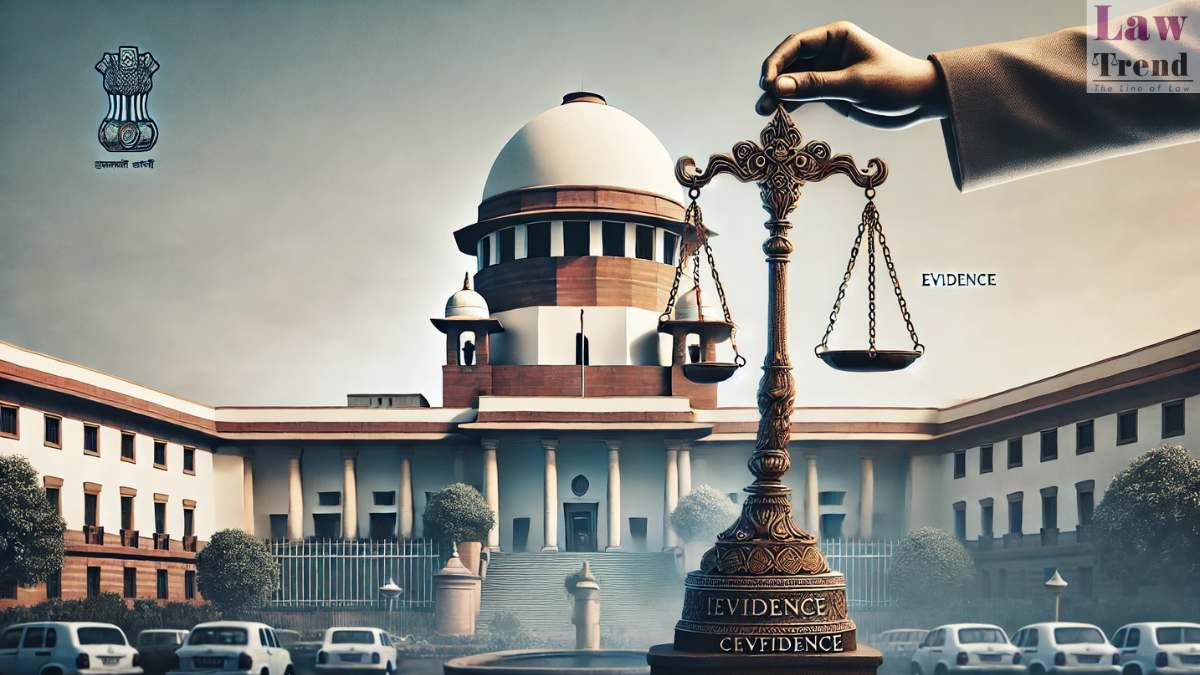
The Supreme Court of India, in the case of Pooranmal v. The State of Rajasthan & Anr., has set aside the conviction and life imprisonment of an appellant accused of murder, citing a lack of credible circumstantial evidence and the inadmissibility of electronic records due to the absence of a mandatory certificate under Section 65-B of the Evidence Act.
A Bench comprising Justice Vikram Nath, Justice Sandeep Mehta, and Justice N.V. Anjaria observed that the prosecution “miserably failed” to establish a complete and coherent chain of incriminating circumstances. The Court emphasized that in cases resting on circumstantial evidence, the circumstances must be of a conclusive nature and exclude every possible hypothesis except the guilt of the accused.
Background
The case dates back to the night intervening March 2, 2010, and March 3, 2010, when Smt. Aruna, the wife of co-convict Ladu Lal, was murdered in her home. While Ladu Lal initially reported the incident as a robbery by unknown persons, suspicion eventually turned toward him and the appellant, Pooranmal.
The trial Court (Additional Sessions Judge, Bhilwara) convicted both under Sections 302/34 and 201 of the IPC on February 8, 2012. The Rajasthan High Court (Jodhpur Bench) affirmed the conviction in 2018. While Ladu Lal’s appeal was dismissed by the Supreme Court in 2022, Pooranmal approached the Court through legal aid after a delay of 2,749 days, which the Court condoned noting “distinguishing features” in his case compared to Ladu Lal’s.
Arguments of the Parties
The counsel for the appellant contended that the conviction was based on “conjectures and surmises.” It was argued that the recovery of a blood-stained shirt was unreliable and the Call Detail Records (CDRs) were inadmissible as the mandatory certificate under Section 65-B of the Evidence Act (Section 63 of the BSA) was never proved.
The State, representing the respondent, argued that the recoveries of the shirt and currency notes (₹46,000) were “grave incriminating circumstances.” The State maintained that the CDRs were proved by nodal officers, making the non-production of the Section 65-B certificate “insignificant.”
Court’s Analysis
The Supreme Court examined three primary incriminating circumstances:
1. Recovery of Currency Notes: The Court noted a discrepancy in the amount recovered (₹46,000 vs. ₹46,145 counted in Court). The Bench held, “The very factum of recovery of the currency notes comes under a grave cloud of doubt.” It further stated that mere recovery of money, without a nexus to the crime, is not incriminating.
2. Recovery of Blood-Stained Shirt and FSL Report: The Court found the recovery of the shirt highly “improbable and unnatural,” questioning why a person who was “a free bird” for days after the incident would meticulously conceal a blood-stained shirt in an iron box instead of destroying it.
Crucially, the Court found the chain of custody for the FSL samples was breached. It noted discrepancies in the malkhana register regarding when the samples were sent and why they were returned. Citing Karandeep Sharma alias Razia alias Raju v. State of Uttarakhand (2025), the Bench held that the link evidence was lacking, making the FSL report “a worthless piece of paper.”
The Court also referenced Allarakha Habib Memon v. State of Gujarat (2024), stating that matching blood groups on recovered articles “cannot ipso facto enable us to arrive at the conclusion” of guilt in isolation.
3. Call Detail Records (CDRs): The Court reiterated the settled law on electronic evidence. Referring to Anvar P.V. v. P.K. Basheer (2014) and Arjun Panditrao Khotkar v. Kailash Kushanrao Gorantyal (2020), the Bench held:
“The Evidence Act does not contemplate or permit the proof of an electronic record by oral evidence if requirements under Section 65-B of the Evidence Act are not complied with… To hold otherwise would render Section 65-B(4) otiose.”
Since the certificate was not proved, the CDRs were deemed inadmissible.
Decision
The Supreme Court concluded that the prosecution failed to prove an unbroken chain of circumstances. Setting aside the judgments of the trial Court and the High Court, the Bench ruled:
“The appellant-Pooranmal is acquitted of the charges. He is in custody and shall be released forthwith, if not wanted in any other case.”
Case Details:
- Case Title: Pooranmal v. The State of Rajasthan & Anr.
- Case No: Criminal Appeal No. [As arising out of SLP (Crl.) No. 1977 of 2026]
- Bench: Justice Vikram Nath, Justice Sandeep Mehta, and Justice N.V. Anjaria
- Date: March 10, 2026