

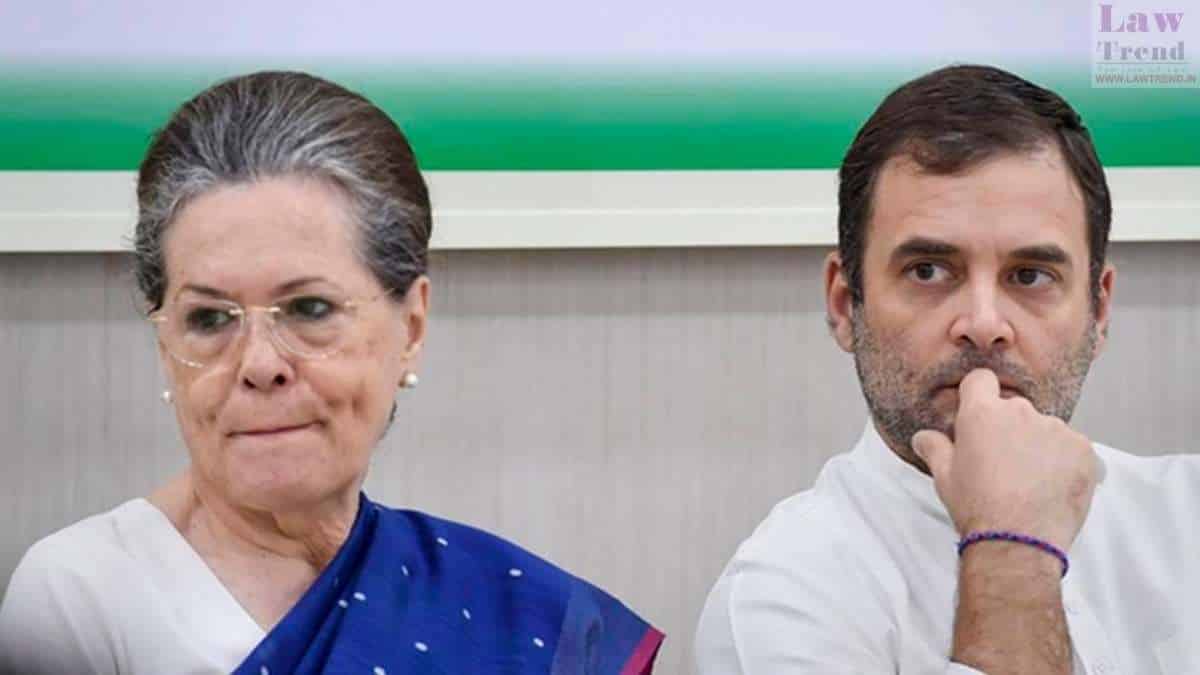
The Delhi High Court on Monday scheduled April 20 for hearing the Enforcement Directorate’s (ED) plea challenging a trial court order that refused to take cognisance of the agency’s prosecution complaint against Congress leaders Sonia Gandhi, Rahul Gandhi and others in the National Herald-linked money laundering case.
The matter came up before Justice Swarana Kanta Sharma, who said the court would not be able to hear the case on Monday. Accepting a request by Additional Solicitor General S. V. Raju, appearing for the ED, the court agreed to list the case for hearing on April 20.
The ED has moved the High Court against a December 16, 2025 order of the trial court which held that taking cognisance of the agency’s complaint under the Prevention of Money Laundering Act (PMLA) was “impermissible in law” as it was not founded on a registered FIR.
Earlier, on December 22, the High Court issued notices to Sonia Gandhi, Rahul Gandhi and other respondents on the ED’s petition as well as on the agency’s application seeking a stay on the trial court’s order. Apart from the Gandhis, notices were also issued to Suman Dubey, Sam Pitroda, Young Indian, Dotex Merchandise Pvt Ltd and Sunil Bhandari.
The ED has alleged that Sonia Gandhi and Rahul Gandhi, along with late Congress leaders Motilal Vora and Oscar Fernandes, and others including Suman Dubey, Sam Pitroda and the company Young Indian, were involved in a conspiracy and money laundering linked to the acquisition of assets belonging to Associated Journals Limited (AJL).
According to the agency, AJL, which publishes the National Herald newspaper, owned properties worth around ₹2,000 crore. The ED claims that the Gandhis held a majority stake of 76 per cent in Young Indian, which allegedly acquired AJL’s assets in exchange for a ₹90 crore loan.
During earlier hearings on February 19, Solicitor General Tushar Mehta, representing the ED, argued that the matter involved a “neat question of law.” He contended that the reasons cited by the trial court for refusing to take cognisance were “patently perverse” and that the issue should be examined on legal grounds rather than on facts. He also argued that the trial court’s findings could affect other cases.
In its December 2025 order, the trial court had ruled that the ED’s investigation and the prosecution complaint in the money laundering case were “not maintainable” because no FIR had been registered for the scheduled offence under the PMLA.
The court noted that the probe stemmed from a private complaint filed by BJP leader Subramanian Swamy and not from a police FIR. Despite the complaint and the summoning order issued in 2014, the Central Bureau of Investigation did not register an FIR for the alleged scheduled offence.
Challenging this reasoning, the ED has argued before the High Court that the trial court’s decision effectively provides a “hall pass” to certain categories of money launderers merely because the scheduled offence originated from a private complaint rather than an FIR registered by law enforcement agencies.
The agency has further contended that the special judge failed to appreciate that cognisance taken by a competent court on a private complaint stands on a stronger footing than an FIR, where there remains the possibility that cognisance may ultimately be declined even after a police chargesheet is filed.
The High Court will now examine the ED’s challenge to the trial court’s order when the matter is taken up on April 20.




