

Supreme Court Enhances Motor Accident Compensation; Reiterates ‘Loss of Love and Affection’ Subsumed Under ‘Consortium’
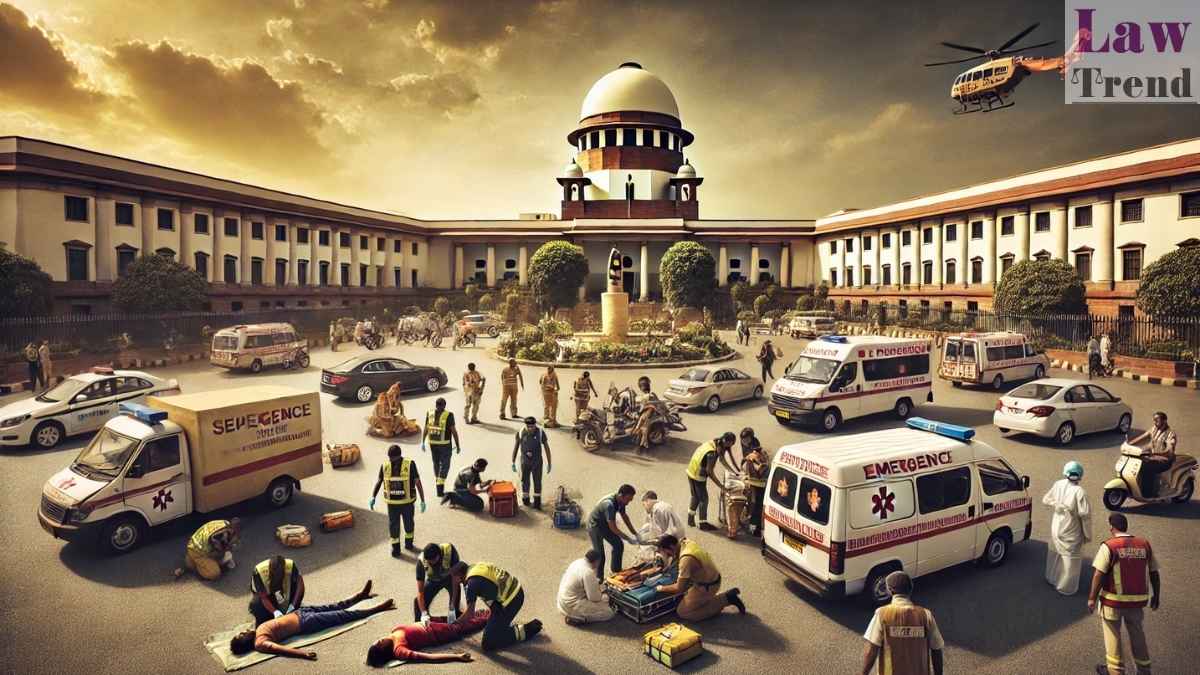

The Supreme Court of India, in a judgment delivered on February 6, 2026, has enhanced the compensation awarded to the family of a motor accident victim, increasing the amount from Rs. 10.51 Lakhs to Rs. 20.80 Lakhs.

The Division Bench comprising Justice Dipankar Datta and Justice Satish Chandra Sharma allowed the appeal filed by the claimants, emphasizing that the determination of income must be based on evidence rather than conjecture. The Court also reiterated the legal position that “loss of love and affection” cannot be awarded as a separate head of compensation, as it is subsumed under the broader concept of “loss of consortium.”

Case Background

The case arose from a fatal road accident on June 9, 2011, involving the deceased, D. Velu, aged 37, who was employed as a driver. He was riding a two-wheeler when he was hit by a tanker lorry insured with Bharthi Axa General Insurance Co. Ltd. The accident resulted in his instantaneous death.

The claimants—the widow, two minor children, and parents of the deceased—approached the Motor Accidents Claims Tribunal (MACT), Chennai, claiming compensation of Rs. 20,00,000. They asserted that the deceased was earning a monthly salary of Rs. 10,000.

The MACT, in its award dated November 8, 2012, assessed the monthly income at Rs. 6,000 due to a lack of documentary evidence and awarded a total compensation of Rs. 9,37,000.

Upon appeal, the Madras High Court, via an order dated January 31, 2020, marginally enhanced the income to Rs. 7,000 and modified the total compensation to Rs. 10,51,000. The High Court did not award any amount towards “future prospects.” Aggrieved by this assessment, the claimants moved the Supreme Court.

Arguments

The primary contentions of the appellants were:

  1. Income Assessment: The High Court erred in assessing the income at Rs. 7,000 despite documentary proof of a monthly salary of Rs. 10,000.
  2. Future Prospects: The High Court failed to award “future prospects” contrary to the law laid down in National Insurance Co. Ltd. v. Pranay Sethi.

The respondent-Insurance Company argued that the High Court was correct in not accepting the claimed income without sufficient proof. Relying on Pranay Sethi, the insurer also contended that the High Court erred in awarding Rs. 60,000 specifically for “loss of love and affection,” arguing that such a head is impermissible.

Court’s Analysis and Observations

1. Assessment of Income The Supreme Court rejected the lower courts’ assessment of the deceased’s income. The Bench noted that the claimants had produced a salary certificate (Exhibit P-14) issued by the employer, which confirmed a fixed monthly salary of Rs. 10,000. This was corroborated by the employer’s affidavit (PW-3).

READ ALSO  Rent Authority Has Jurisdiction to Evict Tenants Under UP Tenancy Act 2021 Even Without Written Agreement or Intimation: Allahabad High Court

The Court observed:

“On the face of such cogent and relevant evidence, which was not impeached by the insurer, it would be wholly impermissible to assess the income at a lower figure. The determination of income must be founded on proof placed on record and cannot rest on conjecture or assumptions divorced from evidence.”

Consequently, the Court reckoned the monthly income at Rs. 10,000.

2. Future Prospects The Court held that the High Court committed a “manifest error of law” by declining an addition towards future prospects. Citing the Constitution Bench judgment in National Insurance Co. Ltd. v. Pranay Sethi (2017), the Court reiterated that for a self-employed person or one on a fixed salary below the age of 40, an addition of 40% towards future prospects is mandatory.

The Court stated:

“This is not a matter of choice, but a binding norm flowing from Article 141 of the Constitution.”

READ ALSO  केवल नगर निकाय द्वारा जारी डेमोलिशन नोटिस के आधार पर किसी किरायेदार को बेदखल करने का आदेश नहीं दिया जा सकता: सुप्रीम कोर्ट

3. Loss of Love and Affection vs. Loss of Consortium Addressing the conflict between the heads of “loss of love and affection” and “consortium,” the Court referred to the judgments in Pranay Sethi, Magma General Insurance Co. Ltd. v. Nanu Ram (2018), and United India Insurance Co. Ltd. v. Satinder Kaur (2021).

The Bench clarified that while Magma General Insurance expanded “consortium” to include spousal, parental, and filial consortium, Satinder Kaur explicitly held that “loss of love and affection” is comprehended within “loss of consortium” and cannot be a separate head.

The Court held:

“Consistent with the aforesaid position… this Court is bound by the law declared by the Constitution Bench in Pranay Sethi (supra), which does not countenance ‘loss of love and affection’ as a distinct head of compensation… Consequently, no separate award under the head of loss of love and affection is warranted.”

READ ALSO  Universities Can’t Dilute The Standards Prescribed By AICTE But Can Enhance It: SC

The Decision

Allowing the appeal, the Supreme Court re-computed the compensation as follows:

  • Monthly Income: Rs. 10,000
  • Future Prospects (40%): Rs. 4,000
  • Total Monthly Income: Rs. 14,000
  • Deduction (1/4th for personal expenses): Rs. 3,500
  • Monthly Dependency: Rs. 10,500
  • Multiplier: 15
  • Total Loss of Dependency: Rs. 18,90,000

Conventional Heads Awarded:

  • Transport Charge: Rs. 10,000
  • Loss of Estate: Nil
  • Spousal Consortium (Widow): Rs. 50,000
  • Parental Consortium (Two Children): Rs. 80,000 (Rs. 40,000 each)
  • Filial Consortium (Mother): Rs. 40,000 (Father died during pendency)
  • Funeral Expenses: Rs. 10,000

The total compensation was determined at Rs. 20,80,000 (Twenty Lakhs Eighty Thousand).

The Court directed the insurer to pay the balance amount within twelve weeks, with interest at 9% per annum from the date of filing the claim petition until realization, noting that the dependents had been pursuing legal proceedings for 15 years.

Case Details:

  • Case Title: V. Pathmavathi & Ors. v. Bharthi Axa General Insurance Co. Ltd & Anr.
  • Case Number: Civil Appeal No. of 2026 [Arising out of SLP (C.) No. 23880 of 2022]
  • Coram: Justice Dipankar Datta and Justice Satish Chandra Sharma

Law Trend
Law Trendhttps://lawtrend.in/
Legal News Website Providing Latest Judgments of Supreme Court and High Court

Related Articles

Latest Articles

