

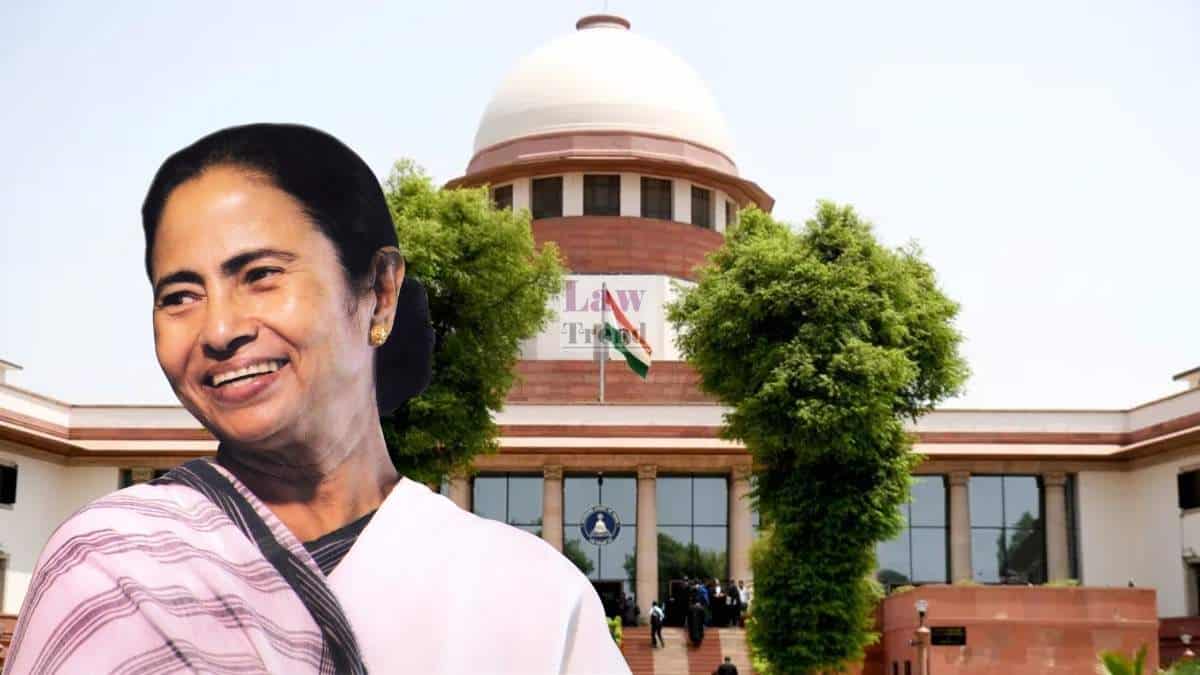
In a high-voltage hearing on Wednesday, West Bengal Chief Minister Mamata Banerjee personally addressed the Supreme Court, accusing the Election Commission of India (ECI) of “targeting” her state through the deletion of legitimate voters. Describing the poll body as a “Whatsapp Commission,” Banerjee argued that millions of voters were being disenfranchised due to minor “logical discrepancies” in the electoral rolls, specifically naming mismatches caused by dialect and transliteration.
A bench led by Chief Justice of India Surya Kant, along with Justice Joymallya Bagchi and Justice Vipul M Pancholi, heard the matter concerning the SIR (Special Summary Revision) case. The court, acknowledging the linguistic nuances of the Bengali language, suggested a collaborative approach to ensure no genuine voter is deleted from the rolls.
“Justice is Crying Behind the Door”
The hearing saw impassioned submissions from the Chief Minister, who appeared alongside top legal counsel including Senior Advocates Kapil Sibal and Shyam Divan. Bypassing standard legal protocol, Banerjee spoke directly to the bench to highlight the ground reality.
“I am a bonded labour… I prefer that, I am not fighting for my party,” Banerjee told the court. “When justice is crying behind the door… then we thought we are not getting justice anywhere.”
She alleged that the ECI had appointed micro-observers from BJP-ruled states to systematically delete names. “They have targeted West Bengal… to bulldoze West Bengal people,” she submitted, claiming that 58 lakh names were deleted in the first phase and another 1.30 crore were left out in the second phase.
“This Election Commission, sorry the ‘Whatsapp Commission’ is doing all of this,” Banerjee remarked, adding that Block Level Officers (BLOs) were facing harassment, leading some to commit suicide. She questioned the disparity in treatment between states, asking, “Why not Assam? Why not Assam?!”
The “Dutta vs. Datta” Dilemma
A central legal and technical issue raised during the hearing was the “Logical Discrepancy” list. Senior Advocate Shyam Divan argued that nearly 70 lakh notices were issued based on minor name mismatches that occur when translating Bengali names to English.
“If ‘Roy’, ‘Dutta’, ‘Ganguly’, etc., are being left out… We don’t know how ‘Tagore’ is pronounced… but that does not mean ‘Tagore’ is not Tagore,” CJI Surya Kant observed, acknowledging the problem.
Justice Bagchi further noted the linguistic particularities, pointing out to ECI counsel Rakesh Dwivedi that in Bengal, the letter “va” does not exist in the same way, and “Dwivedi” would be pronounced “Dibedi.”
Divan cited specific examples, such as a voter named “Chirag Tibrewal” facing discrepancies due to a middle name mismatch, and “Azimuddin Khan” facing issues due to transliteration from Bengali script. He argued that rejecting voters on these grounds, especially with only four days left in the verification timeline, was unjust.
ECI’s Defense and The Court’s Solution
Solicitor General Tushar Mehta, appearing for the Centre, and Senior Advocate Rakesh Dwivedi for the ECI, defended the process. SG Mehta noted that the ECI had reported an “atmosphere of hostility” towards its officials in the state. Dwivedi argued that notices were being sent to rectify errors and that the state had failed to provide adequate Class 2 officers for the process, forcing the appointment of micro-observers.
However, the Supreme Court focused on finding a practical solution to prevent the disenfranchisement of innocent citizens.
“Every problem has a solution; we must ensure that solution comes and no innocent person is left out,” CJI Kant stated. The bench proposed that the State of West Bengal provide a team of officers “well conversant in Bangla” to assist the Commission in verifying whether discrepancies were merely errors of local dialect or spelling.
“If the state provides a team well conversant in Bangla and tells the commission that it is a local dialect mistake… then it will help them,” the CJI remarked.
The Court has adjourned the matter to Monday, asking the state to provide a list of officers who can be spared to assist the Election Commission in resolving the discrepancies.




