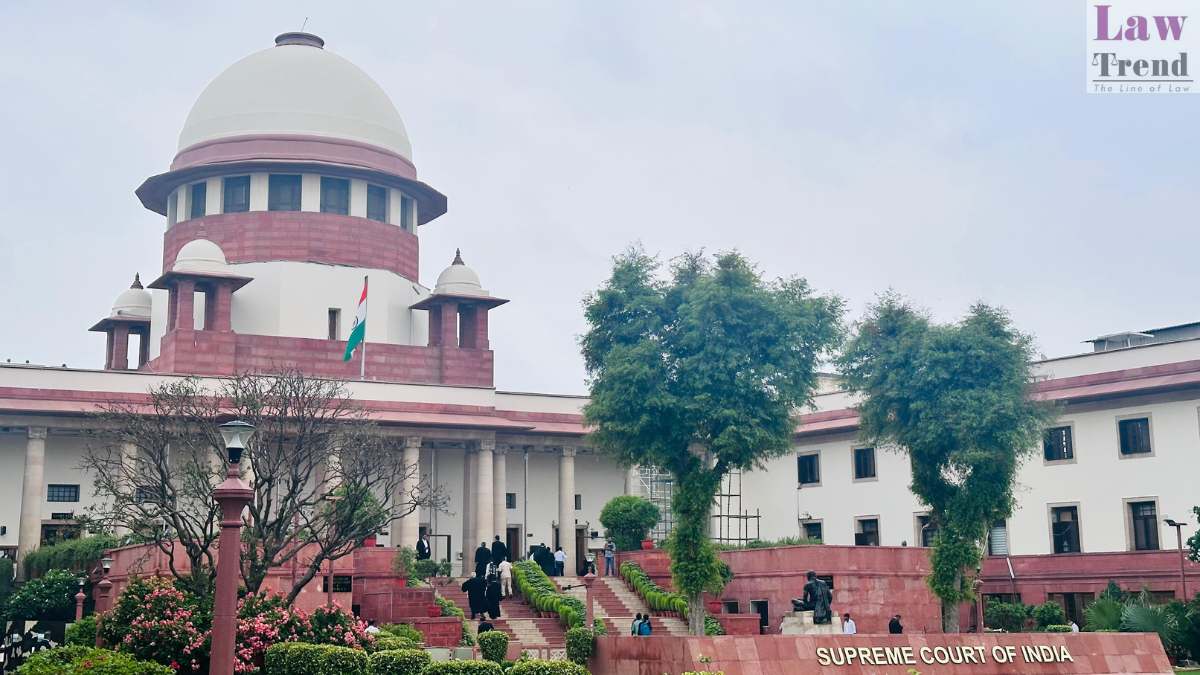
In a ruling balancing strict statutory environmental protections with equity for innocent home buyers, the Supreme Court of India held that water bodies and communal poramboke land cannot be granted on ryotwari patta under the Tamil Nadu Estates (Abolition and Conversion into Ryotwari) Act, 1948. A Bench comprising Justice S.V.N. Bhatti and Justice N. V. Anjaria dismissed appeals challenging the cancellation of a patta issued fraudulently over a water body in Thirumullaivoyal, Tamil Nadu, while directing the State government to allot an alternative site to innocent flat owners before carrying out demolitions.
Background of the Case
The dispute centers on 0.72 acres out of 1.68 acres in Survey No. 572, Thirumullaivoyal Village, Ambattur Taluk (now under Avadi Taluk), Tiruvallur District. In the Resurvey and Resettlement (RSR) ‘A’ Register of 1911, the parcel was recorded as “Government Poramboke – Kanakkan Kuttai” (a pond). Although treated locally as an appurtenance known as Kanakku Pillai Kuttai adjacent to a Minor Inam under Title Deed No. 300, the land was conveyed through successive private sale deeds between 1980 and 1988, eventually landing with P. Ramadoss after legal heirs relinquished shares in 2004.
Ramadoss obtained building permits from Avadi Municipality for a timber mart in 2005. Decades after the expiry of the statutory cutoff dates under the Act of 1948 and relevant Government Orders, Ramadoss petitioned the District Revenue Officer (DRO), Tiruvallur, on October 18, 2010, for a ryotwari patta. On January 21, 2011, the DRO granted the patta, relying on ground usage and asserting that the village map showed no pond in Survey No. 572.
Consequential changes were made in the Town Survey Land Register, after which Ramadoss mortgaged the land to Tamil Nadu Mercantile Bank Limited to secure credit facilities of Rs. 3.40 Crores. He also settled 0.22 acres in favor of his wife, who executed a Power of Attorney to M/s. MVM Builders & Promoters. Avadi Municipality sanctioned plans to erect 20 residential flats (MVM Aparajithapuri), which were constructed and sold to individual buyers.
Following a petition by a third-party objector in 2014, the Additional Chief Secretary cum Commissioner of Land Administration (CLA) conducted an inquiry and cancelled the patta on December 26, 2019. The CLA uncovered glaring administrative fraud: the patta application was barred by limitation by several decades, the file number had been manipulated and kept untraceable without record room entry, and revenue staff had improperly facilitated the classification change over a protected water body. The CLA directed restoration of the water body, prohibitory book entries, and criminal and disciplinary action against complicit officials.
Writ petitions filed by the bank challenging the CLA order were dismissed by the Madras High Court on July 11, 2024, and July 2, 2025. The High Court affirmed the CLA’s findings, directed the eviction of occupants, demolition of all structures within 16 weeks, and ordered vigilance surveillance and criminal proceedings against the errant officers. The bank and a flat buyer, S. Gururaj, subsequently appealed to the Supreme Court.
Arguments of the Parties
Learned Senior Counsel Mr. T. Raja and Counsel Mr. K.S. Mahadevan, appearing for the appellants, argued that the authorities erred in presuming the land was a tank without a specific prior adjudication. They submitted that the Chennai Metropolitan Development Authority had designated Survey No. 572 as a “Mixed Residential Zone,” which conclusively established its ryotwari status. They further contended that the DRO had the requisite jurisdiction to grant the patta and that the CLA order was vitiated because neither the bank nor the bona fide flat purchasers were granted an opportunity of being heard before the cancellation order was passed.
Opposing the appeals, Counsel Ms. Jayasree Narasimhan argued that the earliest resurvey and settlement record of 1911 unambiguously registered the land as “Government Poramboke – Kanakkam Kuttai.” She maintained that private transactions cannot defeat the statutory rights of the government or local bodies over watercourses. She contended that revenue authorities possessed no jurisdiction under the Act of 1948 to grant ryotwari patta for communal lands, watercourse poramboke, or private tanks, highlighting that Section 14-A expressly forbids any such grants and cancels pre-existing ones. She added that proper notice had been issued to the recorded pattadar, Ramadoss, and that the bank as a mortgagee had no independent marketable title against the State.
The Court’s Analysis
The Supreme Court examined the statutory scheme under the Act of 1948 and Section 14-A, introduced by Tamil Nadu Amendment Act No. 49 of 1974. The Court emphasized that communal water bodies vest in the State free from all encumbrances and cannot be granted under ryotwari patta to ryots or erstwhile landholders.
Rejecting the appellants’ contention that an explicit adjudication was needed to classify the land as a tank, the Bench held:
“In our considered view, this contention appears untenable because the Act, 1948 does not require adjudication to protect communal Government Poramboke, etc. Simply put, the Ryotiwari tenures under the Act, 1948 apply to Ryoti land covered by the said Act. The inquiry in this behalf determines the nature of the land, the type of enjoyment, the period of enjoyment, and the entitlement to grant of patta.”
Referring to its earlier decision in Salem Municipality v. P. Kumar and Others (2019), the Court underscored that the definition of ryoti land excludes beds and bunds of tanks, supply, drainage, and irrigation channels. Under Section 14-A, even if a patta had been granted for a private tank or oorani, it is declared void and stands statutorily cancelled:
“Section 14-A of the Act, 1948, prohibits officers from considering and granting Ryotwari Patta for non-Ryoti land. The Legislature designed a prohibitory mechanism to prevent changes in land classification. The said Section even renders the Order already issued void. That being the statutory scheme, the DRO, Tiruvallur, without any reason, went beyond the provisions of the said Act and granted Patta.”
The Court also rejected the contention that mixed residential zoning under the Tamil Nadu Town and Country Planning Act, 1971, superseded the 1948 Act, holding that zoning regulations apply to individual development plots and cannot extinguish State rights in poramboke lands or water bodies. The Bench also dismissed the natural justice challenge regarding non-hearing of the bank and flat owners, noting that notice was duly served on the pattadar who claimed interest in the property.
Addressing the plight of innocent buyers deceived by official approvals, the Court made pointed observations against the State machinery:
“The Court is constrained to observe that a bona fide purchaser for consideration looks at the presumptive value of entries and town survey records while purchasing the property. At the government’s convenience, the nature of the land is changed. The remedies against the developer and the landowner are independent, but the State and its officers ought not to be allowed to pass on without paying the price for such willy-nilly felicitation by the officers of the State.”
Decision and Directives
While upholding the invalidity of the patta and refusing to interfere with the restoration of the water body, the Supreme Court fashioned a protective equitable remedy to prevent homelessness for innocent purchasers:
“In the circumstances of the case, to ameliorate the possible hardship and, without committing a breach of Section 14-A of the Act, 1948, we direct the Chief Secretary, State of Tamil Nadu, and the District Collector, Tiruvallur, to allot a vacant, commensurate site to the owners of the flats represented by the Society, preferably within 6 months from today, and thereafter to undertake the demolition of the constructed area to an extent of 0.22 acres.”
The Court permitted development and restoration work to proceed immediately in the vacant and unoccupied portions of the land without hindrance. The flat owners and the bank were left free to pursue civil remedies against the developer, owner, or mortgagor, and the State was permitted to initiate or conclude disciplinary action against the erring officers. With these directions, the Civil Appeals were dismissed.
Case Details:
Case Title: S. Gururaj v. The Additional Chief Secretary/Commissioner of Land Administration and Others (with connected appeals)
Case No.: Civil Appeal No. 13629 of 2026 (with Civil Appeal Nos. 13630 and 13631 of 2026)
Bench: Justice S.V.N. Bhatti and Justice N. V. Anjaria
Date: October 16, 2026