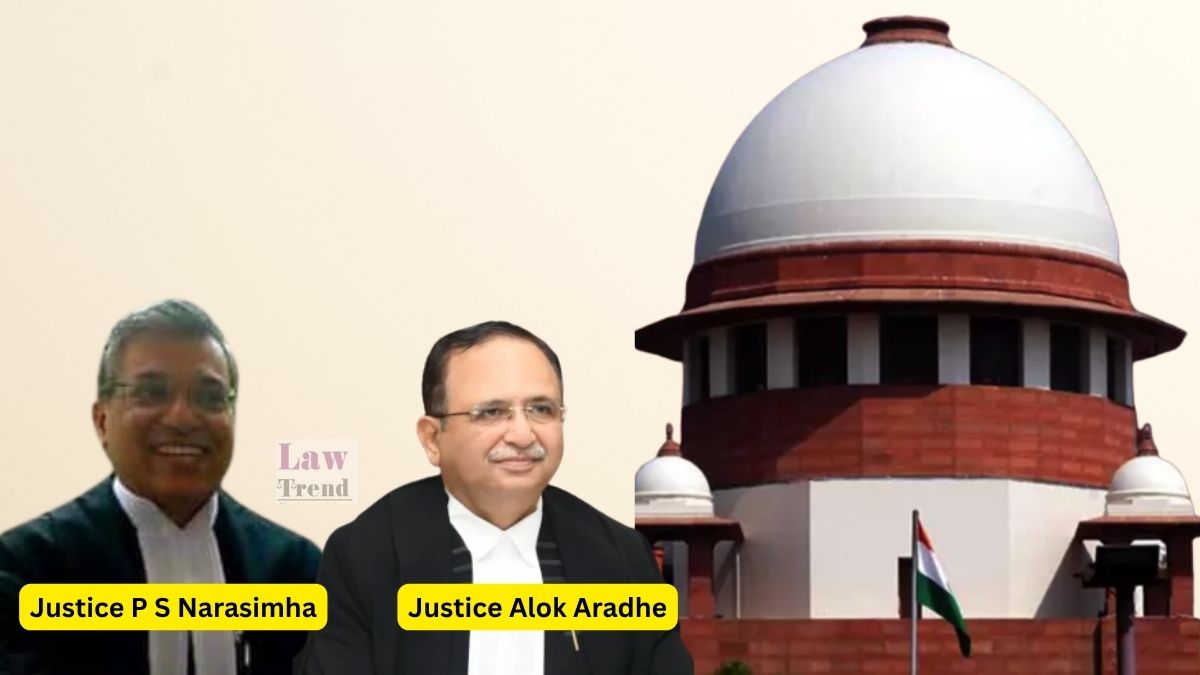
The Supreme Court has held that temple inam land cannot be gifted to the State Government. It declared such a gift void under Section 41(1) of the Tamil Nadu Hindu Religious and Charitable Endowments Act, 1959. The Court set aside a Madras High Court order that had upheld the transfer, raised the rent payable by the State for the land and imposed ₹1 lakh costs on Tamil Nadu.
A Bench of Justice Pamidighantam Sri Narasimha and Justice Alok Aradhe opened the judgment with a clear principle: “The administration of property belonging to a religious/charitable institution carries with it a duty of preservation, not a power of unfettered disposition.”
How the Case Reached the Supreme Court
The land, measuring 1 acre and 10 cents in Kodumudi Village, Erode District, belonged to the Nagapalayam Mariamman-Ponnachiamman Temple. On 30.08.2017, the temple’s temporary trustee gifted it to the Government of Tamil Nadu for the construction of a Taluk Office. The Tehsildar accepted the gift.
The hereditary trustee challenged the gift deed in a writ petition. On 19.03.2019, the Madras High Court dismissed it. The High Court reasoned that Section 34 of the 1959 Act does not use the word “gift” and that title was a disputed question of fact. Devotees of the temple then took the matter to the Supreme Court.
While the appeals were pending, the State filed an affidavit dated 23.03.2022. In it, the State admitted that the land was inam land granted to the deity under Inam Title Deed No. 388. It also said the Revenue Department had agreed to cancel the gift and take the land on lease.
Arguments
Counsel S. Ravi Shankar, appearing for the appellants, argued that the land admittedly belonged to the temple and that a temporary trustee had no power to alienate it. He submitted that the gift was void for want of sanction under Section 34, that Section 22-A of the Registration Act barred its registration, and that rent should be fixed with reference to market value.
Counsel K.L. Janjani, appearing for the temporary trustee, contended that the land was transferred in public interest following a unanimous decision of devotees and villagers. He argued that Section 34 does not expressly cover gifts.
Additional Advocate General Haripriya Padmanabhan for the State and Senior Counsel M. Sathyanarayanan for the HR&CE Department did not dispute that the land belongs to the temple or that the gift deed cannot stand. They submitted that a Taluk Office had since been built on the land with public funds. Amicus curiae Shailesh Madiyal argued that a gift, being without consideration, can never be necessary or beneficial to the donor institution.
Supreme Court: Gift of Temple Inam Land Void Ab Initio
The Court held that because the land is inam land, Section 41 applies, and Section 34(5) excludes it from Section 34. Under Section 41(1), the Government may sanction certain transactions, but not a gift. The Bench held: “A gift of an inam property dedicated to the support of a deity is, in consequence, void ab initio and no sanction, however solemnly accorded, could have breathed life into it.”
The registration of the deed did not save it. The Court said: “registration under one statute cannot validate what another statute, governing the very property in question, declares void.”
Rejecting the argument that a temporary trustee’s power is unlimited, the Court said a gift “cannot by its very nature be characterised as an act of ordinary prudence in the management of another’s property.” It added that the State “is a custodian and regulator of temple properties, not their owner.”
The Court also took note of the State’s conduct. The State had defended the gift before the High Court and the Supreme Court, and conceded only after the Court called for an affidavit in 2022.
Rent Enhanced, Costs Imposed
Since a Taluk Office now stands on the land, the Court did not annul the lease in the Government’s favour. It applied the Fair Rent Committee’s formula, valuing the land at 225% of the market value under G.O. (MS) No. 200 and adding the building’s depreciated value. On that basis, it raised the rent from ₹13,235 to ₹31,000 per month, effective from 08.03.2019.
The State must pay the arrears within three months and ₹1 lakh costs to the temple within eight weeks. The rent is to be re-fixed every three years under Section 34-A, but not below ₹31,000. The Court also directed authorities to strictly follow Sections 34, 34-A and 41 of the 1959 Act. It stressed that decisions on temple property must be guided by the trust’s interest and “never by the administrative convenience of the Government.”
Case Title: K. Ramalingam and Others v. Government of Tamil Nadu Rep. by its Secretary and Others
Case No.: Civil Appeal Nos. ___ of 2026 (arising out of SLP (C) Nos. 20051-20052 of 2019)
Bench: Justice Pamidighantam Sri Narasimha and Justice Alok Aradhe
Date: October 16, 2026