

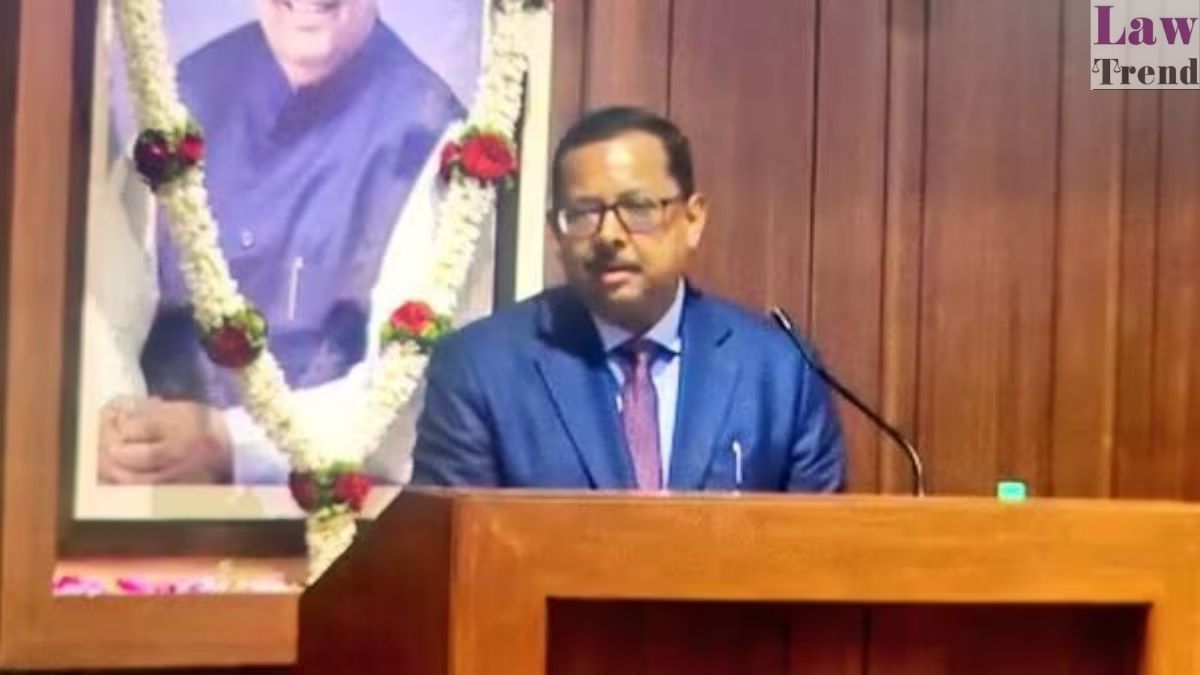
Supreme Court Judge Justice Ujjal Bhuyan has declared that India’s goal of becoming a developed nation (‘Viksit Bharat’) by 2047 will remain unattainable if the state continues to criminalise dissent, rely on “mindless” arrests under anti-terror laws, or ignore deep-seated social inequalities.
Speaking on Sunday at the first national conference of the Supreme Court Bar Association (SCBA) in Bengaluru, Justice Bhuyan delivered a wide-ranging address that touched upon the misuse of the Unlawful Activities (Prevention) Act (UAPA), the lack of gender diversity in constitutional courts, and the persistence of caste-based discrimination.
Justice Bhuyan raised serious concerns regarding the application of the UAPA, citing a stark disparity between arrests and actual convictions. Presenting data from 2019 to 2023, he noted that while thousands have been detained under the act, the conviction rate hovers around a mere five per cent.
“Low convictions under UAPA show overuse, if not misuse, of the law,” Justice Bhuyan asserted. He suggested that such figures indicate many arrests are “premature and unsupported by sufficient evidence,” ultimately placing an undue burden on the criminal justice system and the courts.
Emphasizing the role of debate in a democracy, the judge stated that a truly developed nation must prioritize constitutional values over political slogans. “Debate should not be criminalised. There should be more tolerance towards diverse views and criticism,” he said, adding that the judiciary in a developed India “can’t be an eternal critic or a cheerleader.”
The judge also lamented the “highly inadequate” representation of women in the Supreme Court and High Courts. He pointed out a sharp contrast between the district judiciary, where women make up over 50 per cent of judicial officers, and the constitutional courts.
“Why is it that when the assessment becomes subjective, women do not make the grade?” Justice Bhuyan questioned, pointing to the collegium system’s subjective criteria. He noted that out of 287 Supreme Court judges since 1950, only 11—roughly two per cent—have been women.
Currently, women represent only 14 per cent of High Court judges, with only two women Chief Justices across the 25 High Courts in India. Justice Bhuyan argued that for India to be a “Viksit Bharat,” the Supreme Court must become a “rainbow institution” reflecting the nation’s true diversity.
Justice Bhuyan further argued that economic growth alone does not define a developed nation. He highlighted “deep social fault lines,” specifically citing instances of caste-based discrimination and violence against Dalits.
“We cannot have Viksit Bharat when Dalit people are made to stand in the corridor and people urinate on them,” he said, referring to recent reports of atrocities. “Parents cannot insist that their children will not have food prepared by a Dalit woman. That cannot be a Viksit Bharat model.”
His vision for 2047 includes the equal distribution of wealth and the disappearance of acute disparity, as envisioned in the Directive Principles of State Policy.
The conference also saw remarks from Justice B.R. Gavai, who expressed concern over the government’s handling of judicial appointments. He noted that despite Supreme Court verdicts stating the government must appoint candidates if the collegium reiterates their names, there remain “many instances where even after repeated reiterations, the persons have not been appointed.”




