

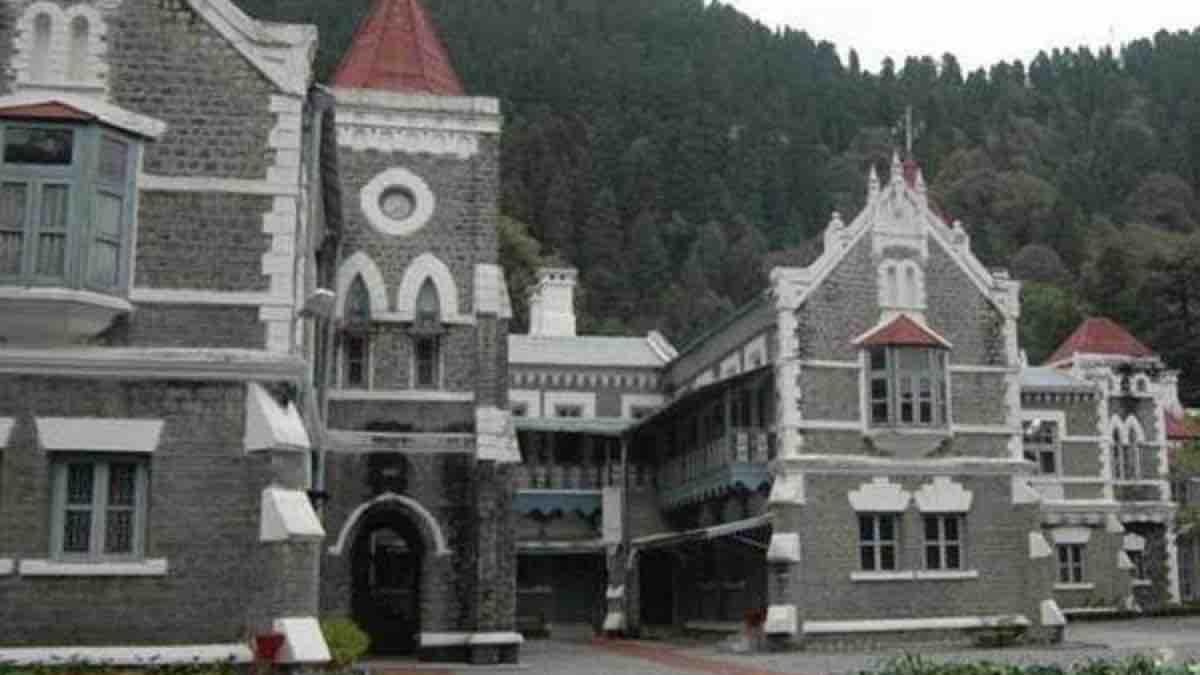
The Uttarakhand High Court has dismissed a petition opposing the proposed relocation of its complex from Nainital to Haldwani, ruling that the challenge was premature and observing that infrastructural limitations and the high cost of living in the tourist town hinder access to justice.
A division bench comprising Justice Manoj Kumar Tiwari and Justice Pankaj Purohit rejected the plea challenging administrative decisions to identify alternative land for the court. In its September 3 ruling, the bench noted that authorities have merely identified suitable land and have not yet de-reserved any forest area, adding that the state government has assured full compliance with due legal processes before any relocation takes place.
Institutional Constraints and Accessibility Concerns
The judges highlighted severe structural and logistical bottlenecks in Nainital that constrain the institution’s operations. The court observed that the hill town suffers from an acute lack of space and inadequate infrastructure, which limits the institution’s expansion and prevents an increase in the sanctioned strength of judges.
The bench also drew attention to poor connectivity and the steep cost of living in the hill station, noting that these conditions do not promote social and economic justice. According to the court, the high expenses create an extraordinary financial burden on marginalized litigants seeking legal remedies, while also creating persistent difficulties for junior advocates and registry personnel.
Timeline and Proposed Site
The relocation initiative gained formal momentum on May 14, when the Nainital District Magistrate issued an order directing the identification of land. Subsequently, on June 19, the high court approved a full court resolution proposing to shift the premises from Nainital to an estimated 73 hectares of forest land in the Tarai-Central Forest Division, located near the Bel Baba Temple in Rudrapur.
Legal Challenge and Environmental Arguments
The petitioner sought to halt the move by arguing that the identified site is ecologically sensitive and falls within an elephant corridor. Counsels M C Pant, Navnish Negi, and M S Bhandari, representing the petitioner, submitted that constructing a judicial complex constitutes a non-site-specific and non-forest purpose.
The petitioner’s lawyers argued that utilizing the land without prior approval from the central government violated the Forest (Conservation) Act, its associated rules, and the consolidated guidelines dated December 29, 2023. They maintained that diverting the parcel without statutory clearance breached the constitutional mandate to protect the natural environment.
State Submissions and Court Findings
Opposing the petition, Advocate General S N Babulkar submitted that Nainital’s physical load-bearing capacity has been exhausted, making the shift to Haldwani necessary for the welfare of litigants, legal practitioners, staff, and the town itself. The advocate general stated that the project remains at the preliminary land-identification stage and that statutory clearances will be obtained at the appropriate time.
Deputy Solicitor General Lalit Sharma confirmed to the court that the state government has not yet submitted an approval proposal to the regional empowered committee. Advocate Shobhit Saharia, appearing for the high court administration, noted that de-reserving forest land involves well-defined statutory steps.
Addressing the environmental objections, the division bench ruled that the claim regarding the elephant corridor lacked factual merit. The court observed that the designated site is situated approximately 10 kilometers away from the marked wildlife passage, a detail corroborated by the documents submitted by the petitioner. The judges concluded that federal approvals can be pursued when the project reaches the formal stage of forest de-reservation and land diversion.


