

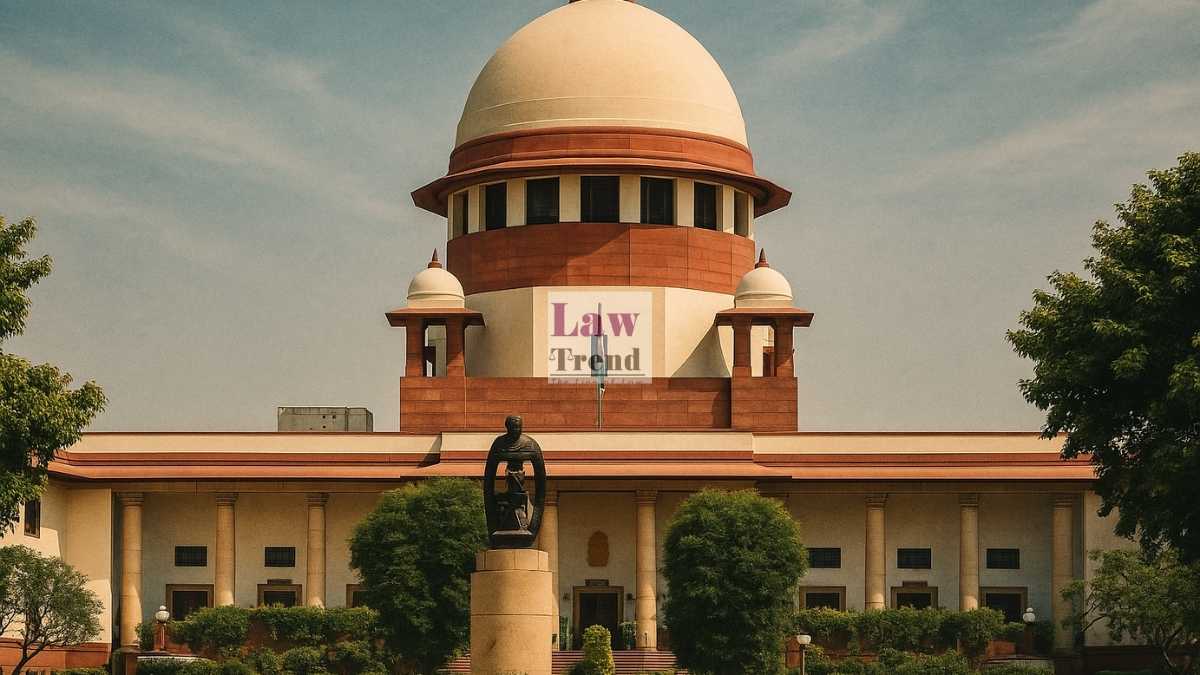
The Supreme Court has struck down two Uttar Pradesh laws: the Uttar Pradesh Qualifying Service for Pension and Validation Act, 2021, and the Uttar Pradesh Entitlement to Pension and Validation Act, 2025. These laws had excluded service rendered in work-charged establishments from qualifying service for pension. The Court held that once employees are regularised, the State cannot use a law with retrospective effect to deny them retiral benefits on the basis of how they were first appointed.
A Bench of Justice Dipankar Datta and Justice Satish Chandra Sharma allowed a batch of writ petitions and appeals filed by employees and their associations. It dismissed the State’s appeals against High Court rulings that had favoured the employees.
Background: From Prem Singh to the Validation Acts
The petitioners are serving and retired employees of UP’s Public Works, Ground Water and Irrigation departments, among others. Many of them were first engaged in work-charged establishments between the late 1970s and the mid-1980s and were regularised later.
On September 2, 2019, in Prem Singh v. State of Uttar Pradesh, the Supreme Court read down Rule 3(8) of the Uttar Pradesh Retirement Benefits Rules, 1961. It held that service in a work-charged establishment must be treated as qualifying service for pension. The State’s review petition was dismissed on February 13, 2020, and the State later withdrew its curative petition.
The State then promulgated an Ordinance, which was replaced by the Validation Act, 2021, in force from March 5, 2021. While the present challenge was being heard, the State brought another Ordinance in 2025. That Ordinance was replaced by the Validation Act, 2025 (U.P. Act No. 5 of 2026), which applied retrospectively from April 1, 1961. It introduced the term “substantive appointee” and declared that past denials of pension were valid notwithstanding any court judgment.
Arguments
The employees argued that the Validation Acts did not cure the defect identified in Prem Singh. In their submission, the Acts restored the same exclusion in different statutory language and took away a pensionary right that had already vested.
Attorney General R. Venkataramani, appearing for the State, argued that work-charged establishments are legally distinct from regular ones and that regularisation operates only prospectively. He submitted that the enactments validly changed the legal basis of Prem Singh and met the test laid down in Shri Prithvi Cotton Mills Ltd. v. Broach Borough Municipality. He also urged that Prem Singh should be reconsidered by a larger Bench.
Court’s Findings on the Validation Acts
The Court held that Prem Singh did not create a pension right in disregard of the statutory scheme. Instead, it read down an exclusion that could not survive constitutional scrutiny. The question, the Bench said, was whether the new laws actually removed that defect.
Relying on Madan Mohan Pathak, the Court observed that “the Constitution does not permit the legislature, under the garb of changing the law, to command that a final judicial determination shall be construed as though it had never been made in the first place.”
On the State’s reliance on retrospective operation, the Court said: “Retrospectivity is a characteristic of a legislation; and not a cure for the constitutional vice of legislative annulment of a judicially-crystallised right.”
Applying Article 14 independently, the Bench found that the classification had no rational nexus with the object of the pension scheme. On Section 4 of the 2025 Act, which deems past denials valid, the Court held: “A validating provision cannot be permitted to direct indirectly what the Constitution forbids directly.”
Regularisation Erases the ‘Birthmark’
The Court held that regularisation under a duly formulated scheme gives the employee substantive status and erases the “birthmark” of the initial appointment. A State that tries to revive that birthmark through retrospective legislation violates Articles 14, 16 and 21. The Bench noted that pension is not a bounty and that a classification based on a “vanished birth-mark would be arbitrary and discriminatory.”
‘Financial Burden’ Plea Rejected: Parks vs Pensions
During the hearing, the Attorney General said that if the Court ruled for the employees, settling their pension claims would place an onerous financial burden on the State, running into thousands of crores of rupees. The Bench called the submission “entirely unpersuasive.”
The Court pointed to how the State has spent its money: “Judicial notice is taken that not too long back, the State had itself committed substantial public funds, worth thousands of crores, towards the construction and beautification of parks and public spaces.”
The Bench said it was not criticising that spending as such: “Not for a moment do we suggest that expenditure on public infrastructure, development or beautification is, by itself, unjustified.” It added that the contrast becomes significant when the State cites financial constraints to resist or delay obligations it lawfully owes to individuals.
The Court held that “Expenditure undertaken at the State’s discretion for aesthetic enhancement and public embellishment cannot be positioned on a higher pedestal than the obligation to honour legal entitlements”. It noted that such entitlements include those flowing from Prem Singh.
The Bench also said that “The public exchequer exists not merely to finance projects reflecting the priorities of a particular dispensation, but also to fulfil the State’s obligations under law.” In its view, fiscal considerations may shape how and through what mechanism the State complies, but cannot be a ground for postponing compliance indefinitely.
The Court made clear that it was not questioning the State’s spending choices and described the issue as one of priorities in public expenditure. It concluded: “the bogey of financial constraints of the State should never be raised, even in the passing, to defeat a legal obligation.”
The Court also held that Prem Singh, being a 3-Judge Bench decision, binds it.
Directions
- Both Validation Acts are declared ultra vires the Constitution.
- Claims of eligible work-charged employees are to be considered in light of Prem Singh.
- Retired employees may file claims with the competent authority, which must decide them within six months.
- Arrears are restricted to three years before Prem Singh filed his writ petition. This limit does not apply to heirs of employees who died before the Prem Singh judgment, but such heirs must produce unimpeachable proof of their claim.
- A claim may be rejected only after a hearing and by a reasoned order.
- If payment is delayed beyond the deadline, the State must pay 9% simple interest.
- The directions operate in rem. Benefits do not depend on membership of any association.
The Court also said it would be desirable for writ courts to require associations to attach a list of their members when they file a writ petition.
The contempt petitions were disposed of. The State was given a “final opportunity” to pay the amounts due under Prem Singh within six months, failing which it must pay 9% interest. The Court warned that any further non-compliance would be viewed extremely seriously and may amount to aggravated contempt.
Case Title: Uttar Pradesh Ground Water Department Non Gazetted Employee Association (Regd.) & Anr. v. The Chief Secretary & Ors.
Case No.: Writ Petition (Civil) No. 1458 of 2020 (2026 INSC 1252)
Bench: Justice Dipankar Datta and Justice Satish Chandra Sharma
Date: November 18, 2026


