

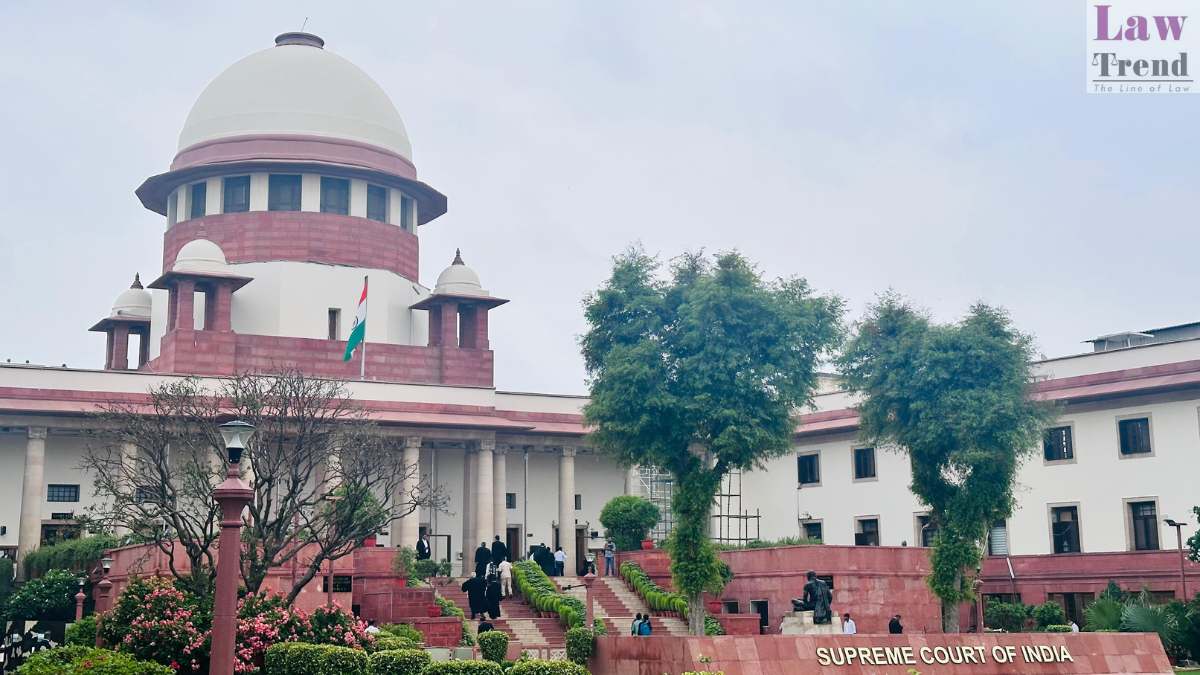
The Supreme Court on Thursday expressed strong concern over the functioning of tribunals across the country, observing that they have become a “liability” and a “mess” due to lack of accountability. The Court also flagged instances where technical members were allegedly not writing judgments themselves and were instead “outsourcing” the task.
A Bench of Chief Justice of India Surya Kant and Justices Joymalya Bagchi and Vipul M. Pancholi made the remarks while hearing a plea seeking extension of tenure of tribunal members and chairpersons following the Court’s November 2025 judgment striking down provisions of the Tribunals Reforms Act, 2021 relating to appointments and tenure.
The Court said tribunals are “creation of the government” and are functioning like a “no-man’s land” without accountability either to the judiciary or to any other authority.
CJI Kant remarked:
“Mr. Attorney General, tribunals are your (Centre) creation, and they have become a headache. They are a headache for you and a liability for us. They are a liability for us because of the kind of orders they pass. The way they are functioning is becoming a challenge for us due to the legislative regime.”
He added:
“Now the kind of orders we are seeing, barring a few tribunals, these institutions have become a no man’s land as they are not accountable to the judiciary nor are they accountable to anyone on earth.”
The Court observed that such a situation was “not in national interest.”
The Bench flagged the existing framework under which, upon the superannuation of a tribunal chairperson, a technical member becomes the acting chairperson. It expressed disapproval of this arrangement and asked Attorney General R. Venkataramani to ensure that vacancies are filled expeditiously so that tribunals do not face a functional crisis.
The Court said it was not inclined to grant a blanket extension of tenure to existing members but was constrained to do so due to the continued vacancies.
The CJI stated that the Court had received credible information regarding a “very important tribunal” where technical members were not writing judgments on their own.
“These technical members are not writing a single judgment, they are insisting that judicial members should write the judgment on their behalf and name. I even know the audacity of one technical member, who asked a judicial member to write the judgment in his name and blackmailed that he would not sign the judgement,” he said.
He further observed:
“There are some technical members of the tribunal who are actually outsourcing the writing of judgments, something completely unheard in the judicial system. I am really perturbed and someday, I would sack them at appropriate time. What a mess we have created in the name of creating a tribunal…”
The Bench also noted that technical members often lack adequate understanding of specialised areas such as environmental law, company law and insolvency law, while High Court judges posted to tribunals do not get sufficient exposure to these subjects to develop expertise within their limited tenure.
“These judges don’t learn any environmental law, commercial law etc. and in the four years they are expected to become experts. Perhaps a completely new mechanism is needed. The manner in which they are completely unaccountable is not in national interest,” the CJI said.
As an interim measure, the Court directed extension of tenure of tribunal chairpersons until further orders or until alternative arrangements are made. It asked the Union government to streamline the process of appointments and filling of vacancies at the earliest.
The Bench was dealing with issues arising after its November 2025 ruling which struck down provisions of the Tribunals Reforms Act, 2021 relating to appointment and tenure of tribunal members for being contrary to earlier judgments of the Court on tribunal independence.
The matter remains pending for further consideration.




