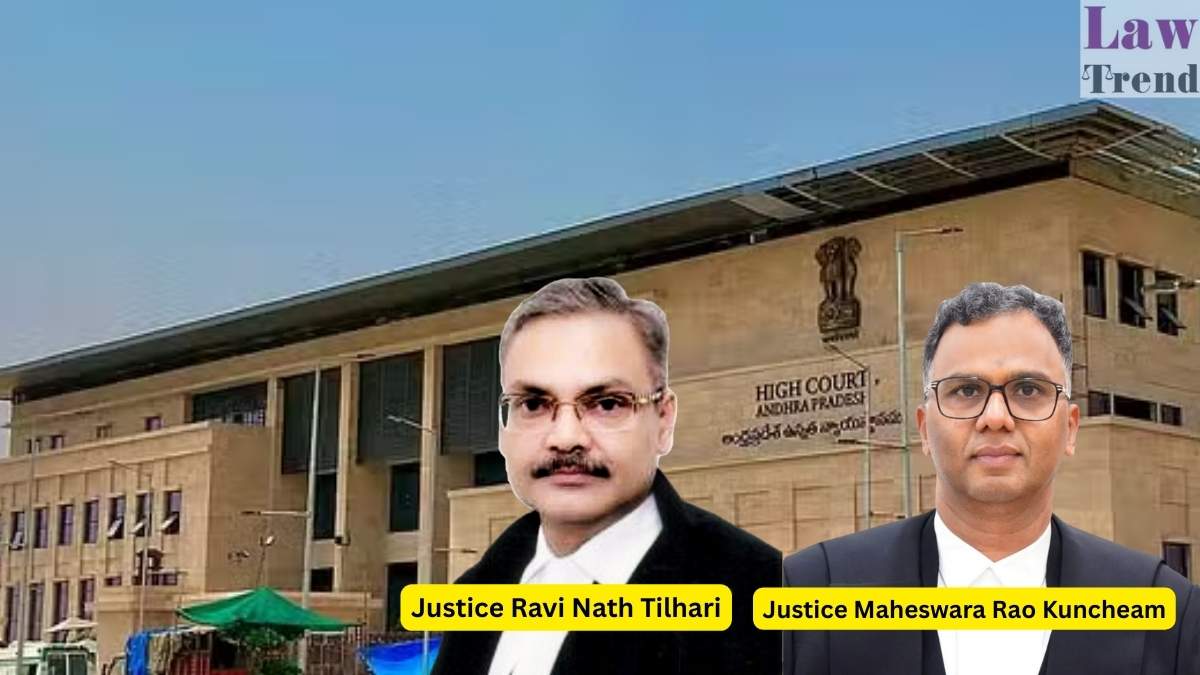
The High Court of Andhra Pradesh has allowed an appeal filed against the dismissal of a partition suit, setting aside the trial court’s judgment. The Division Bench comprising Justice Ravi Nath Tilhari and Justice Maheswara Rao Kuncheam held that the trial court failed to correctly apply fundamental principles of law regarding joint Hindu family property, specifically regarding admissions made by the defendants and the concept of joint possession. The Court remanded the matter to the trial court for a fresh decision in accordance with the law.
Background
The case arose from a suit (O.S. No. 94 of 2010) filed by the plaintiff, Ayalasomayajula Bhavani Sankara Shastry, seeking partition of various schedule properties. The plaintiff claimed that he and the defendants were members of a joint family and that the properties were acquired from joint family funds or business.
The 2nd defendant, the plaintiff’s brother, opposed the suit, initially claiming that the plaintiff had been given in adoption to another family and thus had no right to the properties of his natural father. The 2nd defendant also contended that the properties were not joint family assets.
The X Additional District and Sessions Judge, Visakhapatnam at Anakapalle, dismissed the suit on November 22, 2017. While the trial court rejected the adoption plea and held the plaintiff was the son of the deceased father, it ruled that the plaintiff failed to prove the properties were joint family assets and was not in joint possession. The trial court also rejected interlocutory applications filed by the plaintiff to amend the plaint to include additional properties and plead a Will executed by the mother.
Arguments
The appellant (plaintiff) argued that the trial court ignored crucial evidence, specifically the admissions made by the 2nd defendant (DW 1). The counsel for the appellant pointed out that in a prior legal proceeding (Ex. A9) and during cross-examination, the 2nd defendant had admitted that the properties were joint family properties and that he was the manager. The appellant further argued that the trial court erred in holding that the plaintiff was not in joint possession merely because he resided elsewhere due to his profession as a doctor.
The respondents (defendants) contended that the burden of proof lies on the plaintiff to establish that the properties are joint family assets or that a nucleus existed for their acquisition. They argued that an admission in a written statement is merely a piece of evidence and not conclusive proof. They supported the trial court’s dismissal of the amendment applications, arguing they were filed to protract litigation.
Court’s Analysis
The High Court observed that the trial court had “miserably failed to consider and appreciate the entire evidence on record.”
On Admissions regarding Joint Family Property: The Court noted that while an admission may not be conclusive proof, it is the best piece of evidence and cannot be ignored. The Bench observed that the trial court failed to weigh the 2nd defendant’s admissions in his previous written statement (Ex. A9) and his deposition where he acknowledged purchasing properties with joint family funds.
The Court cited the Supreme Court’s decision in Bhagwat Sharan v. Purushottam (2020), noting that while an admission is not conclusive, “It cannot be said that the admission not being conclusive proof, no weight is to be attached to the admission and the same be not taken in to consideration.”
On Joint Possession: The High Court found the trial court’s finding on possession legally unsustainable. The trial court had ruled against the plaintiff because he lived in Mussoorie and not at Anakapalle. Referring to the Supreme Court judgments in Annasaheb Bapusaheb Patil v. Balwant (1995) and Neelavathi v. N. Natarajan (1980), the Bench reiterated that “The possession of one, therefore, is the possession of all.”
The Court stated: “The mere fact that one of the coparceners is not in joint possession does not mean that he has been ousted… So, the finding on those issues of joint possession and court fee are also unsustainable.”
On Amendment of Pleadings: The High Court held that the trial court acted illegally in rejecting the plaintiff’s applications to amend the plaint (I.A. No. 492 of 2014 and I.A. No. 986 of 2017). The trial court had rejected the addition of properties by conducting a “mini trial” on their ownership at the amendment stage.
Citing Rajesh Kumar Aggarwal v. K. K. Modi (2006) and Andhra Bank v. ABN Amro Bank N. V. (2007), the Court observed: “While allowing an application for amendment of the pleadings, the Court cannot go into the question of merit of such amendment.”
The Court further clarified that the proviso to Order VI Rule 17 CPC does not absolutely bar amendments after the trial commences if “due diligence” is shown, citing J. Samuel v. Gattu Mahesh (2012).
Decision The High Court allowed A.S. No. 80 of 2018, setting aside the judgment and decree dated November 22, 2017, except for the finding on Issue No. 1 (confirming the plaintiff is the natural son).
The Court also allowed C.R.P. Nos. 3813 and 5818 of 2017, setting aside the orders rejecting the amendment applications and restoring them for fresh consideration. C.R.P. No. 5836 of 2017 was dismissed as infructuous.
The matter was remanded to the trial court to decide the suit afresh within one year, with a direction to consider the entire evidence and apply the correct principles of law.
The Court concluded: “The evidence on record including the admissions of the 2nd defendant… having been ignored… has resulted into the findings recorded… not according to law and suffering from perversity.”
Case Details:
- Case Title: Ayalasomayajula Bhavani Sankara Shastry v. Smt. Ayalasomayajula Lakshmi Narasamma (died) and others
- Case No.: A.S. No. 80 of 2018 & C.R.P. Nos. 3813, 5818 and 5836 of 2017
- Coram: Justice Ravi Nath Tilhari & Justice Maheswara Rao Kuncheam
- Counsel for Appellant: Sri Sunil H. Ganu, Senior Advocate, assisted by M. Chalapathi Rao
- Counsel for Respondents: Sri V. R. N. Prashanth