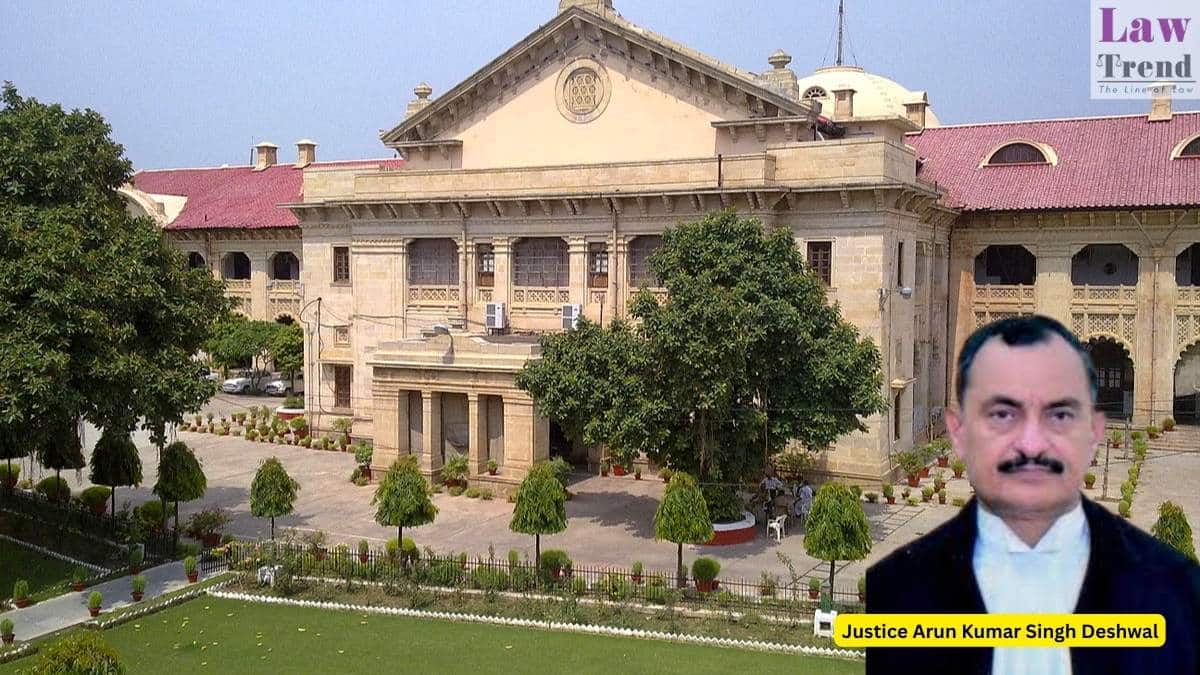
In a landmark judgment that moves beyond a simple bail hearing, the High Court of Judicature at Allahabad has rejected a bail plea in a murder case while simultaneously issuing a scathing indictment of the systemic failures causing judicial pendency. Justice Arun Kumar Singh Deshwal used the proceedings to highlight that judicial officers are often unfairly blamed for delays that are actually rooted in state negligence and police non-cooperation.
The applicant, Mevalal Prajapati, sought bail in a murder case (Case Crime No. 290/2025) involving sections 103(1), 238, 309(6), and 317(2) of the Bhartiya Nyay Sanhita (B.N.S.). The Court, while rejecting the bail due to incriminating forensic and circumstantial evidence, utilized its powers to address the “heavy pendency” of criminal cases in U.P. district courts, citing a lack of staff, poor infrastructure, and faulty police investigations.
Case Background and Parties’ Arguments
The prosecution alleged that the deceased went missing on October 16, 2025. Based on CDR (Call Detail Record) locations, the applicant was arrested three days later. Disclosures by the applicant led to the recovery of the victim’s e-rickshaw and a blood-stained screwdriver.
Counsel for the Applicant: Argued that there were no eyewitnesses and the recovery was planted. He stated the applicant had no criminal history and had been in jail since October 19, 2025. Counsel for the State (A.G.A.): Opposed the bail, citing CDR evidence placing the applicant at the scene and the recovery of the weapon which substantiated the post-mortem injuries. The recovery was also duly videographed as per Section 105 of the Bhartiya Nagarik Suraksha Sanhita (BNSS).
The “Damini” Reality: Paragraph 19 Analysis
The Court directly addressed the cultural stigma of judicial delays, referencing the famous 1993 film Damini. Paragraph 19 of the judgment provides a sharp reality check:
“A filmy dialogue from the film ‘Damini’ released in the year 1993 that ‘Tarikh pe Tarikh, Tarikh pe Tarikh Milti Rahi hai….. lekin Insaf Nahi Mila My Lord, Insaf Nahi Mila! Mili Hai to Sirf Tarikh’. This dialogue became very popular because it was the perception of a common man, but the reason for it, of course, is not the judicial officer alone, but the State and its police, as a judicial officer can’t decide the cases without sufficient staff and the cooperation of police to ensure the presence of the accused, witnesses and a proper FSL report, etc.”
The Court emphasized that many young, hardworking judicial officers become “frustrated” because they are unable to perform their duties in the absence of basic infrastructure, staff, and police cooperation.
Comprehensive Summary: Why Cases Are Pending
Based on a study of several districts including Agra, Ghaziabad, and Mathura, the Court categorized the major causes of pendency into 14 points (Para 11):
- Accused Non-Appearance: Delays at preliminary stages.
- Staff Shortage: Acute lack of clerks, stenographers, and deposition writers; some clerks handle thousands of files.
- Process Execution: Non-compliance by police in serving summons and warrants.
- Witness Issues: Frequent absence of police and medical witnesses due to transfers.
- Infrastructure: Excessive daily cause lists (100-150 cases per day).
- FSL Delays: Late receipt of forensic reports and non-production of case property.
- Bar-Related Issues: Repeated adjournments sought by advocates.
- Docket Explosion: High institution rates exceeding disposal rates.
- Underutilization of ADR: Insufficient use of mediation and Lok-Adalats.
- Procedural Complexities: Lengthy committal proceedings in multi-accused cases.
- Administrative Gaps: Missing or incomplete records in transferred cases.
- Coordination Gaps: Lack of synchronization between Judiciary, Police, and Prosecution.
- Old Cases: Lack of consistent priority for cases pending over 5 years.
- External Constraints: Parties relocating or becoming untraceable.
Structural Critiques and Protocol Discrepancies
The Court noted that District Police Chiefs often send representatives instead of attending monitoring cell meetings, calling it “disrespect to the District Judge.” It also noted a discrepancy in a 2013 State notification:
“The Commissioner of Police and the Divisional Commissioner are much lower in rank and protocol than a District Judge. It is also surprising that the State Government has issued an incorrect notification dated 17th July 2013, showing the District Magistrate above the District Judge in protocol, and this must be corrected immediately.”
The Digital Shift: BNSS and E-Processes
The Court highlighted the new provisions in the Bharatiya Nagarik Suraksha Sanhita, 2023 and U.P. Electronic Processes Rules, 2026 intended to expedite trials:
- Section 193(3)(1) & 210(1)(b): Allows for charge sheets to be submitted and cognizance taken electronically.
- Rule 31 (BNSS Rules 2024): Mandates service of summons via email, N-STEP, or other digital applications.
- Rule 8 (E-Processes Rules): Requires police to record verified email and messaging app (WhatsApp/Telegram) details of the accused during investigation.
Court’s Mandatory Directions
The Court issued 11 specific directions (Para 26) to the State Government and the Director General of Police (DGP):
- Provide additional staff and infrastructure to District Courts.
- Consider making U.P. FSL an autonomous department under the Home Ministry.
- Fill FSL vacancies and provide high-end instruments within one year.
- Train police officers specifically for forensic evidence collection.
- Provide Personal Security Officers (PSOs) to all District Court Judges.
- Ensure all District Police Chiefs attend monthly monitoring meetings personally.
- DGP to ensure I.O.s seek DNA matching queries from FSLs for every case.
- Mandate the recording of electronic contact details in charge sheets.
- Implement “Speech-to-Text AI modules” for recording witness statements under Section 180 BNSS.
- Disciplinary action for negligence in court process execution.
- Judicial officers to transition fully to e-summons and e-warrants.
Final Decision on Bail
Returning to the merits of the case, the Court found the CDR data, the recovery of the blood-stained weapon, and the matching injuries in the post-mortem report to be sufficient grounds to deny liberty.
“Considering the submissions… this Court is not inclined to grant bail to the applicant, at this stage,” the Court concluded.
Case Details Block
- Case Title: Mevalal Prajapati vs. State of U.P.
- Case No.: Criminal Misc. Bail Application No. 11476 of 2026
- Bench: Justice Arun Kumar Singh Deshwal
- Date: May 7, 2026