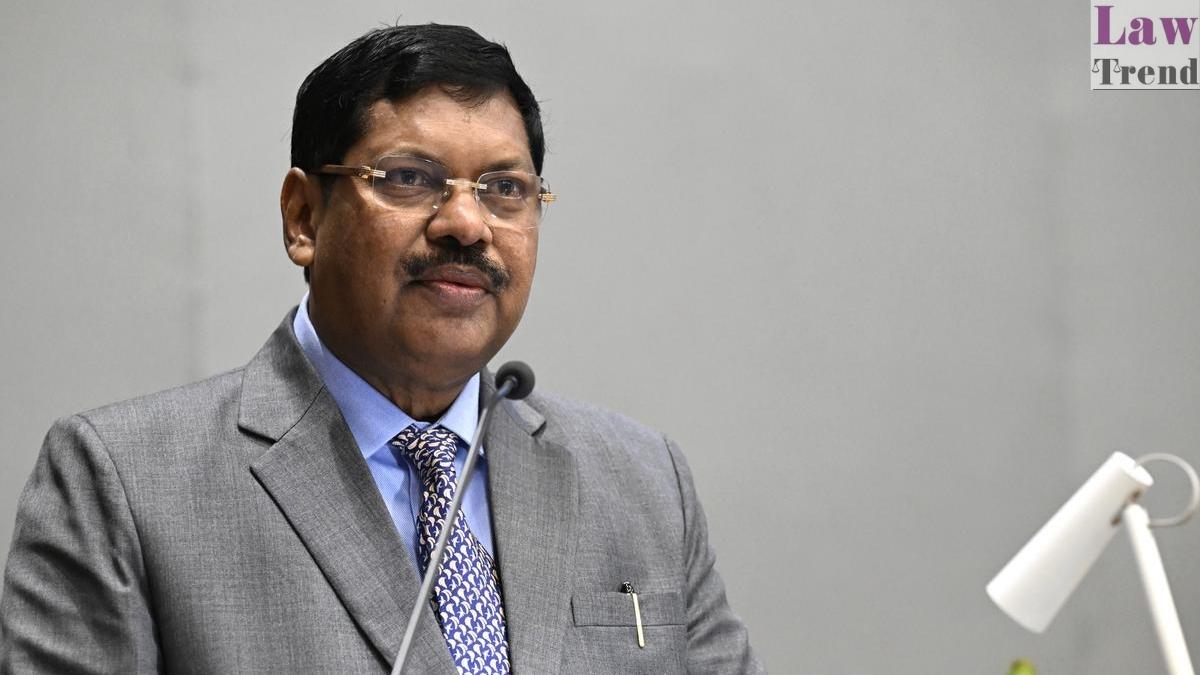
Highlighting the judiciary’s pivotal role in preserving democratic values, Former Chief Justice of India BR Gavai on Friday asserted that the Supreme Court has consistently ensured that the state’s power to restrict expression does not eclipse the citizen’s fundamental right to think and participate in democracy.
Speaking at the Justice KT Desai Memorial Lecture 2025, the former top judge emphasized that while the Supreme Court has spent the last 75 years shaping the contours of freedom of speech, the current digital era demands a recalibration of these traditional principles to tackle modern challenges like surveillance and misinformation.
Delivering the lecture titled ‘Freedom of Speech and Expression: Its Scope and Limitations Under the Constitution’, Justice Gavai traced the evolution of the law since Independence. He noted that the judiciary has been engaged in a continuous effort to balance the rights guaranteed under Article 19(1)(a) with the permissible restrictions under Article 19(2).
“The evolution of free speech jurisprudence in India reflects a larger constitutional commitment to ensure that the state’s power to restrict expression does not overshadow the citizen’s right to think, to speak and to participate freely in the democratic set-up,” Justice Gavai stated.
He observed that the “constitutional journey” of the apex court has been marked by a conscious effort to preserve the breadth of free speech. The Court, he noted, has worked to constrain the scope of restrictions to ensure the right is not diluted by “overreach, vagueness and excessive state control.”
Justice Gavai highlighted how the Supreme Court has expanded the understanding of “expression” beyond mere speech to include dignity, autonomy, and identity. Citing landmark judgments, he pointed to the apex court’s ruling that affirmed the constitutionally protected right of transgender persons to express their gender.
Furthermore, he remarked on the judiciary’s shift at the turn of the 21st century, where the Court increasingly recognized free speech as integral to the “health of democracy.” He stressed the judiciary’s role in ensuring transparency, which enables citizens to make informed electoral choices.
Addressing the complexities of the modern era, the former CJI flagged the “unprecedented reach” of digital communication and its fundamental role in shaping public discourse. He acknowledged that the Supreme Court is increasingly being called upon to navigate the potential for misuse in the digital sphere.
Concluding his address, Justice Gavai called for an evolution in legal thinking to match technological advancements.
“Traditional free speech principles must be recalibrated to respond to the unique challenges posed by the online world, including misinformation, surveillance and the monopolistic powers of digital intermediaries,” he said.