

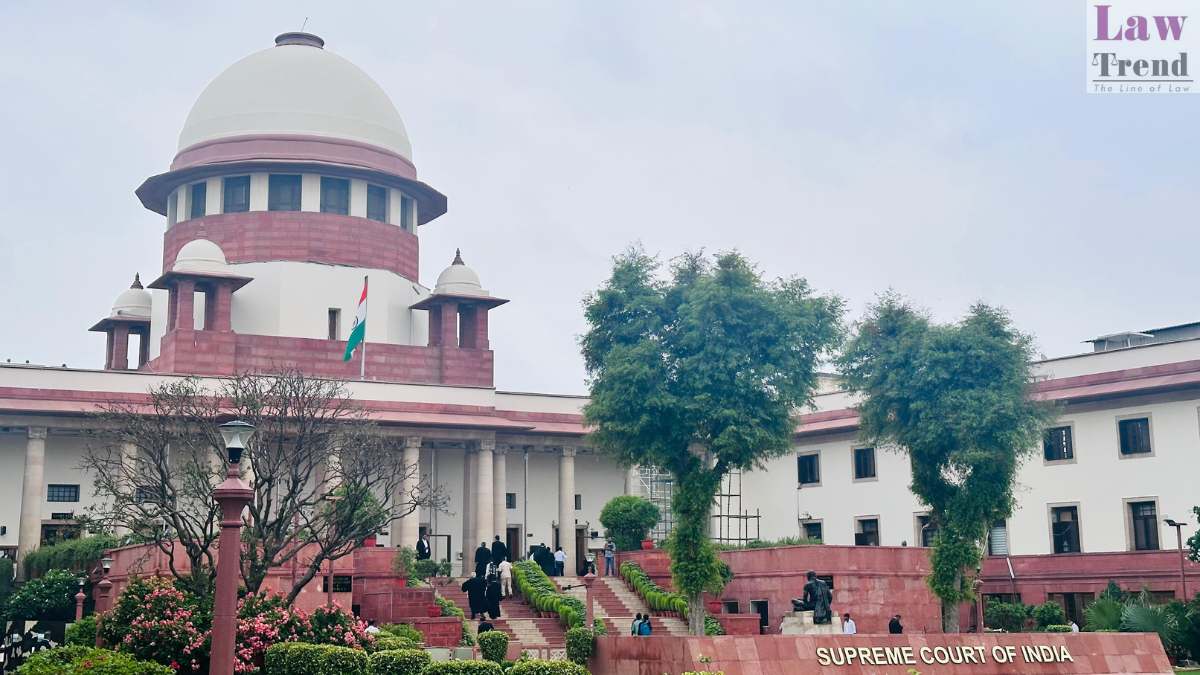
A nine-judge Constitution Bench of the Supreme Court clarified on Wednesday that its upcoming decision on the correctness of a landmark 1978 judgment—which significantly expanded the definition of “industry”—will apply to all existing cases currently being litigated under the now-repealed Industrial Disputes Act, 1947.
The Bench, led by Chief Justice of India Surya Kant, is re-examining the “Triple Test” established in the Bangalore Water Supply and Sewerage Board case of 1978. That ruling brought millions of workers in hospitals, educational institutions, clubs, and government welfare departments under the protective umbrella of labour laws.
The clarification comes at a critical juncture as the Industrial Disputes Act (ID Act), 1947, has been replaced by the Industrial Relations Code, 2020, which became operational in 2025. During the hearing, Justice B.V. Nagarathna addressed concerns regarding the relevance of the reference given the change in law.
“Whatever is going to be said now will apply to the existing cases under the old law. That is the long and short of it,” Justice Nagarathna observed.
Responding to arguments from senior advocate C.U. Singh regarding the repeal of the 1947 Act, Justice Dipankar Datta challenged the notion that the Bench should not answer the reference. “The reference is made. Now, show us an authority which says in these circumstances, the nine-judge bench may not answer,” Justice Datta remarked.
At the heart of the proceedings is the 1978 verdict delivered by a seven-judge bench. That judgment, authored by Justice V.R. Krishna Iyer, established that an entity is an “industry” if it involves:
- Systematic activity;
- Cooperation between employer and employees;
- Production of goods and services.
This wide interpretation has long been contested by various state governments. Senior advocate Indira Jaising, appearing in the matter, assailed the opposition from states, characterizing it as “surrogate litigation” on behalf of private players. She emphasized that the 1947 Act was a “beneficial legislation” intended to provide security of tenure and access to justice against victimization and malafide termination.
Chief Justice Surya Kant concurred with the sentiment, noting, “The Industrial Disputes Act, 1947, is a beneficial legislation and workmen are entitled to some kind of statutory protection.”
The Bench has formulated several key issues for adjudication, primarily whether the 1978 Bangalore Water Supply case remains “correct law.” The Court is also examining whether social welfare activities and government schemes can be construed as “industrial activities” under Section 2(j) of the 1947 Act.
The Chief Justice emphasized that the Court is focused on the original provision’s interpretation. “If that interpretation was wrong, if that provision has been completely misconstructed by giving such a wide meaning, then we will correct our mistake,” the Bench previously stated.
Justice Joymalya Bagchi further clarified that the Court’s current interpretation is strictly in reference to the repealed 1947 law and does not extend to the new 2020 Code.
The nine-judge Bench includes Chief Justice Surya Kant and Justices B.V. Nagarathna, P.S. Narasimha, Dipankar Datta, Ujjal Bhuyan, Satish Chandra Sharma, Joymalya Bagchi, Alok Aradhe, and Vipul M. Pancholi. Arguments are scheduled to continue on Thursday.




