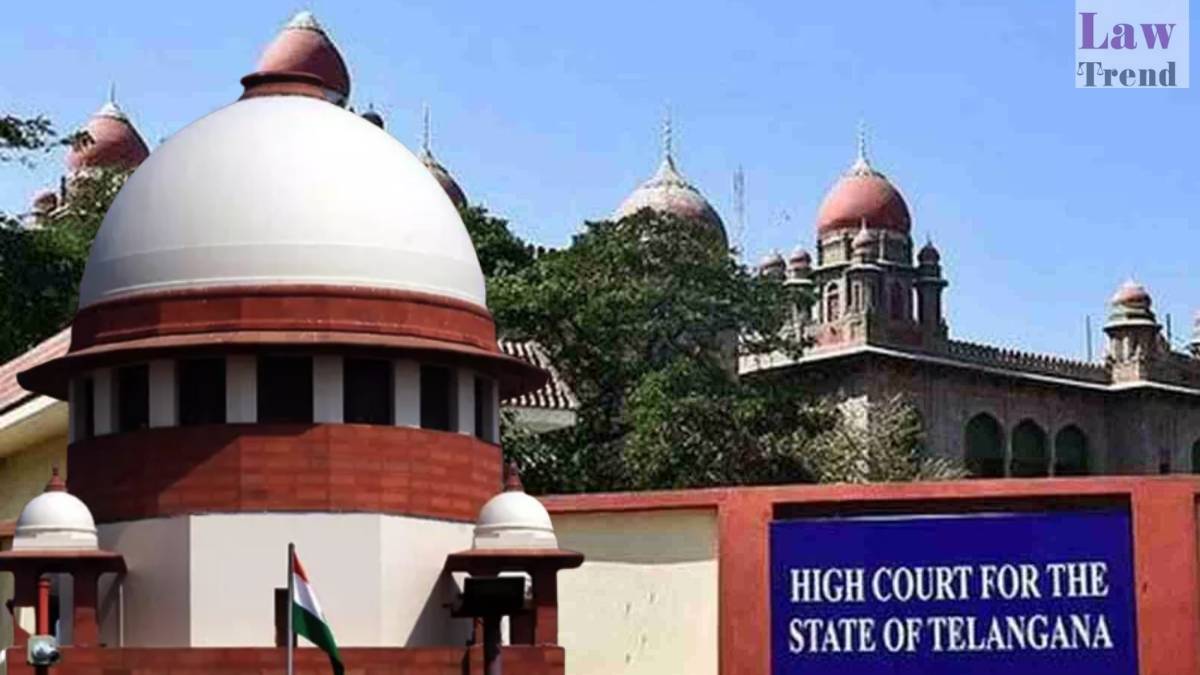
The Supreme Court has set aside a judgment of the Telangana High Court and restored the award passed by the Commissioner for Workmen’s Compensation, granting relief to the family of a deceased driver. The Court held that the High Court erred in concluding there was no employer-employee relationship, especially after the vehicle owner unequivocally admitted to the employment.
The judgment was delivered by a bench comprising Justice Vikram Nath and Justice Augustine George Masih in the case of Panganti Vijaya Versus United India Insurance Company Ltd. & Ors. (Civil Appeal arising out of SLP (C) No. 15218 of 2024).
Background of the Case
The case originated from a fatal accident that occurred on September 10, 2004. The deceased, Panganti Suresh, was employed as a driver by the fifth respondent (the vehicle owner) on a monthly salary of Rs. 3,500. While driving the vehicle bearing No. AP-15L-4000 from Hyderabad, the car was rammed by a lorry coming from the opposite direction. Two occupants of the car, including Suresh, succumbed to their injuries.
The appellant, being the legal representative of the deceased, filed a claim under the Workmen’s Compensation Act, 1923, asserting that the deceased was employed by the fifth respondent and that the accident occurred during and in the course of employment.
Proceedings Before Lower Authorities
During the initial proceedings, the owner of the vehicle, Sathyanarayanan, filed a counter-affidavit denying that the deceased was under his employment. However, during his cross-examination and re-examination, he admitted that the deceased was indeed employed by him. He explained that the initial denial was an oversight due to confusion, as the accident occurred the very next day after the deceased was employed.
Based on the oral and documentary evidence, the Commissioner for Workmen’s Compensation and Deputy Commissioner of Labour, Nizamabad, passed an award on April 30, 2009. The Commissioner recorded a finding that the deceased was employed as a driver and the accident occurred during the course of employment. Consequently, the Commissioner fixed joint and several liability on the Insurance Company and the owner, directing them to pay compensation of Rs. 3,73,747/- along with interest at the rate of 12% per annum.
High Court’s Decision
The Insurance Company challenged the Commissioner’s order before the High Court for the State of Telangana. By an order dated March 22, 2022, in CMA No. 98 of 2010, the High Court allowed the appeal and set aside the Commissioner’s award.
The Supreme Court noted that the High Court, “relying on the earlier counter-affidavit filed by respondent No. 5 erroneously recorded the fact that there was no employer-employee relationship between the deceased and the owner of the vehicle.” The Apex Court further observed that the High Court had wrongly recorded that the FIR was filed by the appellant, whereas it was actually lodged by the wife of the other deceased person.
Supreme Court’s Analysis and Decision
The Supreme Court scrutinized the evidence and the findings of the lower courts. The bench observed that the Commissioner’s finding was based on a “correct appreciation of evidence and did not suffer from perversity or legal infirmity.”
During the proceedings before the Supreme Court, the vehicle owner failed to appear initially, leading the Court to issue bailable and subsequently non-bailable warrants. Upon appearance, the owner filed an affidavit unequivocally admitting that the deceased Suresh was under his employment.
The Court noted: “He also admitted that his denial of factum of employment in the counter-affidavit placed before the Commissioner was to avoid civil liability.”
Based on this admission and the evidence on record, the Supreme Court held: “In view of the above, we hold that the deceased was employed as a driver and his death occurred during the course of and arising out of his employment. The claim of the appellant was rightly allowed by the Commissioner and the interference by the High Court was unwarranted.”
The Supreme Court allowed the appeal, setting aside the High Court’s judgment dated March 22, 2022. The Court restored the award dated April 30, 2009, passed by the Commissioner for Workmen’s Compensation.
Regarding the disbursement of the compensation, the Court noted that the principal amount and interest had already been deposited by the Insurance Company at the time of filing the appeal before the High Court, and the appellant had withdrawn one-third of the amount.
The Court directed: “The appellant is hereby permitted to withdraw the rest of the amount with accrued interest lying in deposit with the High Court. Registrar General of the High Court of Telangana shall ensure that the amount is released within four weeks of the filing of this order before the Registry.”
Case Details:
- Case Title: Panganti Vijaya v. United India Insurance Company Ltd. & Ors.
- Case No: Civil Appeal arising out of SLP (C) No. 15218 of 2024 (2026 INSC 9)
- Coram: Justice Vikram Nath and Justice Augustine George Masih