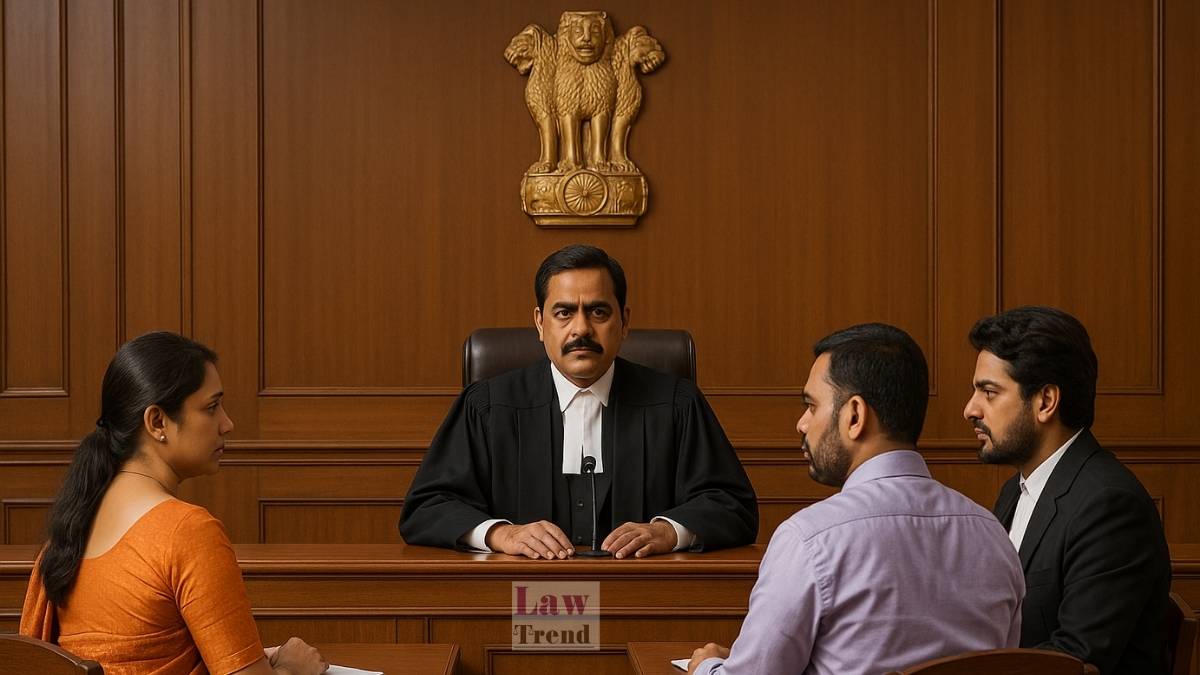
The Supreme Court has invoked its extraordinary powers under Article 142 of the Constitution of India to dissolve a marriage following a settlement between the parties. The Bench, comprising Justice Ahsanuddin Amanullah and Justice K. Vinod Chandran, allowed the appeal and quashed multiple criminal and civil proceedings pending between the husband and wife, noting that the marriage had “irretrievably broken down.”
Case Background
The matter reached the Supreme Court via a Criminal Appeal filed by Baburam Gautam and others against the State of Uttar Pradesh and another. The appeal challenged the rejection of an application under Section 482 of the Criminal Procedure Code, 1973 (CrPC) by the High Court. The appellants had sought to quash the proceedings in Criminal Case No. IX of 2024, arising out of Case Crime No. 177 of 2023, instituted at Mahila Thana, District Mathura.
During the hearing on September 9, 2025, the parties—including the husband (third appellant) and the wife (second respondent)—submitted that a settlement was being negotiated. Subsequently, a joint application was filed under Article 142 of the Constitution seeking the dissolution of the marriage.
Terms of Settlement
When the matter was taken up on December 18, 2025, both the husband and wife were present before the Court. They informed the Bench that they had agreed to “go their independent ways” based on a final settlement of Rs. 30,00,000 (Rupees Thirty Lakhs) to be paid by the husband to the wife.
The Court noted the payment details, recording that two demand drafts of Rs. 15,00,000 each had been handed over to the wife’s counsel.
A significant aspect of the settlement involved the parties’ conduct on social media. The Court recorded the specific undertaking regarding digital content:
“The parties herein undertake to remove all photo/video relating to each other and their family members from all social media platforms and also undertake not to upload any photo/video of each other or each other’s family member on any social media portal in future.”
Court’s Observations and Order
The Bench acknowledged the joint application and the list of cases pending between the parties, which included proceedings under the Indian Penal Code (Sections 380, 323, 504, 506) and the Bharatiya Nagarik Suraksha Sanhita (Section 379 BNSS), as well as a petition under Section 9 of the Hindu Marriage Act.
Accepting the settlement, the Court directed that the cases listed in the joint application “shall be closed on the certified copy of this order being produced before the concerned court/authority.”
Regarding the dissolution of the marriage, the Court observed:
“Considering the fact that the marriage has irretrievably broken down, we invoke the power under Article 142 of the Constitution of India to dissolve the marriage between the third appellant and the second respondent under Section 13B of the Hindu Marriage Act, 1955.”
The Registry was directed to draw up a decree for the dissolution of marriage. Consequently, the appeal was allowed, and all pending applications were disposed of.
Case Details:
- Case Title: Baburam Gautam and Ors. v. State of U.P. and Another
- Case No.: Criminal Appeal of 2025 (@ Special Leave Petition (Crl.) No. 6653 of 2025)
- Citation: 2025 INSC 1493
- Coram: Justice Ahsanuddin Amanullah and Justice K. Vinod Chandran