

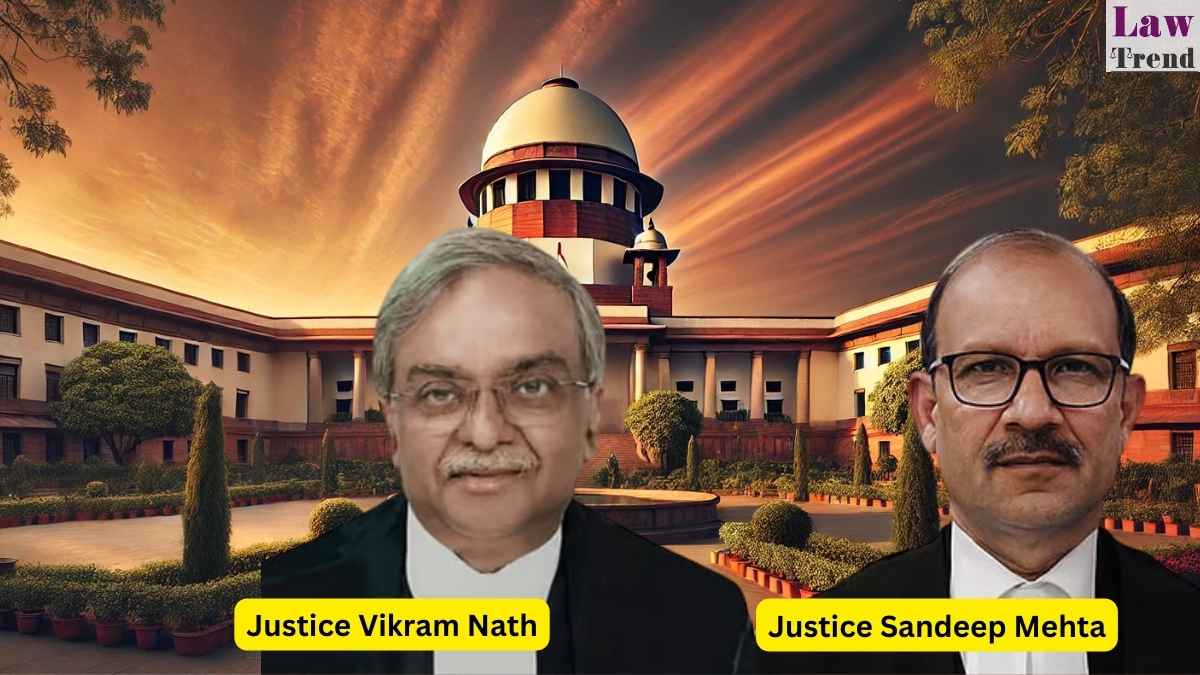
The Supreme Court of India has granted bail to Anosh Ekka, a former Minister in the State of Jharkhand, by suspending his substantive sentence of imprisonment in a disproportionate assets (DA) case investigated by the Central Bureau of Investigation (CBI). The Bench, comprising Justice Vikram Nath and Justice Sandeep Mehta, set aside the order of the High Court of Jharkhand which had previously rejected the appellant’s application for suspension of sentence and grant of bail during the pendency of his appeal.
Background of the Case
The case originated from an FIR (Vigilance Bureau P.S. Case No. 26 of 2008) registered on a complaint by one Kumar Binod. It was alleged that the appellant and another Minister, Hari Narain Rai, acquired assets disproportionate to their known sources of income. Following a High Court order in 2010, the investigation was handed over to the CBI.
The prosecution alleged that the appellant amassed assets worth approximately ₹57.01 crores, including land in Ranchi and a palatial bungalow, against a pre-check asset of ₹10,48,827. It was further alleged that the appellant:
- Floated construction companies registered with the Rural Works Department to legalize wealth.
- Illegally acquired large tracts of tribal lands in violation of the Chota Nagpur Tenancy Act, 1908 (CNT Act) through his wife, Mrs. Menon Ekka, using false addresses and affidavits.
- Conferred undue pecuniary advantage on his firms, such as M/s Mahamaya Construction and M/s Ekka Construction Pvt. Ltd., by awarding them government contracts from departments under his direct control.
The appellant was tried and convicted by the trial court on August 29, 2025, in R.C. Case No. 04(A)/2010-AHD-R(C) for offences under:
- Section 120B read with Section 13(1)(d) of the Prevention of Corruption Act (PC Act), 1988.
- Section 13(2) read with Section 13(1)(d) of the PC Act, 1988.
- Section 120B read with Section 193 of the Indian Penal Code (IPC).
He was sentenced to seven years of rigorous imprisonment for the PC Act offences and two years for the IPC offence, with sentences to run concurrently.
Arguments of the Parties
Appellant’s Contentions: Learned Senior Counsel Shri Siddharth Dave, appearing for the appellant, argued that:
- Substantial assets worth approximately ₹18 crores have already been attached and seized by the Enforcement Directorate.
- The original case was split into two chargesheets involving overlapping allegations and the same check period.
- The appellant has already undergone nearly four years of imprisonment in an earlier related case and more than ten months in the present case.
- Subjecting the appellant to two separate trials for the same set of allegations “tantamounts to a dual punishment for the same set of allegations thereby being in the teeth of right against double jeopardy as guaranteed under Article 20(3) of the Constitution of India.”
- There is no likelihood of the appeal being heard in the near future.
Respondent’s Contentions: Shri Davinder Pal Singh, learned Additional Solicitor General for the CBI, opposed the bail plea, stating:
- The appellant misused his official position as a Minister to amass grossly disproportionate assets.
- The allegations are grave in nature.
- While substantial assets and tribal lands have been confiscated, the State Government has not yet taken steps for the cancellation of sale deeds and reversion of tribal land under the CNT Act.
Court’s Analysis and Observations
The Supreme Court observed that two split chargesheets were filed from the same Vigilance case, leading to R.C. Case No. 04(A)/2010-AHD-R(B) and R.C. Case No. 04(A)/2010-AHD-R(C). The Court noted that “many of the allegations in the present case and the earlier case appear to be overlapping.”
Regarding the contention that separate prosecutions were impermissible, the Court stated:
“This aspect of the case would have to be gone into by the High Court while deciding the pending appeals.”
However, considering the period of incarceration, the Court remarked:
“the fact remains that the appellant has undergone custodial incarceration of more than 10 months in the present case as well. The sentence awarded to the appellant in the other case involving allegations of acquisition of disproportionate assets, having been suspended by this Court, we are inclined to grant bail to the appellant in the present case also.”
The Decision
The Supreme Court allowed the appeal and directed the release of Anosh Ekka on bail. The release is subject to the following conditions:
- The appellant must file an undertaking before the trial court within seven days of his release, stating that he shall assist in the process of restoration of the tribal land to its original status as and when required.
- The furnishing of bail bonds and sureties to the satisfaction of the trial court.
- Any other terms and conditions the trial court may deem fit to impose.
Case Details:
- Case Title: Anosh Ekka vs. State through Central Bureau of Investigation
- Case No.: Criminal Appeal No(s). [To be assigned] of 2026 (Arising out of SLP (Crl.) No(s). 891 of 2026)
- Bench: Justice Vikram Nath and Justice Sandeep Mehta
- Date: April 13, 2026




