

The Supreme Court has held that a High Court, using its supervisory jurisdiction under Article 227 of the Constitution, cannot act as an appellate court and set aside a reasoned sanction granted by the Charity Commissioner for the sale of trust property. It set aside two Bombay High Court judgments that had quashed the sanctions for the sale of the Ratanshi Premji Charitable Trust’s lands in Thane. It also restored the registered conveyance deed that the High Court had annulled.
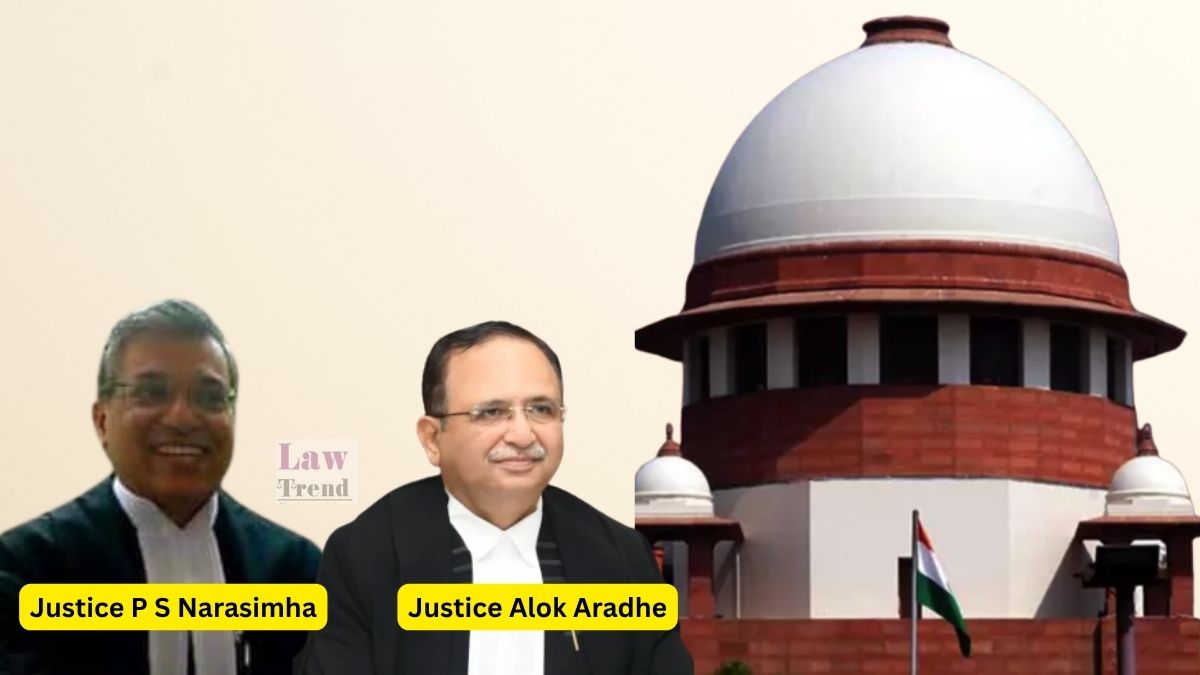
A Bench of Justice Pamidighantam Sri Narasimha and Justice Alok Aradhe allowed appeals filed by the purchaser, Destini RealPro Developers LLP (formerly M/s Fenkin Infotech LLP), by the Trust, and by the Thane Municipal Corporation.
Background
The Trust, which is registered under the Maharashtra Public Trusts Act, 1950, owned two parcels of land at Villages Vadavali and Owale in Thane. On May 6, 2024, the trustees resolved to sell both parcels “as is where is”. They cited hilly and marshy terrain, encroachments by persons claiming to be agricultural tenants, pending litigation and the Trust’s meagre income.
Public notices inviting bids were published in two newspapers. The purchaser’s bids were the highest: ₹75 crore for the Vadavali land and ₹38 crore for the Owale land. A government-approved valuer had valued the two parcels at about ₹70.90 crore and ₹33.68 crore. The Charity Commissioner called for a second valuation, which came to about ₹71.25 crore and ₹33.67 crore. He then granted sanction under Section 36(1)(a) of the Act on July 8 and July 31, 2024, after the purchaser raised each offer by ₹5 lakh.
A conveyance deed for the Vadavali land was executed on September 6, 2024. The purchaser later surrendered 94,860 sq. mtrs. of reserved land to the Corporation in exchange for Transferable Development Rights.
A former trustee (respondent No. 1) challenged the sanctions under Article 227. On March 7, 2025, the High Court quashed them, citing deficiencies in how the valuation had been scrutinised, and sent the matters back for fresh consideration. In the Vadavali matter it also declared the conveyance deed void ab initio.
Arguments
Senior Advocates Kapil Sibal and Neeraj Kishan Kaul, appearing for the purchaser, argued that respondent No. 1 had no locus because he ceased to be a trustee in 2012. They submitted that Section 36(2) of the Act provides an efficacious remedy, and that once a conveyance is executed, a sanction can be revoked only for fraud, which had not been pleaded. They also contended that the High Court had re-appreciated the material, and that cancelling a registered instrument could not be granted as a “necessary corollary” in Article 227 proceedings.
Senior Advocate Dhruv Mehta, for the Trust, submitted that the lands were sold through a fair and transparent process and that the Charity Commissioner had passed a reasoned order. Senior Advocate Balbir Singh, for the Corporation, argued that the Corporation was a bona fide transferee in possession of the reserved land. He said its rights had been extinguished even though it was never a party before the High Court.
Senior Advocate S. Nagamuthu, for respondent No. 1, contended that the lands were undervalued, the tender process was hurried, cheques for the balance consideration had been dishonoured, and the purchaser did not meet the eligibility criteria.
Court’s Findings
The Court found that the Charity Commissioner had considered the “three classic requirements” of interest, benefit and protection of the Trust, and had acted in line with Section 36(1)(a). It noted that the trustees hold property for the beneficiaries and that, once the Charity Commissioner accepts the need to sell, “the beneficiaries cannot insist that property should be sold to a person of their choice.”
On the High Court’s approach, the Bench observed, “The High Court has virtually acted like an Appellate Court while examining the validity of the decision of the Charity Commissioner.”
It listed several infirmities in the impugned judgments and held, “The finding that a transparent process by public notice was not followed is contrary to the record.” The Court said the negative weightages applied by the valuers concerned matters within the domain of experts. For the Owale land, it held that the High Court’s figures did not match the valuation report. It also held that the High Court’s finding that the basis of the TDR valuation was unclear was factually incorrect. It added that “Section 36 does not contemplate a trial and the Charity Commissioner is required to arrive at his satisfaction on the material placed before him.”
The Court further held that under the proviso to Section 36(2), “after the execution of the conveyance deed, a sanction cannot be revoked except on the ground of fraud practised on the Charity Commissioner.” Respondent No. 1 had not raised that plea and had not used the remedy under Section 36(2). The Bench said, “On this ground alone, the High Court ought not to have entertained the writ petitions.”
The Court declined to examine respondent No. 1’s other contentions, such as the dishonoured cheques and the purchaser’s eligibility. It noted that the High Court had recorded no finding on them and that most were never urged before it.
Outcome
The Supreme Court quashed the High Court judgments in W.P. No. 1915 of 2025 and W.P. No. 1877 of 2025 and restored the Charity Commissioner’s orders. The conveyance deed dated September 6, 2024 and the indenture of transfer dated February 3, 2025 were also restored. The appeals were allowed with no order as to costs.
Case Title: Destini RealPro Developers LLP (Formerly Known as M/s Fenkin Infotech LLP) v. Aniruddh Nikhil Makhecha & Ors.
Case No.: Civil Appeal arising out of SLP (C) No. 9834 of 2025 [2026 INSC 1278]
Bench: Justice Pamidighantam Sri Narasimha and Justice Alok Aradhe
Date: November 26, 2026


