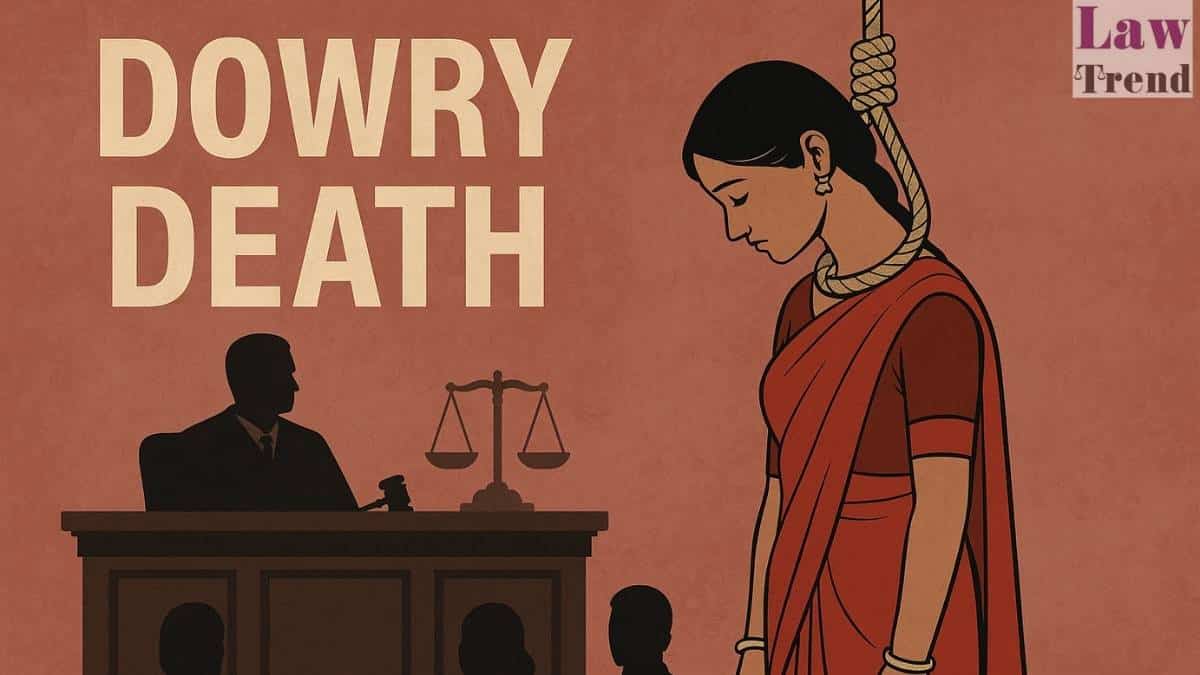
The Bombay High Court, Aurangabad Bench, has acquitted a husband and his mother, who were previously convicted for dowry death and cruelty, ruling that the prosecution failed to prove the charges. The Court observed that the deceased wife was of a “short temperament” and committed suicide in a “fit of anger.” Justice Neeraj P. Dhote emphasized that “every harassment or ill-treatment do not qualify the term Cruelty to attract Section 498-A of the IPC.”
Case Background
The appeal was filed by Rajkumar Ramdas Bhagat (32) and his mother Suratbai @ Sarswati Ramdas Bhagat (58), challenging the judgment dated August 30, 2023, passed by the Additional Sessions Judge, Shrigonda. The Trial Court had convicted them under Sections 498-A (Cruelty), 304-B(2) (Dowry Death), 323, 504, and 506 read with Section 34 of the Indian Penal Code (IPC). They were sentenced to rigorous imprisonment for ten years for the offence under Section 304-B IPC.
The prosecution’s case was that the deceased, Sudeshna, married Rajkumar on December 10, 2010. The prosecution alleged that after five to six months of marriage, the accused began harassing her. It was alleged that in September 2012, ill-treatment resulted in her abortion. The prosecution claimed she was sent to her parents’ house with a demand of Rs. 2 Lakhs for constructing a house and starting a poultry business. Sudeshna committed suicide on November 12, 2014, by throwing herself in front of a running train.
Arguments of the Parties
The Appellants argued that the evidence on record did not establish the ill-treatment required to attract Section 498-A IPC. Their counsel submitted that the deceased was a “short-tempered woman and committed suicide in anger.” It was argued that the husband and in-laws were financially well-off, negating the question of demanding Rs. 2 Lakhs. The defence also contended that the suicide note was planted and the handwriting expert’s report could not be accepted as there was no evidence that the sample handwriting was that of the deceased.
The State, represented by the Additional Public Prosecutor (APP), argued that there was sufficient evidence of ill-treatment and harassment. The APP relied on the testimony of the deceased’s friend (PW-5) and the handwriting expert, asserting that the suicide note was written by the deceased.
Court’s Observations and Analysis
Justice Neeraj P. Dhote analyzed the evidence and found significant gaps in the prosecution’s case.
On Cruelty and Nature of the Deceased: The Court noted the admission of the deceased’s brother (PW-1) and a neighbor (PW-4) regarding the nature of the deceased. PW-1 admitted in cross-examination that “the nature of Deceased was irritative” and that frequent disputes occurred where “both the sides were at some fault.”
The Court observed:
“On evaluation of the above-referred evidence of the material witnesses of the Prosecution, it becomes more than clear that, the Deceased was a short-tempered woman… Quarrels by itself will not be incriminating unless it fall within the term ‘cruelty’ sufficient to drive the victim to commit suicide. The clear evidence on record show that, the Deceased was short-tempered person and she ended her life in anger.”
The Court further held:
“It is needless to state that, it is settled position under the law that, every harassment or ill-treatment do not qualify the term Cruelty to attract Section 498-A of the IPC.”
On the Demand for Dowry: The testimony of PW-5, a friend of the deceased, was scrutinized. The Court noted that she had not been in contact with the deceased for a year prior to the incident. The Court found her evidence regarding the demand for money to be an improvement and exaggerated. The Court also pointed out that a written undertaking signed by the deceased and her husband prior to the incident made no mention of any demand for money or ill-treatment related to such demands.
On the Suicide Note: The High Court expressed serious doubts regarding the recovery of the suicide note. The panch witness (PW-2) stated that no paper was found at the spot of the incident, while the Inquest Panchnama mentioned a chit in the deceased’s hand. The Court observed that the seizure of the note was “highly doubtful” and “remains a mystery.”
Justice Dhote noted:
“If it is so, the Prosecution’s case in respect of the suicide chit is required to be seen with serious doubt. Resultantly, the evidence of handwriting expert that, the handwriting on the chit and two papers matched, or were that of the Deceased, is of no assistance for the Prosecution.”
Decision
The High Court held that the prosecution “utterly failed to establish the demand of money” or cruelty at the hands of the appellants. The Court concluded that the evidence fell short of establishing abetment to suicide or dowry death.
“The evidence clearly show that, the Deceased was of short temperament and frequent quarrels used to take between her and the in-laws and she committed suicide in a fist of anger.”
The Court allowed the appeal, quashed and set aside the conviction and sentence recorded by the Trial Court, and acquitted Rajkumar Ramdas Bhagat and Suratbai @ Sarswati Ramdas Bhagat of all charges. They were directed to be released forthwith.
Case Details:
- Case Title: Rajkumar S/o. Ramdas Bhagat And Another vs. The State Of Maharashtra
- Case Number: Criminal Appeal No. 828 of 2023
- Coram: Justice Neeraj P. Dhote
- Counsel for Appellants: Mr. Rajendra K. Temkar h/f Mr. Madhav N. Kalyane
- Counsel for Respondent: Ms. A. S. Deshmukh, APP