

State Cannot Conduct De Novo Inquiry Into Selected Candidate’s Eligibility After PSC Recommendation: Supreme Court
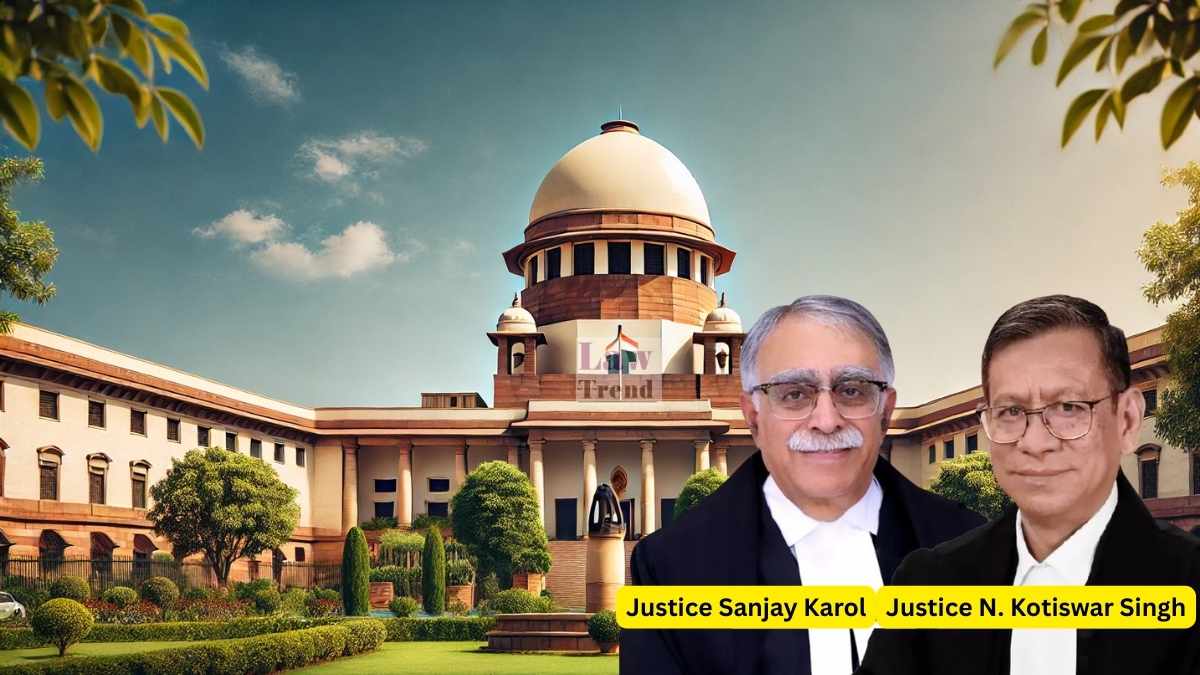

Addressing the interplay between the constitutional role of Public Service Commissions and the discretion of appointing authorities, the Supreme Court of India held that State Governments cannot independently conduct a de novo or exhaustive inquiry into the eligibility of a candidate who has been scrutinized, selected, and recommended by a Public Service Commission, especially when governing rules attach finality to the Commission’s decision. A Bench comprising Justice Sanjay Karol and Justice N. Kotiswar Singh ruled that while inclusion in a select list does not confer an indefeasible right to appointment, an appointing authority cannot supplant the statutory domain of the Public Service Commission by conducting fresh evaluations on materials already examined by experts.

Background of the Case

The dispute arose from a recruitment process initiated on February 9, 2021, by the Chhattisgarh Public Service Commission (CGPSC) for three posts of Registrar in State Universities under Schedule II of the Chhattisgarh State Universities Service Rules, 1983. Dr. Shailendra Kumar Patel, who was serving as a Deputy Registrar since 2016 and had prior teaching experience, applied under the Other Backward Classes (OBC) category.

After scrutinizing his qualifications and experience with subject experts, the CGPSC permitted Dr. Patel to participate in the written examination and interviews. Upon completing the selection process, the Commission published the select list on September 30, 2021, ranking Dr. Patel first in the OBC category, and recommended his name to the State Government on October 07, 2021. The recommendation letter noted that verification of original documents and satisfaction regarding eligibility should be completed before issuing an appointment order.

Despite the recommendation, no appointment order was issued. In subsequent proceedings, a Departmental Promotion Committee (DPC) on March 10, 2022, also found Dr. Patel suitable for promotion to Registrar, though no promotion order followed due to alleged non-availability of promotional vacancies. He was, however, given additional charge as Registrar at Pt. Ravishankar Shukla University, Raipur.

Dr. Patel approached the High Court of Chhattisgarh (WPS No. 780 of 2022), where a Single Judge directed the State on August 29, 2022, to issue his appointment order within four weeks. Instead of issuing the order, the State Government constituted an inquiry committee, which concluded that Dr. Patel lacked the requisite experience in prescribed Academic Grade Pay (AGP) scales. Consequently, on October 31, 2022, the State declared him ineligible.

Dr. Patel challenged this decision in WPS No. 8005 of 2022. During review and contempt proceedings before the High Court, the State was directed on March 31, 2023, to issue a provisional appointment order while liberty was granted to verify documents. On April 10, 2023, the State issued a provisional appointment order without specifying a place of posting, later attaching him on August 31, 2023, to the office of the Commissioner, Higher Education Department.

Dr. Patel challenged these actions in WPS No. 7350 of 2023. A Single Judge dismissed his petitions on May 22, 2025, and a Division Bench affirmed the dismissal in Writ Appeal No. 360 of 2025 on June 17, 2025, upholding the State’s authority to reassess eligibility. Aggrieved by the concurrent findings, Dr. Patel appealed to the Supreme Court.

READ ALSO  Non-Consideration Of Bail Orders And Unexplained Delay Snaps Live Link: Andhra Pradesh High Court Quashes Preventive Detention Under PIT NDPS Act

Arguments of the Parties

Appellant’s Submissions:

Counsel for Dr. Patel argued that Rule 10 of the Service Rules, 1983 accords finality to the Commission’s decision on candidate eligibility, precluding the State from reopening the issue. Citing Patna Improvement Trust v. Smt. Lakshmi Devi and Tata Chemicals Ltd. v. Commissioner of Customs (Preventive), the appellant contended that where a statute prescribes a specific manner for doing an act, it must be done in that manner alone.

It was further submitted that expert bodies, including CGPSC experts and the DPC, had repeatedly verified Dr. Patel’s credentials. Furthermore, on March 28, 2024, CGPSC explicitly reaffirmed to the State Government that subject experts had verified Dr. Patel’s qualifications prior to his interview. Relying on Shankarsan Dash v. Union of India, Manoj Manu v. Union of India, and Anoop Mishra v. State of Chhattisgarh, the appellant argued that while selection does not give an absolute right to appointment, the State cannot deny appointment arbitrarily or adopt discriminatory standards, pointing out that other candidates with comparable service histories had been appointed.

Respondents’ Submissions:

State counsel contended that a recommendation by the Commission does not create an indefeasible right to appointment, relying on Punjab State Electricity Board v. Malkiat Singh, Commissioner of Police v. Umesh Kumar, and Tej Prakash Pathak v. Rajasthan High Court. They argued that the Commission’s recommendation letter dated October 07, 2021, expressly made appointment subject to document verification and satisfaction of eligibility.

The State maintained that the inquiry report dated June 28, 2023, prepared by a committee of three senior postgraduate college principals, clearly established that Dr. Patel did not meet the requisite teaching and administrative experience in the prescribed pay scales. They asserted that posting him to the Higher Education Department was a temporary administrative arrangement under Article 162 of the Constitution. An intervenor, Dr. Naresh Kant Chandan, a waitlisted candidate, supported the State’s position.

READ ALSO  Sec 216 CrPC | Trial Court Can Proceed With Recording of Evidence Keeping Application of Adding Charge Pending: Delhi HC

Court’s Analysis

The Supreme Court examined three main issues: whether selection confers an indefeasible right to appointment, whether the State was competent to reassess eligibility prior to issuing the final appointment order, and whether the inquiry committee’s findings could be legally sustained.

1. No Indefeasible Right to Appointment, But State Action Must Be Non-Arbitrary

Reaffirming principles from Shankarsan Dash v. Union of India, the Court observed:

It is not correct to say that if a number of vacancies are notified for appointment and adequate number of candidates are found fit, the successful candidates acquire an indefeasible right to be appointed which cannot be legitimately denied.

The Court also referenced Tej Prakash Pathak v. Rajasthan High Court, noting:

Thus, in light of the decision in Shankarsan Das (supra), a candidate placed in the select list gets no indefeasible right to be appointed even if vacancies are available.

However, citing H. Mukherjee (Dr) v. Union of India, State of Haryana v. Subash Chander Marwaha, Neelima Shangla v. State of Haryana, Jatinder Kumar v. State of Punjab, and Asha Kaul (Mrs.) & Anr. v. State of Jammu and Kashmir & Ors., the Court emphasized that the appointing authority’s discretion is not absolute. If the State decides not to act on a Commission’s recommendation, it bears the burden of justifying its decision with cogent, rational, and non-arbitrary reasons based on governing statutory rules.

2. Finality under Rule 10 and Limits of Post-Selection Verification

Examining Rule 10 of the Chhattisgarh State Universities Service Rules, 1983, the Court cited the statutory text:

10. Commission’s decision about the eligibility of candidates Final.- The decision of the Commission as to the eligibility or otherwise of a candidate for selection shall be final and no candidate to whom a certificate of admission has not been issued by the Commission shall be interviewed by them.

Analyzing the recommendation letter’s stipulation regarding document verification, the Court cited the relevant text:

Before issuing the appointment letter, verification of all original educational certificates and other documents of the candidates and, in case of candidates belonging to the physically handicapped category, their disability certificates, shall compulsorily be undertaken. Further action regarding appointment shall be taken only after verification and satisfaction regarding the eligibility of the candidate for the post.

The Bench clarified that executive directions or verification clauses cannot dilute or render statutory provisions redundant. The Court ruled that document verification by the appointing authority is restricted to checking document genuineness, detecting patent or manifest errors easily discoverable without an exhaustive inquiry, or evaluating newly discovered material.

If the appointing authority has doubts regarding eligibility, Rule 10 requires referring the matter back to the Commission rather than conducting an independent, subjective re-evaluation. The Court noted that when the State queried CGPSC in 2024, the Commission explicitly stood by its expert determination.

READ ALSO  Orissa HC Junks PIL Against RBI Circular Permitting Exchange of ₹2000 Currency Notes Without ID

Decision and Directions

The Supreme Court allowed the appeal, set aside the judgment of the High Court Division Bench dated June 17, 2025, and allowed Dr. Patel’s writ petitions (WPS No. 8005 of 2022 and WPS No. 7350 of 2023).

The Court arrived at the following conclusions and directions:

  1. Selection and recommendation by the CGPSC did not confer an indefeasible right to appointment, but Rule 10 of the Service Rules, 1983 accords finality to the Commission’s decision on candidate eligibility.
  2. The State’s verification authority prior to issuing an appointment order is limited to verifying document authenticity or identifying patent, demonstrable deficiencies. The State cannot independently embark on an exhaustive, subjective re-inquiry into eligibility.
  3. If doubts arise, the appointing authority must refer the matter back to the Commission.
  4. The inquiry report dated June 28, 2023, submitted by the expert committee constituted by the Higher Education Department, is unsustainable in law and shall not be given effect to.
  5. Dr. Shailendra Kumar Patel is declared eligible for the post of Registrar under the advertisement dated February 9, 2021, and the State Government’s order dated October 31, 2022, declaring him ineligible, is set aside.
  6. The State Department is directed to issue an appointment order in favor of Dr. Patel as Registrar in any State University of Chhattisgarh within three weeks.
  7. Dr. Patel is entitled to appointment from the date his co-selected candidates were appointed, with all consequential service benefits and seniority determined per statutory rules. However, arrears of pay were restricted, holding that he shall not be entitled to arrears from the initial appointment date of others up to April 10, 2023 (the date of his provisional appointment order).
  8. Contempt Petition (C) No. 765 of 2025 was disposed of accordingly.

Case Details

Case Title: Shailendra Kumar Patel v. State of Chhattisgarh & Ors.
Case No.: Civil Appeal No. 238 of 2026
Bench: Justice Sanjay Karol and Justice N. Kotiswar Singh
Date: August 20, 2026

Law Trend
Law Trendhttps://lawtrend.in/
Legal News Website Providing Latest Judgments of Supreme Court and High Court

Related Articles

Latest Articles

