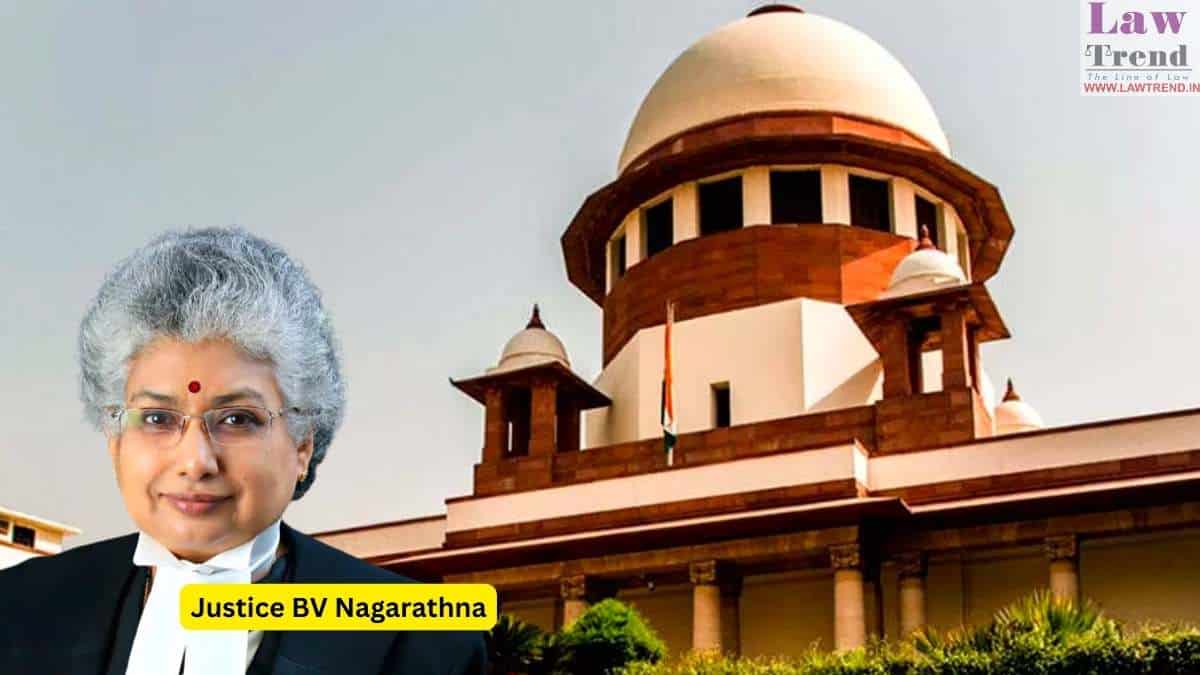
Emphasizing the linguistic diversity of India and the practical necessity of a connecting language, Supreme Court Judge Justice B.V. Nagarathna on Wednesday observed that South Indians do not wish to be isolated simply because they do not know Hindi. Her Ladyship cautioned against linguistic exclusivity, reminding that India functions as a subcontinent with a multitude of languages recognized under the Constitution.
Justice B.V. Nagarathna made significant oral observations regarding the use of Hindi in the judiciary, stating that moderation is required in language policies to ensure no region feels alienated. She highlighted that English currently serves as the vital link between different South Indian states and is essential for the administration of justice in Constitutional Courts. The Judge clarified that her remarks were not political but stemmed from the practical realities of India’s constitutional and demographic landscape.
The observations came during an interaction where Chief Justice of India Surya Kant was responding to queries from the legal fraternity. A woman lawyer had raised a concern regarding the steps being taken for lawyers who are proficient in their local vernacular languages but lack proficiency in English.
Following the Chief Justice’s response, a specific question was raised regarding the use of Hindi in the judiciary. Responding to this, Justice Nagarathna provided a detailed perspective on why a single language cannot be exclusively imposed or relied upon in a country as diverse as India.
India as a Subcontinent Justice Nagarathna stressed the need to view India not just as a country but as a subcontinent. She pointed out the constitutional recognition of diversity, noting, “There are so many languages in the 8th Schedule of the Constitution, and in South India, there are at least six languages.”
Addressing the apprehensions of non-Hindi speakers, particularly from the southern states, Justice Nagarathna stated:
“South Indians do not want to be isolated because they do not know Hindi. This is what I am saying, coming from the south.”
She emphasized that linguistic exclusivity could lead to the alienation of entire regions. “One cannot be very exclusive in one’s language,” she remarked.
The Judge highlighted the practical role English plays in bridging the linguistic divide. She observed that what connects the different states in South India is the English language. Illustrating the practical difficulties, she noted that in states like Tamil Nadu, communication becomes a significant issue if one relies solely on Hindi, as neither Hindi nor English may be spoken by the general populace in rural areas, yet English remains the medium for inter-state and constitutional communication.
Justice Nagarathna specifically addressed the administrative implications of language in the higher judiciary. She questioned how the transfer of judges to different High Courts would be feasible without a common language like English.
“In district courts, we have our individual languages like Kannada, Tamil, etc. In constitutional courts, English is the official language. Otherwise, how do we transfer judges to different High Courts?” she asked.
Justice Nagarathna concluded her observations by calling for “moderation” in the discourse regarding language in the judiciary. She reiterated that her stance was devoid of politics and purely focused on the effective functioning of the judiciary and the unity of the nation. Her comments underscore the continuing relevance of English as a unifying medium in the Indian judicial system, ensuring that judges and legal professionals from all regions can function effectively across the country without facing isolation due to language barriers.