The High Court of Delhi has clarified that a higher court’s decision to modify or set aside a trial court’s order does not inherently reflect upon the competence, ability, or integrity of the judicial officer who passed it. Disposing of a recall application filed by a serving judicial officer, the Court reassured the applicant that the expunction of his adverse remarks against a police officer in a 2023 judgment was not a personal observation against his judicial conduct.
Background of the Case
The matter stems from a High Court judgment dated March 1, 2023, in which the Court expunged certain remarks made by a Special Judge (NDPS)/Additional Sessions Judge against a Deputy Commissioner of Police (DCP), Sanjay Kumar Sain, and other police officials. The trial court judge had criticized the police for delays in filing Forensic Science Laboratory (FSL) reports. The High Court, however, concluded that the delay was attributable solely to the FSL and not the police, thereby finding the trial court’s remarks against the DCP to be uncalled for.
Arguments of the Applicant
The applicant—the judicial officer who passed the original trial court orders—filed an application seeking condonation of a 736-day delay and the recall of the March 2023 judgment, specifically requesting the expunction of what he perceived as adverse remarks against him.
Counsel for the applicant contended that the 2023 judgment was passed without issuing notice to him or examining the Trial Court Record. He argued that his directions were issued in the bona fide discharge of his duties to uphold the constitutional mandate of a speedy trial, given that the accused had been in custody since 2019.
Furthermore, the applicant stated that the circulation of the judgment by the Registrar General of the High Court, which specifically mentioned his name in the covering letter, caused grave prejudice to his reputation and service record. He highlighted that it led to his transfer and the downgrading of his Annual Confidential Report (ACR) from ‘A+’ to ‘B+’.
The Court’s Analysis
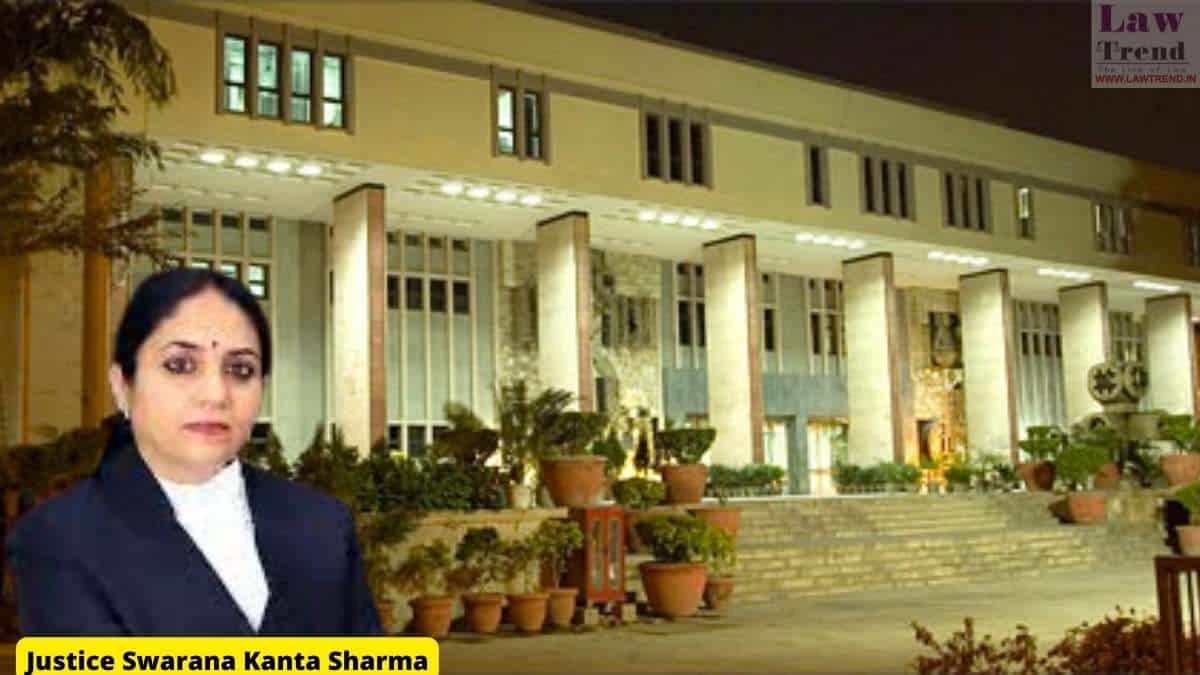
The single-judge bench of Justice Swarana Kanta Sharma observed that no personal observations were made against the applicant in the March 2023 judgment. The Court noted it had explicitly acknowledged the trial court’s anxiety over the delay in framing charges but found no malafide intent on the judge’s part.
The Court emphasized that the hierarchical scrutiny of judicial orders is an essential feature of the Indian judicial system. It noted, “The recording of reasons while setting aside an order cannot, by itself, be construed as a reflection on the competence, integrity, or ability of the judicial officer who passed the order, unless there are specific and express observations to that effect.”
The High Court further added, “If it were to be presumed that the passing of an order by a higher court, staying or setting aside an order of the Trial Court, amounts to commenting on the integrity of the Trial Court, no case could ever be decided by a higher Court.”
In its analysis, the Court referenced the Supreme Court’s ruling in Sonu Agnihotri v. Chandra Shekhar and Ors., quoting: “There is a difference between criticising erroneous orders and criticising a Judicial Officer. The first part is permissible. The second category of criticism should best be avoided…” The High Court also noted that following the Sonu Agnihotri proceedings, Rule 6 of Part H, Chapter I of Volume III of the High Court Rules and Orders—which previously stated it was undesirable for courts to censure police officers—was deleted via a notification dated January 15, 2025.
Addressing the circulation of the judgment with the judge’s name, the Court relied on its prior decision in Ajit Kumar v. State (NCT of Delhi). The bench reiterated its previous directive that any order circulated “shall not mention the name of the concerned judicial officer in the covering letter/circular issued by the Registry to the District Courts and shall instead refer to the court number concerned, as judges preside over courts, and courts do not preside over judges.”
The Decision
The High Court allowed the application to condone the 736-day delay but disposed of the recall application without passing further orders. By way of abundant caution, the Court clarified that the observations in the March 1, 2023, judgment “were confined solely to the adjudication of the writ petition and the same may not be treated as adverse remarks against the applicant for the purposes of recording or assessing his Annual Confidential Report.” The Court firmly reiterated that the ruling shall not be construed as reflecting upon his competence or integrity in any manner.
Case Details:
- Case Title: Sanjay Kumar Sain vs State of NCT of Delhi
- Case Number: W.P.(CRL) 76/2023, CRL.M.A. 11002/2025, CRL.M.A. 11000/2025
- Coram: Justice Swarana Kanta Sharma
- Date of Judgment: March 11, 2026