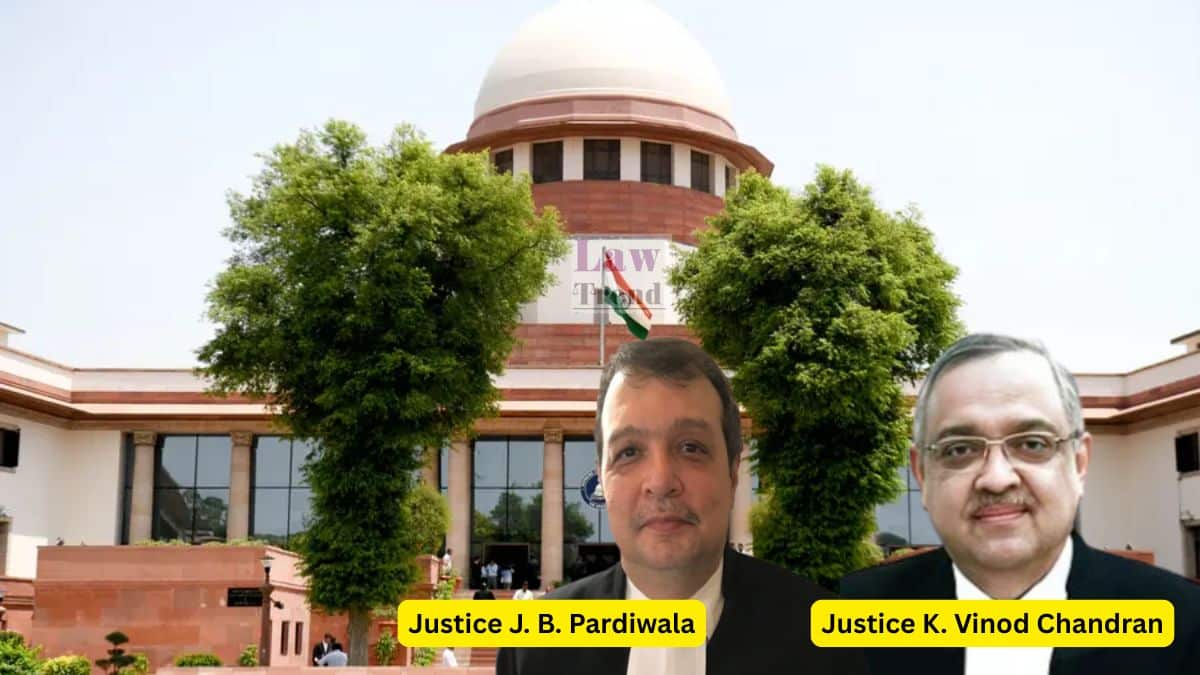
The Supreme Court of India, comprising Justice K. Vinod Chandran and Justice J. B. Pardiwala, acquitted a man sentenced to life imprisonment for the alleged murder of his wife, holding that police statements under Section 161 of the Code of Criminal Procedure (CrPC) cannot be relied upon for conviction. Reversing the rulings of the Trial Court and the High Court of Andhra Pradesh, the apex court emphasized that sworn testimony given in court is what governs judicial determination, and that the prosecution failed to prove a single incriminating circumstance against the accused.
Background of the Case
The case stemmed from an incident on May 6, 2013, involving a quarrel at the marital residence of the appellant, Jupudi Suresh, and his wife. According to the prosecution, the alcohol-dependent appellant took money kept by his wife while she was away at work. When she confronted him upon returning, he allegedly poured kerosene over her, set her ablaze, and left the scene. The victim sustained 96 percent burn injuries across her body and subsequently succumbed to them.
The Trial Court convicted the appellant under Section 302 of the Indian Penal Code (IPC) and sentenced him to life imprisonment, which was subsequently affirmed by the High Court. The conviction rested primarily on two dying declarations, the post-mortem report, and the absence of an explanation from the husband under Section 106 of the Evidence Act regarding a death occurring in the marital home.
Arguments of the Parties
Advocate Satinder Singh Gulati, representing the appellant, argued that there were material inconsistencies regarding the motive between the two dying declarations. He submitted that the first dying declaration was not legally proved as the Head Constable who recorded it had passed away. Furthermore, he highlighted that the victim’s close relatives—her sister (PW1), cousin (PW2), and mother (PW3)—did not implicate the accused in their depositions and was not declared hostile by the prosecution. The defense also pointed to the testimony of the doctor conducting the post-mortem, who stated in cross-examination that a victim with 80 to 90 percent burns could give a fit statement, casting doubt on declarations attributed to a victim with 96 percent burns.
Government Advocate Prerna Singh, appearing for the State of Andhra Pradesh, supported the concurrent judgments of the lower courts. She contended that discrepancies pertained only to prior incidents and not the core crime, where the victim specifically accused her husband. She argued that the Sub-Inspector confirmed the statement recorded by the deceased Head Constable and that the lower courts rightly discarded the depositions of PW1 to PW3 on the ground that they had been won over.
Court’s Analysis
The Supreme Court examined the medical evidence, witness testimonies, and procedural flaws in the prosecution’s case. Evaluating the post-mortem certificate, the bench observed that the presence of scalp burns strongly pointed toward suicide rather than homicidal burning by another person:
“Looking at the post-mortem certificate, we had a doubt as to the theory of the accused having poured kerosene over the deceased to set her ablaze, since the burns were present even over the scalp of the head. The indication is more of the deceased having doused herself with kerosene, which could have resulted in the burn injuries on the scalp of the head.”
Analyzing the testimonies of the close relatives (PW1 to PW3), the court noted that they testified to arriving at the scene upon hearing cries, finding the victim ablaze, and witnessing the appellant present and attempting to put out the fire. In cross-examination, the witnesses stated the victim committed suicide due to underlying health ailments.
The court severely criticized the High Court for brushing aside their testimonies by relying on prior police statements recorded under Section 161 CrPC. Clarifying the legal standard, the Supreme Court held that Section 161 statements cannot form the basis of a conviction and that only court depositions matter:
“PW1 to PW3 were never declared hostile not were they re-examined after they exculpated the accused in the cross-examination and propounded the theory of suicide. The High Court egregiously erred in finding the testimony to be contrary to their earlier version, when neither was the earlier version put to the witnesses nor the statements allegedly made, confronted to the IO. PW1 to PW3 do not at all support the prosecution case.”
Examining the dying declarations, the bench uncovered major timeline discrepancies. The Sub-Inspector (PW8) claimed to have received the recorded declaration at 1:00 AM on May 8, 2013, whereas the document indicated it was recorded between 8:30 AM and 9:15 AM on May 7, 2013—creating an unexplained 15-hour delay in registering the FIR. Additionally, the Executive Magistrate recorded the second dying declaration at 8:55 AM on May 7, coinciding with the time the Head Constable was allegedly recording the first statement.
Regarding Section 106 of the Evidence Act, the court rejected drawing any adverse inference against the husband, noting that witnesses confirmed he was present and actively tried to extinguish the flames.
Supreme Court Decision
Concluding that the prosecution failed to prove homicidal death or any incriminating circumstances, the Supreme Court set aside the judgments of the Trial Court and the High Court:
“We find absolutely no reason to sustain the conviction as entered into by the Trial Court and the High Court. There is no single circumstance proved by the prosecution in trial and the doubt regarding the death having been caused by suicide bring us to disbelieve the prosecution version, as a reasonable doubt lingers in our minds. The prosecution failed to prove a single circumstance and the accused hence stands acquitted.”
The court ordered the immediate release of the appellant if not required in any other case, or the cancellation of his bail bonds if already released on bail.
Case Details
Case Title: Jupudi Suresh v. The State of Andhra Pradesh
Case No.: Criminal Appeal No. 4849 of 2025
Bench: Justice K. Vinod Chandran, Justice J. B. Pardiwala
Date: August 11, 2026