

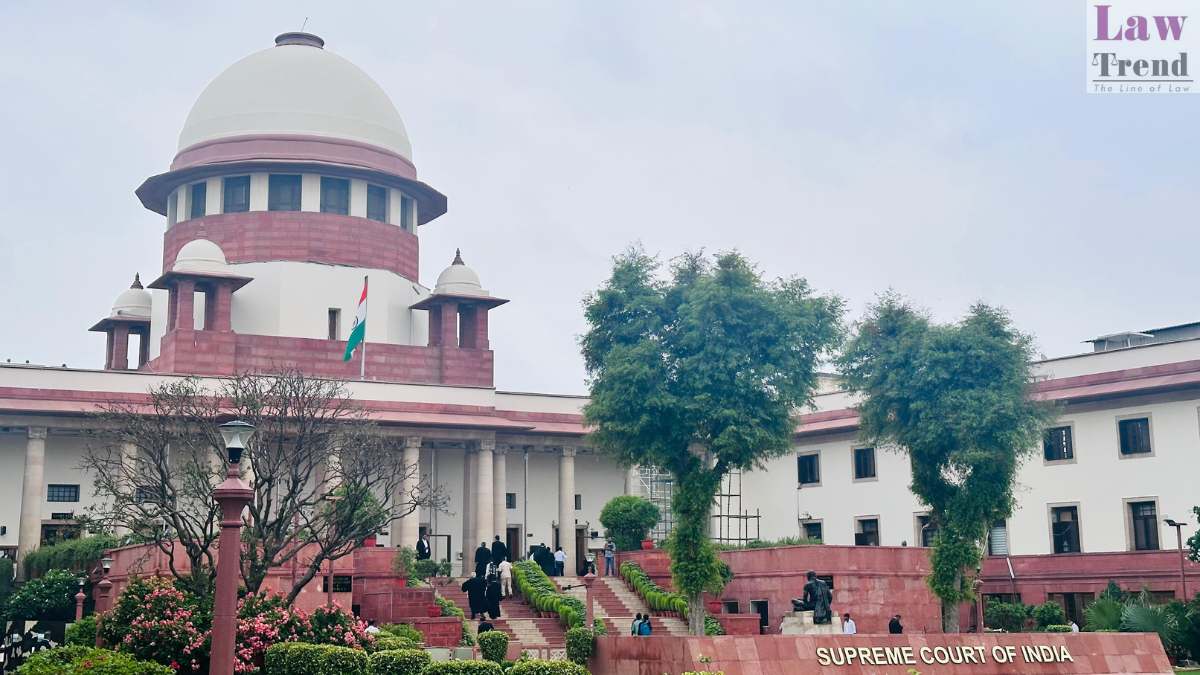
The Supreme Court on Tuesday directed that a high-level meeting be convened on May 6 to deliberate on the critical issue of fund utilisation by States and Union Territories for the installation of CCTV cameras in police stations across the country.
A bench comprising Justices Vikram Nath and Sandeep Mehta instructed senior advocate Siddhartha Dave, acting as amicus curiae in the suo motu matter, to lead the discussions involving the Union Government and all State and Union Territory administrations. The court’s intervention follows concerns regarding the lack of functional surveillance infrastructure in law enforcement facilities, a mandate originally issued by the apex court in 2018 to curb human rights abuses.
The primary focus of the upcoming meeting will be to scrutinize how funds allocated for this project are being deployed. Amicus Curiae Siddhartha Dave flagged the financial aspect to the bench, detailing the funding patterns currently in place.
According to Dave, the Centre provides 100 percent funding for Union Territories and 90 percent for hilly states. For all other states, the central government contributes 60 percent of the cost, while the remaining 40 percent is borne by the respective state governments.
“Why don’t we get responses of the states only on utilisation of funds?” the bench remarked, underscoring the need for accountability in the implementation phase.
The court has mandated a high level of representation for the May 6 meeting. “We are of the view that a meeting be convened by the amicus… in which the home secretary of the central government or his nominee not below the rank of joint or additional secretary and the home secretary of states/Union Territories will participate,” the bench ordered.
The amicus is required to submit a comprehensive report based on these deliberations. The matter has been posted for a follow-up hearing on May 13.
The case originated from a suo motu registration by the Supreme Court after taking cognisance of media reports regarding the absence of functional CCTVs in police stations.
In a landmark 2018 order, the top court mandated the installation of cameras to prevent custodial torture and protect human rights. This was expanded in December 2020, when the court directed that investigating agencies—including the CBI, ED, and NIA—must also install recording equipment at their offices.
The court’s specifications for these systems are stringent:
- Full Coverage: Cameras must be installed at all entry/exit points, main gates, lock-ups, corridors, lobbies, and reception areas.
- Technical Standards: Systems must feature night vision and record both audio and video.
- Data Retention: It is mandatory for storage systems to keep data for at least one year.
Earlier this month, on April 7, Attorney General R. Venkataramani informed the court that issues concerning the installations would be “sorted out within two weeks.” Furthermore, on February 26, the court had pushed for the creation of a centralised dashboard and the standardisation of CCTV infrastructure to ensure uniformity and ease of monitoring nationwide.




