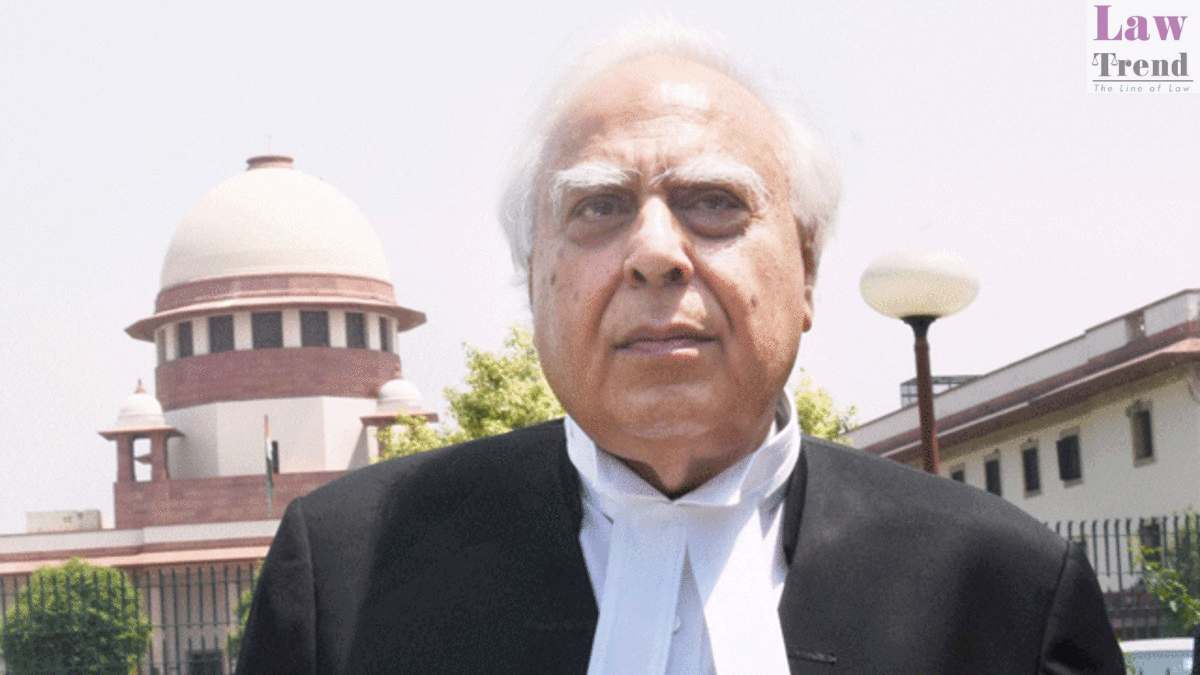
The Supreme Court on Tuesday (December 2, 2025) resumed the hearing on the bail pleas filed by former JNU scholar Umar Khalid, student activist Sharjeel Imam, and others in the “larger conspiracy” case linked to the 2020 North East Delhi riots.
A Bench comprising Justice Aravind Kumar and Justice N.V. Anjaria heard detailed arguments from Senior Advocates Kapil Sibal and Dr. Abhishek Manu Singhvi, appearing for the petitioners, who challenged the prolonged incarceration without trial and the lack of concrete evidence attributing any overt act of violence to the accused.
“8 Years Without Trial”: Sibal on Prolonged Incarceration
Appearing for Umar Khalid, Senior Advocate Kapil Sibal commenced his rejoinder arguments by highlighting the inordinate delay in the commencement of the trial. Khalid has been in custody since September 13, 2020, marking over five years of incarceration.
Sibal argued that the delay in the trial could not be attributed to the accused but was solely due to the prosecution’s “wilful refusal” to declare the investigation complete. He submitted:
“I was ready to argue on the charge, and the trial judge says no… The High Court order does not say that bail was denied to me because of delay. Delay in the trial was occasioned solely on account of the prosecution’s wilful refusal to make a statement that the investigation is complete.”
Pointing to the timeline, Sibal noted that while the prosecution claimed the investigation was ongoing, they filed four supplementary chargesheets, effectively stalling the framing of charges. He expressed a grim prognosis for his client’s liberty if bail were denied:
“Let’s assume your lordships dismissed it. I will be inside for another 3 years. That will be 8 years without a trial. I am an academic. I am an individual. I have not been attributed for any overt act.”
No “Overt Act” or “Regime Change” Evidence
Sibal emphasized that Khalid is implicated in the omnibus FIR (FIR 59/2020) solely based on an alleged “overall conspiracy” and not for any specific act of violence or recovery of weapons. He reiterated that Khalid was not present in Delhi when the riots occurred and that his speech in Amravati—often cited by the prosecution—spoke of “Gandhian principles” and was non-violent.
Senior Advocate Dr. Abhishek Manu Singhvi, appearing for the co-accused, attacked the Delhi Police’s core theory that the riots were a coordinated “regime change operation.” Singhvi argued that this narrative found no mention or substantiation in the chargesheet itself.
“Where have you alleged regime change as the heart of your chargesheet? What is the basis?” Singhvi asked, challenging the prosecution to show material evidence linking the accused to such a grand conspiracy or the specific allegation of supplying stones and weapons.
Prosecution’s Stance and Court’s Queries
The Delhi Police, represented by Additional Solicitor General (ASG) S.V. Raju, had earlier vehemently opposed the bail pleas, arguing that the riots were pre-planned and that the accused cited the Constitution merely as a facade for a deeper conspiracy.
During the hearing, ASG Raju contested the claim that the delay was the prosecution’s fault, suggesting that there were instances where the defense stated they would not argue on charges until the investigation was over.
“Don’t attribute unfairness to me,” the ASG remarked.
Justice Kumar intervened during the exchange regarding the delay, observing that in this case, the trial would commence only after the framing of charges, and queried the attribution of delay during the arguments on charge.
Status of the Hearing
The arguments on the bail pleas remained inconclusive. The hearing was scheduled to continue post-lunch, with the Bench examining the specific roles attributed to each accused and the legal tenability of continued incarceration under the Unlawful Activities (Prevention) Act (UAPA) when the trial has not yet commenced.