

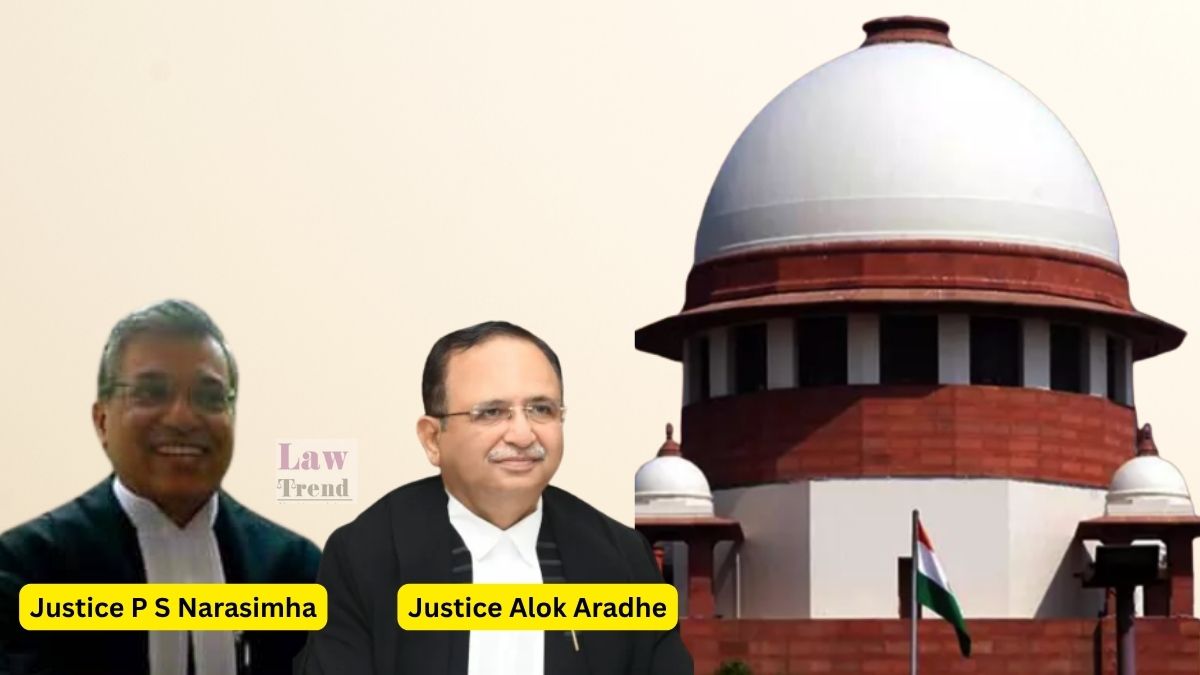
The Supreme Court has held that the principle protecting the finality of auction sales applies only when the auction itself has been conducted in accordance with law. A Bench of Justice Pamidighantam Sri Narasimha and Justice Alok Aradhe set aside the auction sale of an Ooty resort after finding multiple violations of the mandatory procedure under the SARFAESI Act and the Security Interest (Enforcement) Rules, 2002. The Court allowed the appeals filed by Sterling Holiday Resorts Limited and dismissed those filed by purchaser M/s P.M. Associates.
The dispute concerned ‘The Fernhill’, a resort situated at Ooty in Tamil Nadu, which Sterling Holiday Resorts had mortgaged in favour of IFCI and Tourism Finance Corporation of India Limited to secure loans. Following default, IFCI initiated proceedings under the Securitisation and Reconstruction of Financial Assets and Enforcement of Security Interest Act, 2002.
Auction Process And Subsequent Dispute
In March 2010, IFCI issued an auction notice fixing the reserve price of the resort at Rs 20 crore and scheduling the auction for April 28, 2010. However, on April 7, 2010, the Debts Recovery Appellate Tribunal restrained IFCI from proceeding further under the SARFAESI Act, subject to Sterling depositing Rs 1 crore. The company deposited the amount on April 8, bringing the restraint into operation.
Despite the restraint, IFCI received bids pursuant to the auction notice, though the bids were not opened at that stage. After the Madras High Court later set aside the DRAT order on September 6, 2011, IFCI opened the bids on September 12 and declared Rukmani Khemchand as the successful bidder.
The entire sale consideration of Rs 20,00,10,000 was paid on the same day by M/s P.M. Associates, a partnership firm, and a sale certificate was subsequently issued in favour of the firm.
Sterling subsequently cleared IFCI’s dues. IFCI then cancelled the sale certificate in February 2012 and refunded the purchase amount along with interest to P.M. Associates. The purchaser challenged the cancellation before the Madras High Court, which in 2013 held that the sale certificate had been validly issued and that the authorised officer had no power to unilaterally cancel it.
Both Sterling and the purchaser approached the Supreme Court.
Borrower Challenges Validity Of Auction
Senior advocates Abhishek Manu Singhvi and Rakesh Dwivedi, appearing for Sterling, argued that P.M. Associates was a stranger to the auction as the bid had been submitted by Rukmani Khemchand in her individual capacity. The partnership firm was constituted only on September 12, 2011, the day the bids were opened.
It was also argued that IFCI had proceeded with the auction despite the DRAT restraint and that a fresh sale notice should have been issued once the High Court decided IFCI’s writ petition in September 2011.
Senior advocate R. Guru Krishna Kumar, appearing for P.M. Associates, submitted that the authorised officer had no authority to cancel the sale certificate. He argued that Sterling’s right of redemption had already ended when the sale certificate was issued and that the borrower had suffered no prejudice because the property was ultimately acquired by a partnership firm rather than an individual.
SARFAESI Procedure Must Be Strictly Followed
The Supreme Court said the decisive question was whether the auction process beginning with the March 25, 2010 notice and culminating in the September 16, 2011 sale certificate had been conducted according to law.
Referring to Rules 8 and 9 of the Security Interest (Enforcement) Rules, the Court stressed that the statutory procedure governing the sale of secured assets is mandatory.
“Rules 8 and 9 of the Rules are mandatory and must be scrupulously followed.”
The Court explained that the procedural safeguards assume particular importance because the SARFAESI Act allows a secured creditor to take possession of and sell a borrower’s property without intervention of a court.
“The safeguards are thus the very condition upon which the power exists.”
Bid Received In Violation Of DRAT Restraint
The Court found that the bid submitted by Rukmani Khemchand was received after the DRAT restraint had become operative.
It rejected the argument that IFCI had merely received the bids without opening them, holding that receiving a bid and earnest money itself formed part of the sale process.
“A bid received in contravention of a subsisting restraint cannot form the foundation of a valid sale.”
The subsequent High Court judgment in IFCI’s favour, the Court held, could not retrospectively validate an act performed when the restraint order was still in force.
Mandatory 30-Day Period Was Cut Short
The Court also found violation of Rule 9(1), which prohibits a sale before the expiry of 30 days from publication of the sale notice or service of notice upon the borrower.
Only 13 days had elapsed between the March 25 auction notice and the DRAT restraint of April 7. Once the period during which the restraint operated was excluded, Sterling was entitled to the remaining 17 days after the High Court judgment of September 6, 2011.
That period would have expired on September 23. However, the bids were opened on September 12 and the sale certificate was issued on September 16.
“This is not a technical lapse. The thirty days’ window is the very period in which the borrower may exercise the right of redemption; truncating it strikes at the substantive right that Section 13(8) protects.”
The Court further noted that Sterling received no notice that the bids would be opened on September 12, around 17 months after the originally scheduled auction date.
It held that conducting the sale behind the borrower’s back after such a long gap defeated the purpose of the statutory notice requirements and the fairness expected in exercise of the statutory power of sale.
Sale Certificate Could Not Be Issued To Non-Bidder
Another defect identified by the Supreme Court was the issuance of the sale certificate to P.M. Associates even though Rukmani Khemchand had participated in the auction in her individual capacity.
The Court noted that neither Rule 9 nor the auction notice permitted a successful bidder to nominate a third party to receive the property.
P.M. Associates, moreover, did not even exist on the original auction date of April 28, 2010 and was constituted only on September 12, 2011.
“An entity which did not exist when bids were invited and received could neither have been assessed for eligibility nor have participated in the auction.”
The Court also noted the absence of original auction records and any record of inter se bidding among eligible bidders, despite such bidding being required by the auction notice where more than one eligible bidder existed.
‘Sanctity Is The Reward Of Legality’
Considering the defects cumulatively, the Supreme Court held that the sale violated both the statutory Rules and the terms of the auction notice.
“No sanctity in law can be attached to such an auction process.”
While acknowledging earlier decisions emphasising the need to preserve certainty and finality in confirmed auction sales, the Court said such protection presupposes a legally conducted auction.
“Sanctity is the reward of legality, not a substitute for it.”
The Court also noted that Sterling had discharged IFCI’s entire dues, possession of the resort had always remained with Sterling, and P.M. Associates had accepted and encashed the refund of its sale consideration with interest. It rejected the purchaser’s allegation of collusion between Sterling and IFCI.
Referring to Article 300A of the Constitution, the Bench further observed that property can be taken away only by authority of law.
“A sale that disregards the procedure mandated by the statute is not a deprivation by the authority of law.”
Having found that the auction process itself was illegal, the Supreme Court said it was unnecessary to decide the separate questions concerning the authorised officer’s power to cancel a sale certificate, registration of the certificate, or the precise point at which the borrower’s right of redemption stood extinguished.
The Court accordingly set aside the Madras High Court’s August 23, 2013 judgment, allowed Sterling’s appeals and dismissed P.M. Associates’ appeals. It also declined to proceed with the contempt petitions and dismissed the connected special leave petition relating to Sterling’s amalgamation with Thomas Cook (India) Limited as having become infructuous. No order as to costs was passed.
Case Title: Sterling Holiday Resorts Limited v. M/s P.M. Associates & Ors.
Case No.: Civil Appeal Nos. 10077-10078 of 2014 with connected matters
Bench: Justice Pamidighantam Sri Narasimha and Justice Alok Aradhe
Date: September 30, 2026




