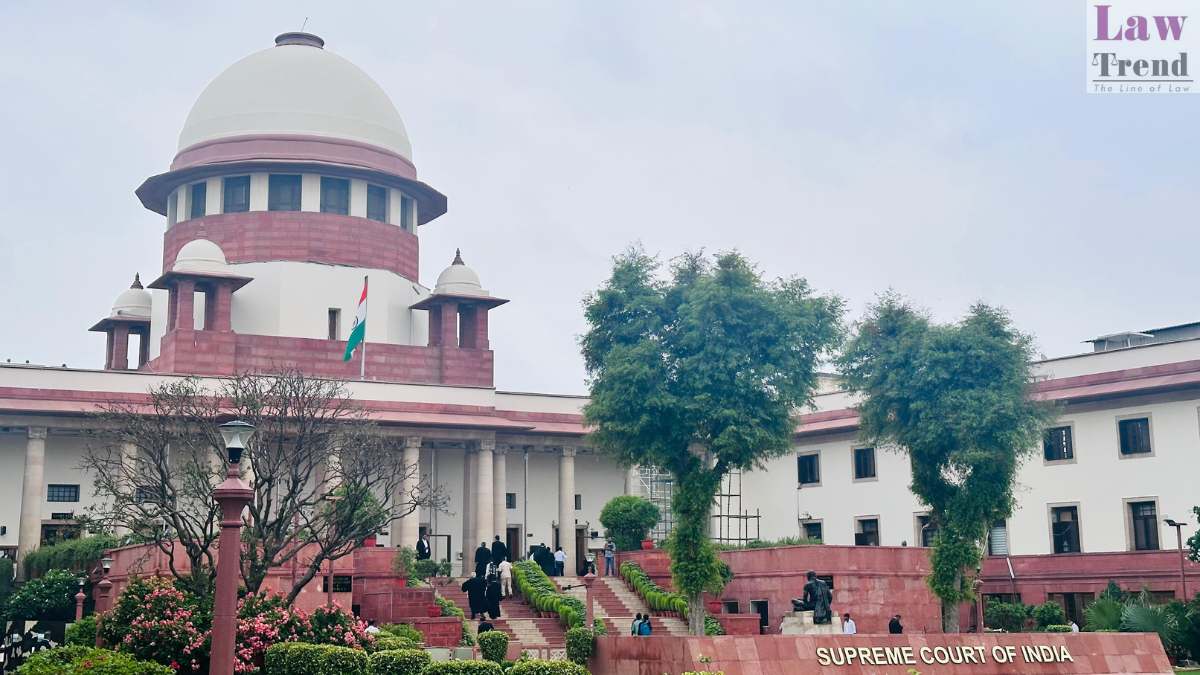
The Supreme Court of India has set aside a judgment of the Patna High Court and ruled that the retrospective application of an amendment to recruitment rules, specifically introduced after the publication of a provisional merit list, is impermissible. The Court held that “the rules of the game cannot be changed once the game has begun.”
In the judgment delivered on January 6, 2026, a Bench comprising Justice J.K. Maheshwari and Justice Vijay Bishnoi allowed the appeal filed by Abhay Kumar Patel & Ors. against the State of Bihar & Ors. (Civil Appeal arising out of SLP (C) No. 22323 of 2023). The Court directed the respondents to finalize appointments for the post of Assistant Engineers strictly following the unamended Bihar Engineering Services Class-II Recruitment Rules, 2019, within two months.
Background of the Case
The dispute centered on the recruitment of Assistant Engineers (Civil, Mechanical, and Electrical) initiated by the Bihar Public Service Commission (BPSC) through four advertisements issued in 2019. The recruitment was governed by the 2019 Rules, which stipulated that selection would be based solely on the marks obtained in a written examination.
The selection process commenced, and the written examination was conducted on March 12, 2022. Following this, the BPSC published provisional merit lists in June and July 2022, and candidates were called for document verification.
However, on November 9, 2022, after the merit lists were published, the State Government issued the Bihar Engineering Service Class-II Recruitment (Amendment) Rules, 2022. This amendment introduced Rule 8(5), which altered the basis of selection by:
- Reducing the weightage of the written examination to 75 marks.
- Granting a maximum of 25 additional marks for work experience on a contractual basis.
- Providing age relaxation for contractual employees.
Crucially, the State made these 2022 Amendment Rules applicable retrospectively from March 6, 2019—the date the original 2019 Rules came into force.
The appellants, who had secured places in the provisional merit list under the original criteria, challenged this retrospective application before the Patna High Court. On July 5, 2023, the High Court dismissed their writ petition (CWJC No. 18302 of 2022), observing that the amendment was a policy decision to grant weightage to contractual employees and that the appellants had no indefeasible right to appointment.
Arguments of the Parties
Appearing for the appellants, Senior Advocate Mr. Vijay Kumar argued that the selection process must be governed by the stipulations existing on the date of the advertisement. He contended that the 2019 Rules originally prescribed selection solely on the basis of the written examination. The appellants argued that applying the 2022 Amendment Rules retrospectively, after the document verification stage, essentially altered the merit list to the detriment of meritorious candidates.
The appellants relied on the principle that “rules of the game cannot be changed once the game has begun,” citing the Supreme Court’s decisions in K. Manjusree v. State of Andhra Pradesh and Tej Prakash and Others v. Rajasthan High Court and Others.
Per contra, Mr. Anshul Narayan, Additional Standing Counsel for the State, submitted that the amendment was a policy decision aligned with executive memorandums from 2018 and 2021 to recognize the services of contractual employees. The State argued that the power to frame rules under Article 309 of the Constitution of India includes the power to legislate retrospectively to rectify anomalies. It was further contended that the merit list was merely provisional and conferred no indefeasible right to appointment.
Court’s Analysis
The Supreme Court rejected the State’s contentions. Justice Maheshwari, writing for the Bench, analyzed Rules 8, 9, 12, and 13 of the unamended 2019 Rules and noted that “suitability of the candidates for the purpose of appointment as per the 2019 Rules has to be determined only as per marks obtained in the written examination.”
The Court observed that the recruitment process was at its “fag end” when the amendment was introduced. The Bench relied on the Constitution Bench decision in Tej Prakash Pathak, reiterating that “Eligibility criteria for being placed in the select list, notified at the commencement of the recruitment process, cannot be changed midway through the recruitment process.”
Addressing the retrospective nature of the amendment, the Court held:
“The issuance of the 2022 Amendment Rules, introducing Rule 8(5) with retrospective effect from 06.03.2019, attempts to rewrite the rules of the game which has already begun. By reducing the weightage of the written examination to 75 marks and introducing 25 marks for contractual experience, the State has fundamentally altered the basis of selection…”
The Court termed the High Court’s finding—that the amendment was merely a policy decision applicable to the ongoing process—as “completely erroneous.” The judgment stated:
“While the State undoubtedly has the power to amend rules under the proviso to Article 309 of the Constitution of India… The power of retrospective legislation cannot be exercised to take away vested rights or to arbitrarily disrupt a selection process that has already resulted in the identification of successful candidates by publication of a provisional merit list.”
Regarding the State’s reliance on executive memorandums, the Court noted that the statutory 2019 Rules did not incorporate these resolutions at the time of the advertisements, and the State cannot rely on executive instructions to override statutory rules ex post facto.
Decision and Directions
The Supreme Court allowed the appeal and set aside the Patna High Court’s order dated July 5, 2023. The Court issued the following key directions:
- Finalization of Appointments: The respondents are directed to finalize appointments strictly following the unamended 2019 Rules, based on the merit lists published in June/July 2022. This must be completed within two months.
- Exclusion of 2022 Amendment: The process must be completed “without taking into account the 2022 Amendment Rules by which the weightage and age relaxation for contractual experience was introduced.”
- Status of Existing Appointments: The Court noted that appointments made pursuant to the impugned High Court judgment may be dispensed with in accordance with law. However, the Court clarified:
“…the directions as issued shall not have any adverse impact if the State of Bihar wishes to continue the services of the persons appointed as above, if they are deemed fit, on the vacancies available, if any, or by creating supernumerary posts without affecting the merit list as indicated above.”
In a connected matter (Special Leave Petition (Civil) No. 8231 of 2025), titled Uttam Kumar & Ors v. The State of Bihar & Ors., the Court directed the Patna High Court to adjudicate the challenge to the validity (vires) of Rule 8(5) itself on its merits, clarifying that the present judgment was limited only to the applicability of the amendment to the 2019 advertisements.