

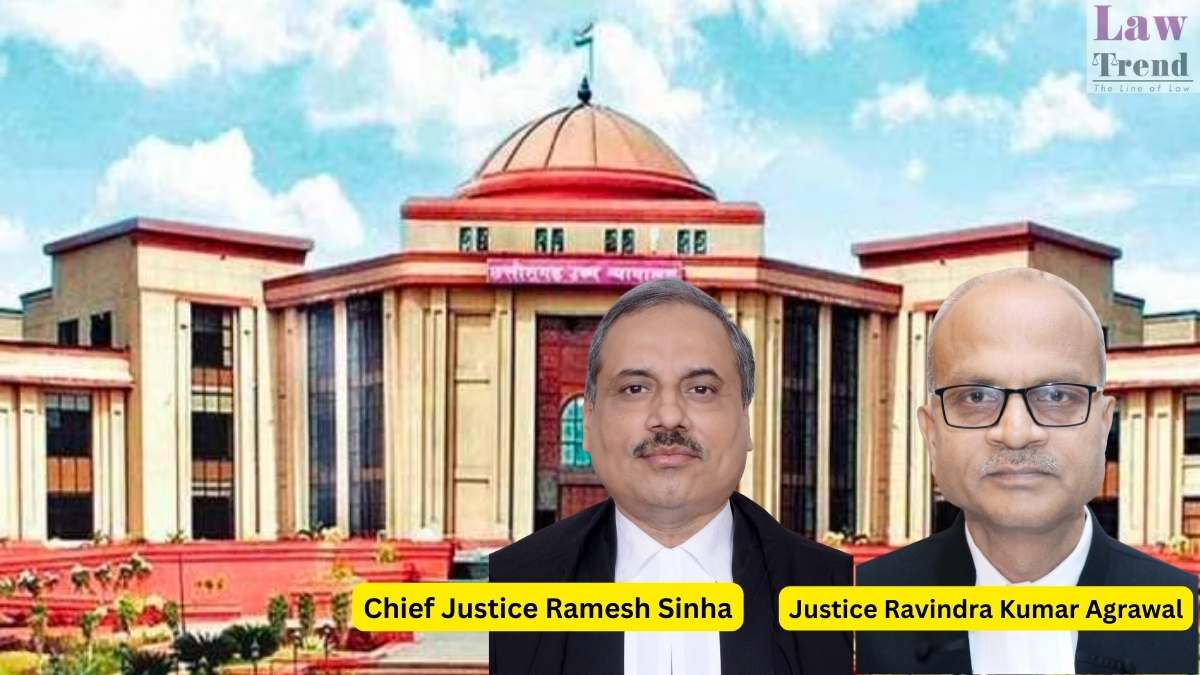
The High Court of Chhattisgarh has declared the Chhattisgarh Molasses Control and Regulation Rules, 2022, as ultra vires to the Constitution of India, emphasizing that subordinate legislation cannot travel beyond the object of its parent Act. A Division Bench comprising Chief Justice Ramesh Sinha and Justice Ravindra Kumar Agrawal held that the state government lacks the legislative competence to regulate molasses used for non-intoxicant purposes, such as cattle feed and industrial applications, under the Chhattisgarh Excise Act, 1915.
Legal Issue
The primary legal question was whether the State, under the guise of its power to control “intoxicating liquors” (Entry 8, List II) and “excisable articles” (Entry 51, List II), could impose an excise licensing and duty regime on molasses—a sugar industry by-product—when used for non-intoxicating commercial purposes.
The court adjudicated a batch of writ petitions led by M/s Kedia Trading v. State of Chhattisgarh (WPC No. 3580/2022). The petitioners, primarily traders in cattle feed and gudakhu (tobacco products), challenged the 2022 Rules which mandated excise licenses and a duty of ₹200 per ton. They argued that molasses, in its raw form, is neither an “intoxicant” nor “potable” and only acquires intoxicating properties after a complex fermentation process.
Arguments of the Parties
Petitioners: Senior Advocate Manoj Paranjpe argued that molasses does not fall within the definitions of “excisable article,” “intoxicant,” or “intoxicating drug” under Section 2 of the Excise Act. He pointed out that the inclusion of molasses under the GST regime (initially at 28%, later 5%) confirms it is treated as a neutral commodity rather than an intoxicant, as the latter is excluded from GST under Section 9 of the CGST Act.
State of Chhattisgarh: Additional Advocate General Shashank Thakur contended that since molasses is a “base” for manufacturing liquor, the state must regulate it to prevent illegal distillation and revenue loss. He relied on Section 8(c) of the Excise Act, which empowers the state to control “any other base” utilized for liquor manufacture.
Court’s Analysis and Headnote Principle
The High Court focused on the relationship between the parent Act and the delegated Rules. It observed that the Preamble of the Chhattisgarh Excise Act is limited to “intoxicating liquor” and “intoxicating drugs,” categories to which raw molasses does not belong.
Regarding the state’s reliance on the term “any other base” in Section 8(c), the Court remarked:
“This Court is unable to accept that the expression ‘any other base’ can be stretched to include molasses in its raw, non-intoxicant form. Such interpretation would override the definition provisions, expand the Act beyond its object, and further violate settled principles of statutory interpretation.”
The Bench highlighted that the 2022 Rules attempted to regulate two distinct categories: distillation use (which is within the State’s domain) and industrial/agricultural use. The latter, the Court found, “clearly falls outside the Excise domain.”
Crucially, the Court applied a fundamental principle of administrative law, as reflected in the judgment’s headnote:
“Any Rules/Legislation framed cannot enlarge the scope of its parent statute and cannot travel beyond the Preamble or the object for which the said Rules/Legislation is framed.”
The Court cited the Supreme Court’s recent 9-judge bench ruling in State of Uttar Pradesh v. Lalta Prasad Vaish, noting that while the state has broad regulatory powers over the industry of intoxicating liquor, this does not permit the regulation of final products or raw materials that do not yet possess intoxicating effects.
The Decision
Declaring the Rules ultra vires, the Court held that the State cannot compel ordinary traders to obtain excise licenses for non-intoxicant molasses.
“The Rules of 2022 extend control to non-intoxicant uses, impose licensing and duty, regulate ordinary trade activity. This clearly travels beyond the scope of the Excise Act and is therefore ultra vires.”
All writ petitions were allowed, and the petitioners were granted consequential reliefs.
Case Details:
- Case Title: M/s Kedia Trading v. State of Chhattisgarh & Ors. (and connected matters)
- Case Number: WPC No. 3580 of 2022
- Bench: Chief Justice Ramesh Sinha and Justice Ravindra Kumar Agrawal
- Date: March 27, 2026




