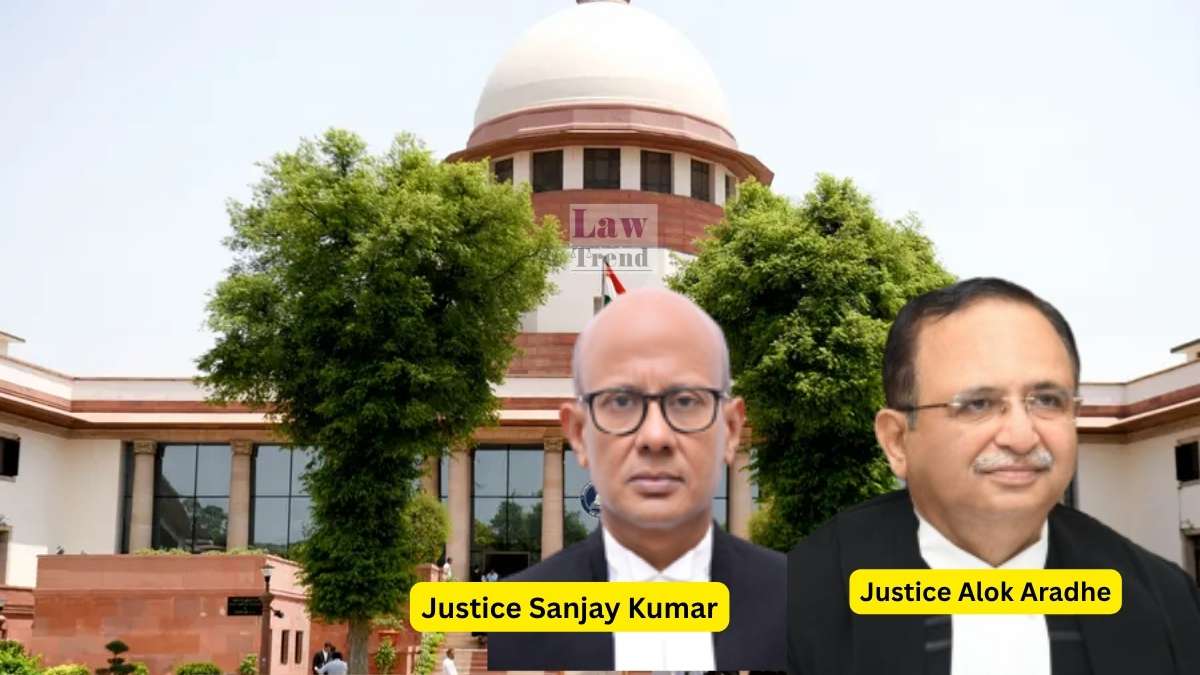
The Supreme Court of India has granted regular bail to Arvind Dham, the former promoter and non-executive Chairman of Amtek Auto Ltd. (AAL), in a money laundering case investigated by the Directorate of Enforcement (ED). The Division Bench, comprising Justice Sanjay Kumar and Justice Alok Aradhe, set aside the Delhi High Court’s order rejecting bail, observing that prolonged incarceration without the commencement of trial violates the fundamental right to liberty and speedy trial under Article 21 of the Constitution.
The core legal issue before the Court was whether the gravity of an economic offence under the Prevention of Money Laundering Act (PMLA) justifies prolonged incarceration when the trial has not commenced and is unlikely to conclude soon. The Supreme Court ruled in the affirmative for bail, emphasizing that statutory restrictions under Section 45 of the PMLA cannot supersede the constitutional right to a speedy trial. Consequently, the Court quashed the High Court’s order dated August 19, 2025, and directed the appellant’s release.
Background of the Case
The case originated from First Information Reports (FIRs) registered on December 21, 2022, at the instance of IDBI Bank and Bank of Maharashtra. The FIRs alleged offences under Sections 120B, 420, 406, and 468 of the Indian Penal Code (IPC) and Sections 13(2) and 13(1)(d) of the Prevention of Corruption Act, 1988. The allegations involved bank frauds amounting to INR 385.35 crores and INR 289 crores, respectively.
Based on these predicate offences, the Directorate of Enforcement registered two Enforcement Case Information Reports (ECIRs) on March 21, 2023, alleging money laundering. The gravamen of the allegation against Arvind Dham was that he was the “ultimate beneficiary” of a well-orchestrated scheme executed at his behest, involving the diversion and siphoning of public funds through layered entities, resulting in wrongful loss to Public Sector Banks.
Dham appeared before the ED on June 19, 2024, in response to summons, and was subsequently arrested on July 9, 2024. A prosecution complaint was filed on September 6, 2024, followed by a supplementary complaint on August 2, 2025, against 40 accused persons.
Dham moved the Special Judge for bail, which was dismissed on January 21, 2025. Subsequently, he approached the Delhi High Court under Section 483 of the Bharatiya Nagarik Suraksha Sanhita (BNSS) read with Section 45 of the PMLA. The High Court rejected his application for regular bail on August 19, 2025, leading to the present appeal before the Supreme Court.
Arguments of the Parties
Appellant’s Submissions: Learned senior counsel for Arvind Dham submitted that the appellant is 64 years old and suffers from multiple ailments. It was argued that he had been in custody for approximately 16 months and 20 days, and his long incarceration violated his right to liberty under Article 21.
Key arguments included:
- Conclusion of Investigation: The counsel pointed out that the investigation qua the appellant stands concluded, citing the Special Court’s order dated August 20, 2025.
- Delay Attributable to Prosecution: It was contended that an eight-month delay in the trial was attributable to the ED, which had filed a petition before the High Court challenging a notice issued to proposed accused persons. This petition led to a stay on proceedings before the Special Judge until it was withdrawn by the ED on May 23, 2025.
- Cooperation: The counsel asserted that the appellant had cooperated with the investigation. The allegation of influencing witness Ms. Anuradha Kapur was termed “incredulous,” as Dham was already in custody when she was arrayed as a witness.
- No Dissipation of Assets: It was submitted that the appellant had no knowledge of the dissipation of properties at Panipat and Alwar and was not a Director of M/s. Marichika Properties.
Respondent’s Submissions: The learned Additional Solicitor General, appearing for the ED, opposed the bail, arguing:
- Gravity of Offence: The gravity of the offence disentitled the appellant from seeking exemption from the mandatory twin conditions under Section 45 of the PMLA.
- Witness Tampering: It was alleged that the appellant is an influential person who instructed his cousin, Ms. Anuradha Kapur, a “dummy director,” not to join the investigation.
- Dissipation of Proceeds: The ED claimed the appellant dissipated proceeds of crime, specifically immovable properties, after attachment.
- Nature of Delay: The ED argued that the delay was attributable to the appellant and that mere incarceration cannot be the sole ground for bail in serious offences.
Court’s Analysis
The Supreme Court, while allowing the appeal, made several significant observations regarding bail jurisprudence in economic offences.
On Gravity of Offence vs. Article 21 The Bench acknowledged that the gravity of the offence is a relevant factor but observed that it must be considered alongside the term of the sentence and attending circumstances. The Court stated:
“The right to speedy trial, enshrined under Article 21 of the Constitution, is not eclipsed by the nature of the offence. Prolonged incarceration of an undertrial, without commencement or reasonable progress of trial, cannot be countenanced, as it has the effect of converting pretrial detention into form of punishment.”
The Court further held that economic offences cannot be classified as a “homogeneous class” to deny bail solely on the ground of seriousness.
On Delay in Trial The Court noted that out of 28 individuals, only the appellant had been arrested. It found that the trial had not commenced, cognizance had not been taken, and the matter was still at the stage of scrutiny of documents.
Regarding the cause of delay, the Court explicitly held:
“The respondent challenged the said order dated 07.09.2024 before the High Court, resulting in eight months stay of proceedings, before the Special Judge, which was lifted on 23.05.2025 only upon withdrawal of the petition. The delay in the trial is thus attributable only to the respondent, not the appellant.”
On Tampering and Dissipation of Assets The Court dismissed the ED’s apprehensions regarding witness tampering and asset dissipation.
- Witness Tampering: The Court found the allegation concerning Ms. Anuradha Kapur “wholly incredulous,” noting that the appellant was in custody since July 9, 2024, while Ms. Kapur was arrayed as a witness only on August 2, 2025.
- Asset Dissipation: Regarding the properties of M/s Marichika Properties, the Court observed that “no material link to the appellant has been established” and there was no evidence he was a signatory to any sale document. The Court termed the allegation “untenable at this stage.”
Decision
The Supreme Court quashed and set aside the judgment and order of the Delhi High Court dated August 19, 2025. The Court directed that Arvind Dham be released on bail during the pendency of the trial in ECIR Case Nos. ECIR/GNZO/13/2024 and ECIR/GNZO/14/2024.
Conditions Imposed:
- The terms and conditions for bail shall be fixed by the Trial Court.
- The appellant must provide a telephone/mobile number to ED officers to ascertain his whereabouts.
- The appellant must surrender his passport to the Trial Court.
- The appellant shall not leave India without the permission of the Trial Court.
Case Details
- Case Title: Arvind Dham v. Directorate of Enforcement
- Case Number: Criminal Appeal No. of 2026 (@S.L.P. (Crl.) No. 15478 of 2025)
- Bench: Justice Sanjay Kumar and Justice Alok Aradhe