

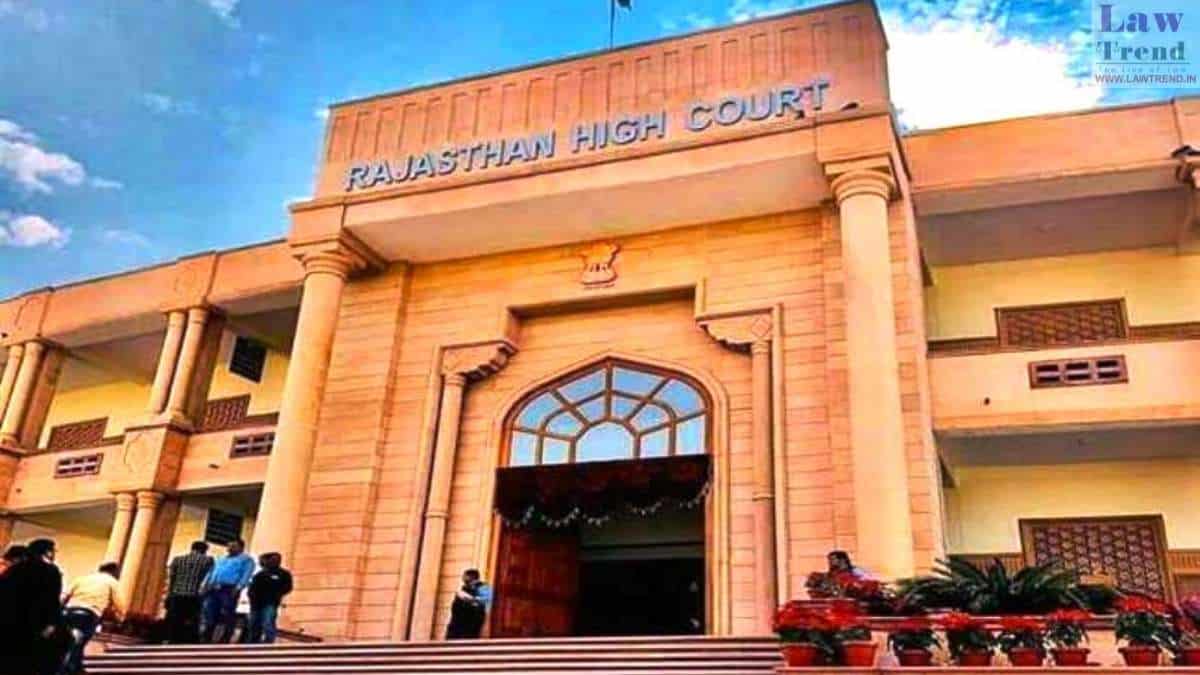
The Rajasthan High Court has held that the failure to produce an accused, in person or through audio-video electronic means, when his judicial custody is extended does not by itself make the detention illegal or entitle him to bail under Section 187(4) of the Bharatiya Nagarik Suraksha Sanhita (BNSS). On that basis, the Court dismissed the bail plea of a 19-year-old accused in a POCSO case.
Justice Sanjeet Purohit also directed the trial court to try to finish the trial within six months, considering the applicant’s young age.
Background
The applicant was booked in Nagaur district under Sections 137(2), 64(2)(m) and 127(4) of the Bharatiya Nyaya Sanhita, 2023, and Sections 3/4 of the POCSO Act. According to the FIR filed by the victim’s father, the applicant lured away and abducted his 14-year-old daughter on February 15, 2026. The two were later traced by the police and brought back to Nagaur.
Arguments Before the Court
Advocate Tapendra Sankhla, appearing for the applicant, argued that the applicant and the victim were in a consensual relationship. He said she had stayed with him for over a month in Nippani, Karnataka, without raising any alarm.
He also challenged the legality of the arrest and remand. According to him, the applicant was taken into custody on March 15, 2026, but his formal arrest was shown only on March 19. He further argued that the applicant’s judicial custody was extended without producing him, in violation of the proviso to Section 187(4) of the BNSS. Relying on Vihaan Kumar v. State of Haryana, he submitted that the grounds of arrest had not been communicated, in breach of Article 22(1) of the Constitution and Section 47 of the BNSS. He also pointed to inconsistencies in the victim’s statements and the absence of visible injuries in the medical examination.
Additional Advocate General Deepak Choudhary, appearing with Public Prosecutor Sameer Pareek, opposed the plea. He cited the gravity of the offences and the fact that the victim was 14 years and 5 months old at the time of the incident.
Rajasthan High Court on Section 187(4) BNSS
The Court found no material on record to support the claim of illegal detention between March 15 and 19, 2026. It noted that the claim had been specifically denied in the Investigating Officer’s counter-affidavit. On the remand issue, the Court noted that the applicant had been produced physically before the remand Magistrate. The dispute was limited to the link court’s order of March 28, 2026, which extended judicial custody in his absence.
The Court said this order did not authorise detention afresh. It only extended custody already authorised by the competent court. Explaining the difference between the words “shall” and “may” in Section 187(4), the Court observed that “This distinction reflects the legislative intent to make physical production of the accused mandatory before an order of police remand is passed, while providing procedural flexibility in cases of judicial remand.”
The Court held, “Mere non-production, whether physically or through audio-video electronic means, would not, in itself, render the detention illegal so as to entitle the accused to release on bail.” It relied on the Karnataka High Court’s ruling in D. Gundappa v. State of Karnataka and the Allahabad High Court’s decision in Ashish Shakya (Dr) v. CBI.
Grounds of Arrest
The Court noted that the arrest memo recorded the FIR particulars and the offences alleged, and that it had been served on the applicant. It relied on the Supreme Court’s decision in State of Rajasthan v. Jhabra Ram, which held that “A hyper-technical objection regarding the form or mode of communicating grounds of arrest cannot be treated as a self-executing, blanket key to unlock regular bail.” The Court said the applicant had not shown that any prejudice was caused to him, so the objection did not independently warrant bail.
Consent of Minor
The Court rejected the plea of a consensual relationship, observing, “Admittedly, the victim was only 14 years old at the relevant time and, therefore, her consent has no legal recognition.” It added that her failure to raise an alarm could not by itself be read as consent, since she had stated that she was threatened during her stay.
The Court declined to assess the alleged inconsistencies in detail, leaving that to the trial court. It noted that the victim had consistently levelled allegations of sexual assault against the applicant.
Outcome
Considering the victim’s age, the nature of the allegations and the material on record, the Court dismissed the bail application. It directed the trial court to try to conclude the trial within six months of receiving a certified copy of the order. The Court clarified that its observations are limited to the bail application.
Case No.: S.B. Criminal Miscellaneous Bail Application No. 5860/2026
Bench: Justice Sanjeet Purohit
Date: November 18, 2026


