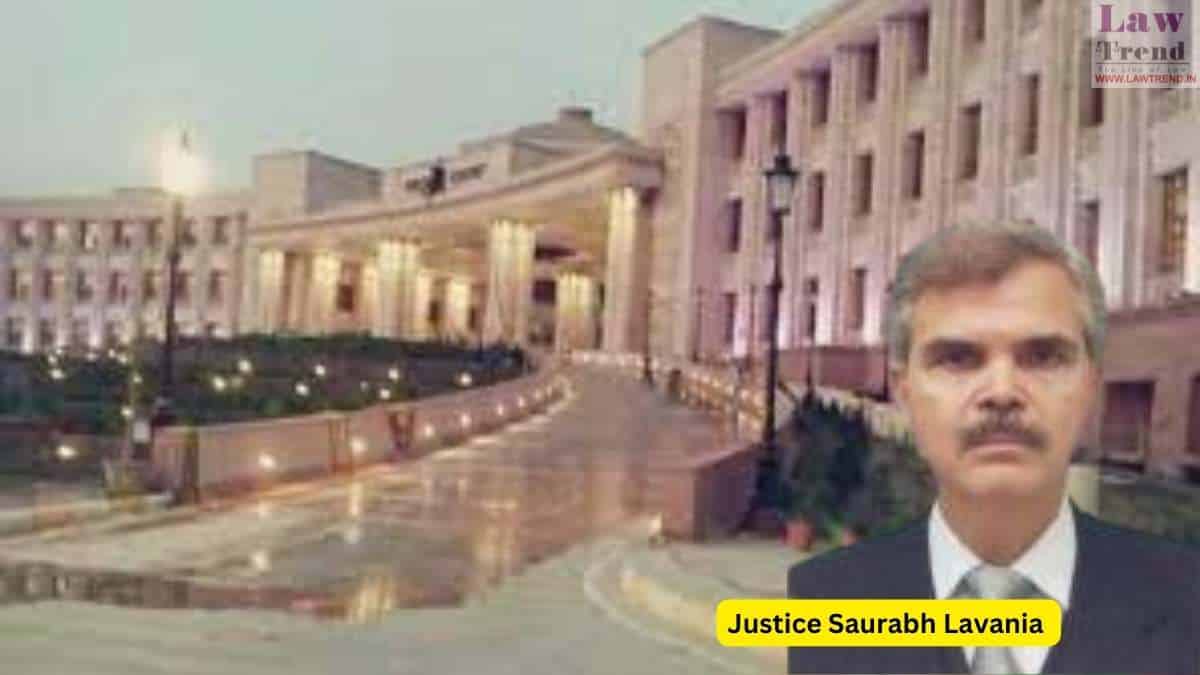
The Lucknow Bench of the Allahabad High Court has rejected the bail application of an accused involved in a “daylight double murder case,” ruling that the mere absence of written grounds of arrest at the time of apprehension does not entitle an accused to bail if they were aware of the grounds and no “demonstrable prejudice” was caused.
Presiding over the case, Justice Saurabh Lavania, observed that while the communication of grounds of arrest is a mandatory constitutional safeguard, procedural lapses—specifically those occurring before the Supreme Court’s mandate for written communication became prospective—do not automatically render an arrest illegal.
Background of the Case
The applicant, Sunil Kumar Shukla, sought bail in Case Crime/FIR No. 607 of 2022, registered under Sections 302, 323, 34, and 504 of the IPC at Police Station Ramkote, District Sitapur. The FIR, lodged on November 25, 2022, by Smt. Munish Kumari Shukla, alleged that the applicant and his sons caused fatal injuries with a ‘Farsha’ (axe) and ‘Kulhadi’ to Manish Kumar Shukla and Munendra Shukla, both of whom died on the spot.
The applicant’s primary contention for seeking bail was the alleged violation of Article 22(1) of the Constitution of India and Section 50 of the Cr.P.C., claiming that the reasons for his arrest were not communicated to him in writing.
Arguments of the Parties
The learned counsel for the applicant argued that the failure to furnish written grounds of arrest violated the applicant’s fundamental rights. They relied on recent legal developments emphasizing the necessity of written communication to ensure the arrestee can effectively seek legal counsel and oppose remand.
Opposing the bail, the learned Government Advocate, Dr. V.K. Singh, argued that the grounds of arrest were indeed communicated to the applicant on the date of his arrest (November 26, 2022). The State presented the arrest memo and the ‘Giriftari Suchna Praptra’ (information of arrest form), which indicated that the applicant was informed of the offences under Section 302 IPC. The State further highlighted the gravity of the offence, noting that the applicant was assigned the specific role of causing fatal injuries in a daylight double murder.
Court’s Analysis and Cited Precedents
The Court conducted an extensive review of recent Supreme Court rulings regarding Article 22(1) and the mode of communicating grounds of arrest:
- Ram Kishor Arora v. ED (2024): The Court noted the Supreme Court’s clarification that the requirement to furnish grounds of arrest in writing was made mandatory “henceforth” from the date of the Pankaj Bansal judgment. Therefore, non-furnishing in writing before that date was not necessarily fatal if the person was informed.
- State of Karnataka v. Sri Darshan (2025): The Court highlighted the “prejudice-oriented test,” noting that “the mere absence of written grounds does not ipso facto render the arrest illegal, unless it results in demonstrable prejudice or denial of a fair opportunity to defend.”
- Mihir Rajesh Shah v. State of Maharashtra (2026): The Court acknowledged the Supreme Court’s recent conclusion that grounds must be communicated in writing in the language the arrestee understands. However, it noted that this procedure was directed to govern arrests “henceforth.”
The Court observed that in the present case, the arrest took place in 2022. It found that the arrest memo and related documents indicated the applicant “was aware of the grounds of his arrest from the outset.”
The Court further stated:
“Delay in furnishing the grounds of arrest cannot, by itself, constitute a valid ground for grant of bail… In the absence of demonstrable prejudice, such as irregularity is, at best, a curable defect and cannot, by itself, warrant release on bail.”
The Decision
Taking into account the specific role attributed to the applicant—causing fatal injuries to two persons in a daylight double murder—and finding no evidence of prejudice caused by the alleged procedural lapse, the Court declined to enlarge the applicant on bail.
“This Court is not inclined to enlarge the applicant on bail on the ground of violation of Article 22(1) of the Constitution of India,” the judge ruled, while directing the trial court to conclude the proceedings “most expeditiously.”
Case Details:
- Case: Criminal Misc. Bail Application No. 928 of 2026
- Parties: Sunil Kumar Shukla vs. State of U.P.
- Judge: Justice Saurabh Lavania
- Date of Order: March 11, 2026