

Power to Correct Clerical Errors in Arbitral Awards Cannot Be Used to Substantially Modify Them by Substituting Simple Interest with Compound Interest: Supreme Court
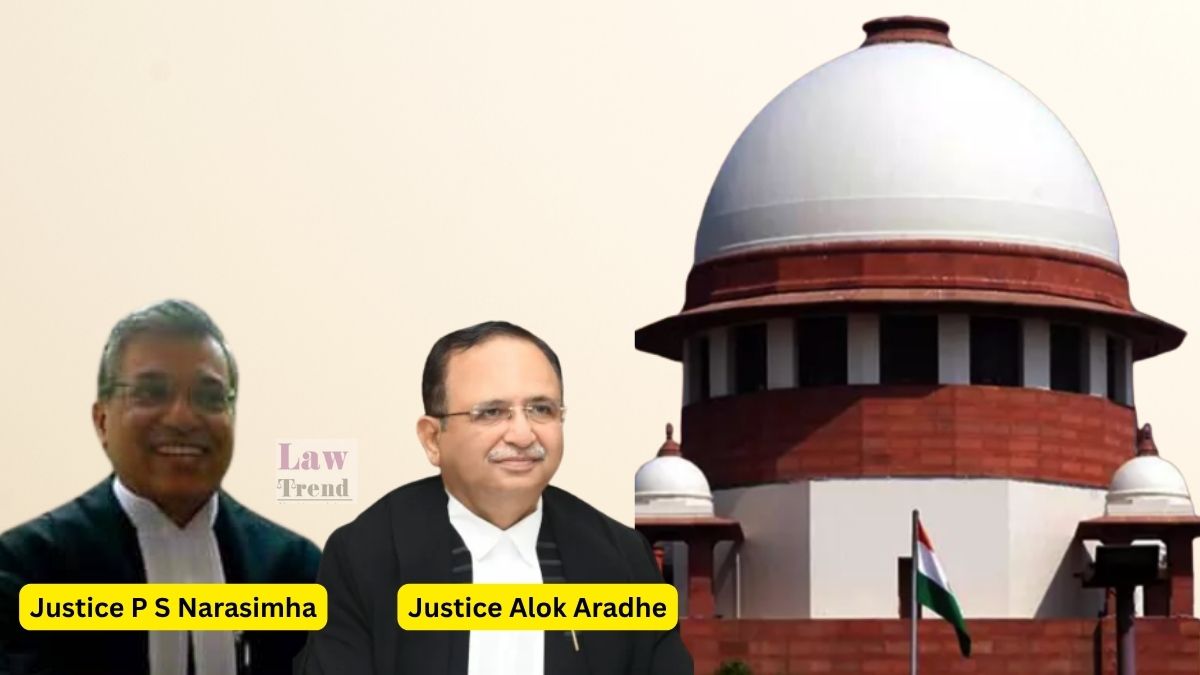
The Supreme Court of India has ruled that the power of an arbitral tribunal or a court to correct computational, clerical, or typographical errors in an arbitral award under Section 33(1)(a) of the Arbitration and Conciliation Act, 1996 cannot be used to make substantive modifications to the award, such as substituting simple interest with compound interest.

A Division Bench comprising Justice Pamidighantam Sri Narasimha and Justice Alok Aradhe set aside the judgments of the Gujarat High Court and the Commercial Court, restoring the sole arbitrator’s original award of simple interest at 21.675% per annum for the pendente lite period. The Court held that changing the nature of interest is a substantive determination on merits and does not constitute a clerical slip. Furthermore, the Court rejected the appellant’s objections regarding the expiry of the arbitrator’s mandate and alleged violations of the principles of natural justice, holding that the appellant had acquiesced to the extensions and delayed the proceedings through its own conduct.

Background of the Case

The appellant, the Gujarat Water Supply and Sewerage Board (“the Board”), was established by the State of Gujarat under the Gujarat Water Supply and Sewerage Board Act, 1978. The respondent, Saryu Plastics Pvt. Ltd. (“the Company”), is a manufacturer and supplier of PVC pipes registered as a small-scale industrial unit.

Between 1998 and 2000, the Board awarded several rate contracts to the Company. An internal audit report for the year 1999–2000 by M/s. Pipara & Company, Chartered Accountants, revealed irregularities and potential excess payments. A subsequent comprehensive audit report dated June 19, 2002, confirmed these excess payments, leading the Board to blacklist the Company on August 29, 2003.

After more than a decade, the Company requested the appointment of an arbitrator. On April 3, 2012, the parties executed an Arbitration Agreement appointing Mr. K.J. Wadher as the Sole Arbitrator. Clause 4 of the agreement stipulated a six-month mandate for the arbitrator, which commenced on April 19, 2012, and was set to expire on October 18, 2012.

The timeline of key events during the arbitration is as follows:

  • Extensions with Consent: The parties initially consented to extend the mandate up to September 30, 2014.
  • Unilateral Extensions: The arbitrator unilaterally extended the mandate thrice—first to March 31, 2015, then to June 30, 2015, and finally to August 31, 2015—citing the need to study voluminous documents (exceeding 4,000 pages) and the Board’s failure to file a point-wise reply.
  • Board’s Participation: On September 4, 2015, the Board agreed to extend the mandate to September 30, 2015. On September 29, 2015, the arbitrator requested an extension to November 15, 2015.
  • The Final Hearing: On October 7, 2015, the arbitrator scheduled a meeting for October 15, 2015. On October 14, 2015, the Board emailed stating that due to “pre-engagements,” it could not attend the meeting and requested the arbitrator “to do needful,” without asking for an adjournment or raising objections to the mandate.
  • The Arbitral Award: On October 27, 2015, the arbitrator treated the matter as closed and passed an award partly allowing the Company’s claims. He awarded Rs. 1.01 Crores with simple interest at 21.675% per annum for the pendente lite period (outstanding payments of Rs. 79,98,361 and price escalation of Rs. 21,99,157) and compound interest from the date of the award till realization. The award was dispatched on October 27, 2015, and received by the Board on October 30, 2015.
  • Post-Award Objections: On October 28, 2015, the Board emailed the arbitrator claiming it had not extended the mandate and would proceed under Section 14 of the Act. The arbitrator corrected typographical details in the award on November 8, 2015.
  • The Dispute over Interest: On December 7, 2015, the Company filed an application under Section 33 of the Act, seeking to substitute the words “simple interest” with “compound interest” for the pendente lite period. The arbitrator declined to decide the application due to pending Section 34 proceedings before the Commercial Court.
  • Commercial Court’s Modification: On September 25, 2018, the Commercial Court allowed a review petition filed by the Company, modifying the award to grant compound interest for the pendente lite period. This modification escalated the Board’s total liability from approximately Rs. 30.38 crores to Rs. 144.93 crores.
  • High Court Appeal: The Board challenged the Commercial Court’s modification. On November 11, 2022 (corrected on December 16, 2022), the Division Bench of the Gujarat High Court dismissed the Board’s appeals, prompting the Board to appeal to the Supreme Court.
READ ALSO  Young Advocates Must Volunteer to Assist Needy Litigants: Supreme Court Stresses Duty to Ensure Access to Justice

Arguments of the Parties

Appellant’s Submissions (The Board)

The senior counsel appearing for the Board argued:

  1. The mandate of the arbitrator expired on September 30, 2015, and the Board did not consent to the arbitrator’s request for an extension to November 15, 2015.
  2. The Board’s email dated October 14, 2015, stating its inability to attend, could not be construed as consent to extend the mandate.
  3. The award was rendered in violation of the principles of natural justice and procedural fairness, as the Board was not afforded an effective opportunity of being heard.
  4. The Commercial Court exceeded its jurisdiction by modifying the award in review proceedings to replace simple interest with compound interest, which exponentially increased the Board’s liability.
  5. The Board relied on the Bombay High Court decision in Bharat Oman Refineries Limited v. M/s. Mantech Consultants and Supreme Court judgments in NBCC Limited v. J.G. Engineering Pvt. Ltd., Jayesh H. Pandya v. Subhtex India Limited, Gayatri Balasamy v. ISG Novasoft Technologies Ltd., and Bharat Udyog Ltd. v. Ambernath Municipal Council.

Respondent’s Submissions (The Company)

The senior counsel for the Company contended:

  1. The Board participated in the proceedings without raising any timely objections to the unilateral extensions of the mandate and only questioned the arbitrator’s jurisdiction after the award was delivered.
  2. The Board’s email dated October 14, 2015, did not raise any objection regarding the expiry of the mandate.
  3. The arbitration agreement did not require an oral hearing, and the Board never demanded one.
  4. The arbitrator’s reference to “simple interest” in the operative portion of the award was an inadvertent error, as the holistic reading of the award indicated an intention to grant compound interest. The Commercial Court was therefore within its rights to correct it under review.
READ ALSO  सुप्रीम कोर्ट ने झारखंड में भाजपा नेताओं के खिलाफ आपराधिक मामलों को रद्द करने के फैसले को बरकरार रखा

Court’s Analysis

The Supreme Court examined the dispute under four primary heads:

1. Subsistence of the Arbitral Mandate

The Court observed that the Board did not object to the three unilateral extensions of the mandate or to the scheduled hearing on October 15, 2015. Under the legal framework existing at the time (prior to the introduction of Section 29A of the Act in late 2015), there was no statutory requirement that extensions of the mandate must be in writing. The Court observed:

“The Board participated in the proceeding before the Arbitrator and had acquiesced with the alleged invalidity and cannot be allowed to turn around after the Award was passed and is estopped from challenging the Award on the ground that the mandate of the Arbitrator had expired.”

Distinguishing the precedent in Bharat Udyog Ltd., the Court pointed out that in that case, there was an absolute absence of a valid arbitration agreement, whereas here the grievance was contractual.

2. Dispatch of the Award

The Court verified that the courier receipt produced before the Gujarat High Court established that the arbitrator dispatched the award to the parties on October 27, 2015, which was prior to the receipt of the Board’s email on October 28, 2015.

3. Compliance with Natural Justice

The Court strongly critiqued the Board’s conduct during the three-and-a-half-year proceedings, noting that the Board repeatedly failed to comply with directions, delayed submitting replies, and stayed absent on scheduled dates. It observed:

“The factual narrative demonstrates that it was the Board’s own dilatoriness that prolonged the proceedings and necessitated the repeated extensions of the mandate. The Board failed to attend hearings, failed to comply with directions to file point-wise replies, and repeatedly sought adjournments.”

Regarding the denial of a hearing, the Bench remarked:

“The Board’s failure to avail itself of these opportunities in a timely and effective manner cannot now be converted into a grievance about denial of natural justice. The opportunity of hearing afforded to the Board across the entire span of the proceedings was more than adequate. The Board’s failure to effectively utilize these opportunities is not a deficiency attributable to the Arbitrator.”

4. Jurisdiction of the Commercial Court to Modify Interest

On the crucial question of substituting simple interest with compound interest, the Court analyzed Section 33(1)(a) of the Act, which permits the correction of computational, clerical, or typographical errors. Citing the decisions in State of Arunachal Pradesh v. Damani Construction Co. and Gyan Prakash Arya v. Titan Industries Ltd., the Court held:

“Section 33(1)(a) of the Act confers upon the arbitral Tribunal the limited power to correct any computational, clerical, or typographical errors in an Award. The provision is neither designed nor intended to serve as a vehicle for the substantive modification of an Award or the review of the merits of the findings recorded therein.”

READ ALSO  Discrepancy in Medical Report Cannot be Seen Under 482 Proceedings: Allahabad HC

The Court found that the arbitrator had consciously decided to award simple interest for the pendente lite period and compound interest only post-award. It observed:

“…it is evident that the substitution of ‘simple interest’ with ‘compound interest’ for the pendente lite period is not, by any stretch of legal reasoning, a correction of a computational, clerical, or typographical error. The Arbitrator had consciously and deliberately awarded simple interest for the pendente lite period, as it appears from the express terms of the Award and the corrected version thereof.”

The Court emphasized that the character of the interest was a substantive determination on merits:

“The characterisation of the mode of interest – whether simple or compound goes to the very of the Arbitrator’s assessment of the equities of the case and reflects a substantive determination on the merits. It is neither a slip of the pen, nor an inadvertent arithmetical mistake, nor a clerical oversight that could be remedied under Section 33(1)(a).”

The Commercial Court, therefore, had “manifestly exceeded its jurisdiction” in correcting the award. The Court noted:

“To hold otherwise would be to render Section 33 an instrument of review and appellate correction, which is plainly contrary to the scheme of the Act and the consistent judicial interpretation placed upon it.”

Decision

The Supreme Court allowed the appeals in part. It quashed and set aside the Division Bench judgment of the Gujarat High Court dated November 11, 2022 (as corrected on December 16, 2022), and the Commercial Court’s order dated September 25, 2018.

The Court restored the original arbitral award to the extent of the interest component, holding Saryu Plastics Pvt. Ltd. entitled only to “simple interest” at the rate of 21.675% per annum for the pendente lite period. The Court ordered that there shall be no order as to costs.

Case Details

  • Case Title: Gujarat Water Supply and Sewerage Board v. Saryu Plastics Pvt. Ltd.
  • Case No.: Civil Appeal Nos. 769-770 of 2026
  • Bench: Justice Pamidighantam Sri Narasimha and Justice Alok Aradhe
  • Date: May 26, 2026

Law Trend
Law Trendhttps://lawtrend.in/
Legal News Website Providing Latest Judgments of Supreme Court and High Court

Related Articles

Latest Articles
