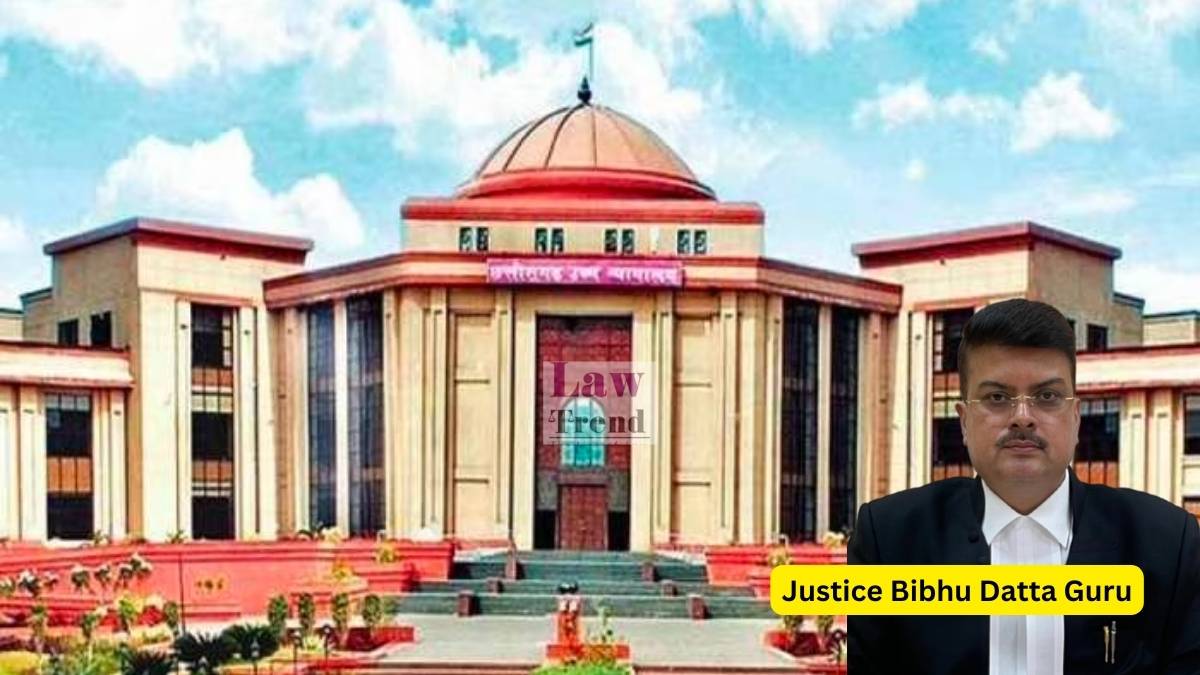
The High Court of Chhattisgarh has held that possession obtained under an agreement to sell is permissive in nature and does not ripen into adverse possession unless there is a clear, hostile assertion of title to the knowledge of the true owner. The Court further clarified that appellate courts possess co-extensive jurisdiction with trial courts to rectify procedural defects, including the deficiency of court fees, under Section 149 of the Civil Procedure Code (CPC).
Justice Bibhu Datta Guru, while dismissing a Second Appeal filed by the legal heirs of the plaintiff, upheld the decision of the First Appellate Court which had reversed a decree of specific performance and granted possession to the defendant.
Background of the Case
The dispute centered on a piece of land bearing Khasra No. 133/3, area 0.70 decimal, in Village Ramhepur. The original plaintiff, Lala Prasad, filed a suit for specific performance of the contract or, alternatively, for a declaration of title.
The plaintiff pleaded that on August 20, 1977, Yusuf (the father of Defendant No. 1, Safi Mohammed) entered into an agreement to sell the suit land for Rs. 1,951. An advance of Rs. 1,000 was allegedly paid, and possession was delivered to the plaintiff on the same day. The plaintiff claimed that the remaining amount was paid later for Yusuf’s medical treatment, but the sale deed was never executed. The plaintiff asserted continuous possession since 1977 and claimed ownership by adverse possession.
The defendants denied the execution of the agreement and contended that the suit was barred by limitation. Defendant No. 1 filed a counterclaim seeking restoration of possession, arguing that if the plaintiff was found in possession, it was merely permissive.
The Trial Court decreed the suit in favor of the plaintiff, directing the execution of the sale deed and alternatively declaring the plaintiff’s title based on adverse possession. However, the District Judge, Kabirdham (First Appellate Court), reversed this judgment, dismissed the suit, and decreed the defendant’s counterclaim for possession.
Substantial Questions of Law
The High Court admitted the Second Appeal on the following substantial questions of law:
- Whether the First Appellate Court was correct in holding the plaintiff’s possession as permissive rather than hostile, given the possession since 1977 under an agreement to sell.
- Whether the First Appellate Court was justified in decreeing the counterclaim for possession filed after more than 12 years.
- Whether the appeal before the First Appellate Court was liable for dismissal due to the non-payment of proper court fees.
Arguments
The counsel for the appellants argued that the plaintiff was put in possession pursuant to a written agreement to sell as part-performance of the contract. It was contended that such possession could not be treated as permissive. The appellants further argued that the counterclaim was barred by limitation and that the First Appellate Court should have dismissed the defendant’s appeal for deficit court fees.
Court’s Analysis and Observations
1. Nature of Possession and Adverse Possession The High Court affirmed the First Appellate Court’s finding that the alleged agreement to sell dated August 20, 1977, was not proved in accordance with the law. Consequently, the plea of possession in part-performance under Section 53-A of the Transfer of Property Act failed.
Regarding the claim of adverse possession, the Court observed:
“It is well settled that possession flowing from a permissive arrangement does not ripen into adverse possession unless there is a clear, hostile assertion of title to the knowledge of the true owner.”
The Bench noted that a person claiming possession under an agreement to sell cannot simultaneously claim adverse possession unless there is a clear repudiation of the permissive character of possession, which was absent in this case.
2. Limitation regarding Counterclaim The Court upheld the maintainability of the counterclaim. It reasoned that the cause of action for seeking possession arose only after the plaintiff’s claim of title was negatived. The counterclaim was held to be in the nature of a defense coupled with a claim for consequential relief.
3. Deficiency of Court Fees Addressing the issue of court fees, the Court referred to Section 149 of the CPC, which empowers the court to allow a party to make up the deficiency of court fees. The Court relied on the Supreme Court judgments in Manoharan v. Sivarajan (2014) and Tajender Singh Bhambhir v. Gurpreet Singh (2014).
Justice Guru observed:
“In respect of deficiency in Court fee, the power of the Appellate Court is coextensive with that of trial Court and the First Appellate Court in the interest of justice can do all that which could be done by Trial Court in suit proceeding.”
The Court held that mere technical objections relating to court fees, absent prejudice to the opposite party, cannot defeat substantive justice.
Decision
The High Court dismissed the Second Appeal, holding it devoid of merit. The substantial questions of law were answered against the appellant and in favor of the respondent.
The Court directed:
“As far as, the objection regarding Court fee is concerned, the deficiency of Court fee being a curable defect. This Court, in exercise of power under Section 149 CPC, permits the defendant to make good the deficit court fee of the first appeal before execution of the Decree drawn by the First Appellate Court.”
Case Details:
- Case Title: Lala Prasad (Died) Through Legal Heirs vs. Safi Mohammed & Ors
- Case No.: SA No. 406 of 2005
- Bench: Justice Bibhu Datta Guru