

Police Confessions Barred Under Evidence Act, Incomplete Circumstantial Chain Entitles Accused To Acquittal: Chhattisgarh High Court
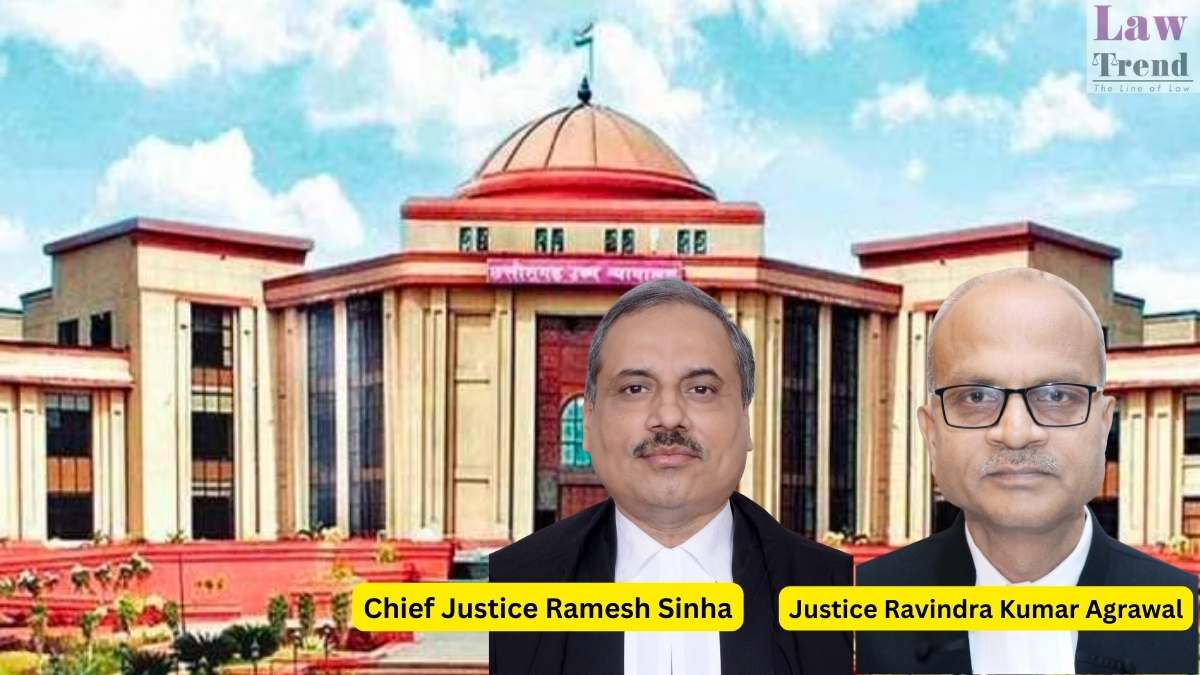

Setting aside the conviction and life imprisonment of two men accused of murder, Chief Justice Ramesh Sinha and Justice Ravindra Kumar Agrawal of the High Court of Chhattisgarh at Bilaspur held that confessional statements made to police officers are barred under Section 25 of the Indian Evidence Act, 1872, and cannot be used to complete a broken chain of circumstantial evidence.

Background of the Case

The case originated on June 26, 2019, when complainant Pirit Ram (PW-1) submitted a merg intimation (Ex.P/1) stating that an unidentified dead body bearing head injuries was lying near the Ranwahi Canal Culvert. The deceased was subsequently identified as Paleshwar Nirmalkar.

Dr. S.S. Nag (PW-10), who conducted the post-mortem at the Community Health Centre in Bhanupratappur, recorded head bone fractures and multiple injuries, opining that the cause of death was throttling and homicidal in nature (Ex.P/19). An FIR (Ex.P/2) was registered against unknown persons under Section 302 of the Indian Penal Code (IPC).

Following suspicions, the police arrested Kaushal alias Deepak Nirmalkar (brother of the deceased) and Lokesh Shori alias Loku. The police recorded their memorandum statements (Ex.P/9 and Ex.P/10) and recovered a t-shirt, motorcycles, soil, a sharp-edged stone, and a wooden club from Kaushal, along with a full shirt from Lokesh. The regional Forensic Science Laboratory (FSL), Jagdalpur, reported human blood on certain seized items (Ex.P/41). The prosecution also implicated a juvenile in conflict with law, filing separate proceedings before the Juvenile Justice Board.

On September 7, 2021, the Additional Sessions Judge, Bhanupratappur, District North Bastar Kanker, convicted both appellants in Sessions Case No. 30/2019 under Sections 302 read with 34 and Section 201 of the IPC, sentencing them to life imprisonment and additional rigorous imprisonment.

Arguments of the Parties

Appearing for the appellants, Advocate Ms. Savita Tiwari contended that the prosecution’s case rested entirely on circumstantial evidence with no eyewitnesses, no last-seen evidence, and major missing links in the chain of events. She argued that the dead body was found in an open public place, seizure witnesses were inconsistent, motive was unproven, and memorandum statements recorded by police were legally inadmissible. Furthermore, she submitted that non-explanation under Section 313 of the Code of Criminal Procedure (CrPC) could not serve as a link to complete an unproven chain of circumstances.

Opposing the appeals, Government Advocate Mr. Jitendra Shrivastava argued that the prosecution proved its case beyond reasonable doubt. He submitted that motive was established, as the deceased was addicted to liquor and ganja and frequently quarrelled with appellant Kaushal and their mother. He asserted that the chain of circumstances was complete, supported by disclosure statements, recovery of the murder weapon and vehicles, and FSL reports showing blood-stained articles for which the accused offered no explanation.

READ ALSO  वैवाहिक विवादों में दबाव बनाने के लिए अस्पष्ट आरोपों के साथ शुरू की गई घरेलू हिंसा की कार्यवाही 'कानून का दुरुपयोग': छत्तीसगढ़ हाईकोर्ट

Court’s Analysis and Legal Findings

Examining the evidence and settled principles on circumstantial cases, the High Court observed that there was no last-seen evidence placing the deceased in the company of the accused prior to his death.

Analyzing judicial precedents on circumstantial evidence, the bench referred to Madhu v. State of Kerala (2012), reiterating:

In a case resting on circumstantial evidence, the prosecution must establish a complete unbroken chain of events leading to the determination that the inference being drawn from the evidence is the only inescapable conclusion. In the absence of convincing circumstantial evidence, an accused would be entitled to the benefit of doubt.

The Court further discussed the five golden principles (“Panchsheel”) laid down in Sharad Birdhichand Sarda v. State of Maharashtra (1984), as affirmed in Nagendra Sah v. State of Bihar (2021), Surendra Kumar v. State of Uttar Pradesh (2021), Hanumant v. State of Madhya Pradesh (1952), Shailendra Rajdev Pasvan v. State of Gujarat, Ravindra Singh v. State of Punjab (2022), Bhagat Ram v. State of Punjab (1954), and C. Chenga Reddy v. State of A.P. (1996).

READ ALSO  स्वास्थ्य के लिए बनाए गए ऑक्सीजन जोन अब 'डंपिंग ग्राउंड' बन गए हैं: छत्तीसगढ़ हाईकोर्ट ने तत्काल सफाई के आदेश दिए

Evaluating the prosecution witnesses, the High Court noted critical discrepancies:

  • PW-1 (complainant) admitted seeing the accused for the first time when brought by police.
  • PW-2 (neighbour) turned hostile and admitted his testimony was based on hearsay.
  • PW-5 (brother-in-law) turned hostile and denied that Kaushal took his motorcycle on the day of the incident.
  • PW-7 (seizure witness) gave contradictory statements, claiming at one point that he sat in the police vehicle during recovery and later stating the wooden club was seized at the police station.
  • PW-8 admitted the police never recorded his statement, while cited memo witness Chaman Salam was never examined.

Addressing the admissibility of the disclosure statements under Sections 25 and 27 of the Indian Evidence Act, 1872, the bench cited Asar Mohammad v. State of U.P. (2018), Pulukuri Kotayya v. King Emperor (1947), and Aghnoo Nagesia v. State of Bihar (1966). The Court held that only the factum of discovery and knowledge of concealment are admissible under Section 27, while the confessional portion admitting guilt before a police officer is completely barred under Section 25.

Quoting Aghnoo Nagesia v. State of Bihar, the bench highlighted:

A confession made to a police officer under any circumstances is not admissible in evidence against the accused.

These provisions seem to proceed upon the view that confessions made by an accused to a police officer or made by him while he is in the custody of a police officer are not to be trusted, and should not be used in evidence against him.

On the issue of blood-stained recovery and burden of proof, the Court cited Digambar Vaishnav v. State of Chhattisgarh (2019), Varkey Joseph v. State of Kerala (1993), and Sujit Biswas v. State of Assam (2013), emphasizing:

Suspicion, however grave it may be, cannot take the place of proof, and there is a large differ- ence between something that “may be” proved, and something that “will be proved”.

It is also well-settled principle that in criminal cases, if two views are possible on evidence adduced in the case, one binding to the guilt of the accused and the other is to his innocence, the view which is favourable to the accused, should be adopted.

Regarding the trial court’s reliance on the accused’s failure to explain circumstances in their Section 313 CrPC statements, the bench cited Shivaji Chintappa Patil v. State of Maharashtra (2021) to clarify that false explanation or non-explanation can only act as an additional circumstance when the prosecution has already established a complete chain, but it cannot be used as a link to fill gaps in an incomplete chain.

Decision of the Court

The High Court held that the prosecution failed to establish a complete and unbroken chain of circumstantial evidence, leaving major components missing. Giving the benefit of doubt to the accused, the Court allowed Criminal Appeal No. 1063 of 2021 and Criminal Appeal No. 1066 of 2021.

READ ALSO  Taking Child Away to Protect His Welfare Cannot Alone Amount to Mental Cruelty Under Section 498A IPC: Calcutta High Court

The impugned judgment of conviction and sentence dated September 7, 2021, was set aside, and both appellants were acquitted of all charges. The Court directed that Kaushal alias Deepak Nirmalkar (in jail since June 29, 2019) and Lokesh Shori alias Loku (in jail since September 7, 2021) be released forthwith if not required in any other case, subject to furnishing personal bonds of Rs. 25,000 each with one surety pursuant to Section 481 of the Bharatiya Nagarik Suraksha Sanhita, 2023.

Case Details:

Case Title: Kaushal @ Deepak Nirmalkar v. State of Chhattisgarh (with CRA No. 1066 of 2021 – Lokesh Shori @ Loku v. State of Chhattisgarh)

Case No.: CRA No. 1063 of 2021

Bench: Chief Justice Ramesh Sinha and Justice Ravindra Kumar Agrawal

Date: 05/08/2026

Law Trend
Law Trendhttps://lawtrend.in/
Legal News Website Providing Latest Judgments of Supreme Court and High Court

Related Articles

Latest Articles

