

Only Complaints Showing Real Possibility of Departmental Action Can Be Treated as ‘Contemplated Proceedings’ for Rejecting VRS: Supreme Court
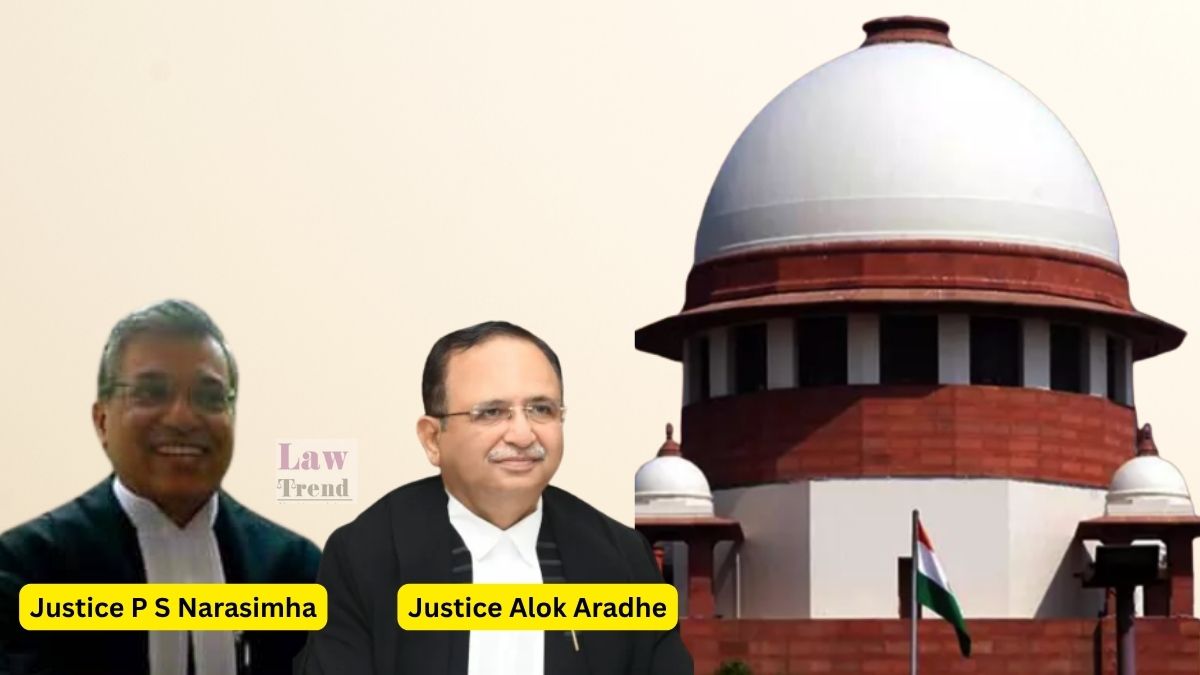

A Division Bench of the Supreme Court of India, comprising Justice Pamidighantam Sri Narasimha and Justice Alok Aradhe, has ruled that the mere existence of a pending complaint against an employee does not automatically equate to “contemplated proceedings” for the purpose of denying Voluntary Retirement from Service (VRS).

Allowing an appeal filed by Indian Police Service (IPS) officer Abdur Rahman, the Bench set aside a Central Government order dated October 25, 2019, which rejected his VRS notice. The Court held that under Rule 16(2A) of the All India Service (Death-cum-Retirement Benefits) Rules, 1958 (the “1958 Rules”), read with the Department of Personnel and Training (DoPT) Guidelines, “contemplation” of disciplinary proceedings requires a deliberate, active intention to proceed on a complaint rather than the passive existence of an un-actioned or withdrawn grievance. Finding that the Central Government failed to apply its mind to this distinction and relied on inactive complaints to withhold vigilance clearance, the Bench directed the Ministry of Home Affairs (MoHA) to reconsider the appellant’s VRS application afresh within three months.

Background of the Case

The appellant, Abdur Rahman, is a 1997-batch IPS officer of the Maharashtra cadre. Between 2014 and 2019, three complaints were filed against him:

  1. Complaint I (July 22, 2014): Filed by Tukaram Bhimrao Jadhav, alleging that the appellant tortured the complainant’s wife. No departmental action had been initiated on this.
  2. Complaint II (April 28, 2016): Filed by the appellant’s father-in-law, alleging that the appellant contracted a second marriage without consent and tortured his first wife and son. This complaint was formally withdrawn by the complainant on September 22, 2017.
  3. Complaint III (March 29, 2019): Initiated after the appellant gave a speech at the launch of his book, Denial and Deprivation, alleging violations of Rules 6 and 7 of the All India Service (Conduct) Rules, 1968 (the “Conduct Rules”).

After previously withdrawing one VRS application and having a second application rejected on separate grounds (which were later closed), the appellant submitted the present notice for VRS on August 1, 2019, under Rule 16(2A) of the 1958 Rules.

On October 16, 2019, the Maharashtra State Government scrutinized these three complaints. Noting that chargesheets had not been issued and that the matters were unlikely to result in a major penalty, the State recommended that the Central Government accept the VRS notice.

However, on October 25, 2019, the Central Government rejected the request, concluding that because disciplinary proceedings were “pending or being contemplated” against the appellant, he was “not clear from the vigilance angle.”

The appellant challenged the rejection before the Central Administrative Tribunal (CAT). During the pendency of this challenge, the State Government issued three formal chargesheets:

  • Chargesheet I (June 17, 2020): For a major penalty concerning the second marriage.
  • Chargesheet II (October 6, 2020): Concerning the book launch speech (initially minor, later converted to major).
  • Chargesheet III (April 24, 2022): For a major penalty concerning his absence from duty, publishing his VRS application on social media, and participating in anti-CAA protests.
READ ALSO  Whether Hyperlinking Defamatory Content Triggers New Defamation Case? Delhi High Court Explains

The CAT dismissed the application on December 7, 2023, holding that the subsequent chargesheets proved complaints were under active contemplation at the relevant time. The Bombay High Court affirmed this on July 23, 2024, ruling that the Central Government possessed independent authority to form its own opinion on “contemplation.” The appellant then moved the Supreme Court.

Arguments of the Parties

Appellant’s Submissions

Mr. Huzefa Ahmadi, learned senior counsel for the appellant, argued that:

  1. No Contemplation on Relevant Date: As of the VRS application date (August 1, 2019) or even the decision date, no formal chargesheet was served. Relying on State of Haryana v. Dinesh Singh, he argued that the mere pendency of a complaint, without active steps toward formal charges, does not amount to legal “contemplation.”
  2. Determinative State Recommendation: Under DoPT Guideline 3(ii), the State Government as the disciplinary authority had formally opined that no major penalty was warranted and recommended acceptance. The Central Government could not arbitrarily substitute this assessment.
  3. Alternative Relief: The Court could exercise its extraordinary power under Article 142 of the Constitution, as in Ashok Kumar Sahu v. Union of India, to allow retirement subject to the outcome of the ongoing disciplinary proceedings.

Respondents’ Submissions

Ms. Aishwarya Bhati, learned Additional Solicitor General for the Union of India, countered that:

  1. Ultimate Authority of Union: Under the All India Services (Discipline and Appeal) Rules, 1969, major penalties of dismissal or removal can only be imposed by the Central Government. The Union is therefore the ultimate disciplinary authority and is not bound by the State’s view.
  2. Broad Scope of Contemplation: Citing Dinesh Singh, she argued that “contemplation” encompasses any period before the formal filing of a chargesheet, and that the complaints were under active consideration on the date of decision (October 25, 2019).
  3. Relevant Date of Consideration: The critical date to evaluate the “vigilance angle” is the date of the rejection order, not the date of the VRS application.

Mr. Shrirang Varma, representing the State of Maharashtra, adopted the Union’s submissions, clarifying that the delay in issuing the chargesheets was due to the unavailability of witness statements.

READ ALSO  Section 36(1)(viii) Deduction Requires Deployment of ‘Own Funds’; General Business Income Not Automatically Eligible Under ‘Derived From’ Test: Supreme Court

Court’s Analysis

The Supreme Court, through the Bench of Justice Pamidighantam Sri Narasimha and Justice Alok Aradhe, focused its analysis specifically on what constitutes a “pending” or “contemplated” proceeding within the framework of Rule 16(2A) and DoPT Guideline 3(ii).

1. Defining “Pending” vs. “Contemplated” Proceedings

The Bench drew a strict legal distinction between proceedings that are “pending” and those that are merely “contemplated”:

  • Pending Proceedings: Referencing Union of India v. K.V. Jankiraman, the Court confirmed that “a disciplinary proceeding is pending only when a formal chargesheet is issued.” Since no chargesheet was served on the appellant as of October 25, 2019, no disciplinary proceedings were legally pending.
  • Contemplated Proceedings: To define “contemplation,” the Bench relied on State of Haryana v. Dinesh Singh and State of UP v. Jai Singh Dixit, declaring:

“‘Contemplation’ in the present context connotes a deliberate intention to act on a complaint, instead of a mere existence of a pending complaint.”

The Bench elaborated that there must exist a concrete “possibility or a contingency that a formal departmental proceedings may follow” to satisfy the threshold of legal contemplation.

2. Application of the “Contemplation” Standard to the Facts

The Bench of Justice Narasimha and Justice Aradhe evaluated the three complaints active on the date of the rejection order (October 25, 2019) to see if they met this legal threshold:

  • Complaint I (Torture allegation, 2014): Inconclusive, with no action taken by the state for five years. This did not meet the definition of active contemplation.
  • Complaint II (Bigamy allegation, 2016): This complaint had been formally withdrawn by the complainant in September 2017—more than two years before the VRS decision. The Bench found it could not be treated as “contemplated.”
  • Complaint III (Book launch, 2019): Only this complaint was in active contemplation, as an inquiry report and draft chargesheet were actively awaited from the Director General of Police.

By lumping together inactive, stale, and withdrawn complaints to deny vigilance clearance, the Central Government’s decision, the Bench held, “suffers from non-application of mind.” Furthermore, the Union failed to engage with the State’s specific assessment that Complaint III was unlikely to lead to a major penalty.

3. The Union’s Discretion and the Duty to Apply Mind

The Court upheld the Central Government’s ultimate authority under Rule 16(2A), noting that a 1988 amendment shifted the power of VRS acceptance from the State to the Union. Citing Ashok Kumar Sahu, it confirmed that “the Central Government has the last word when deciding a request for VRS… and in doing so, it is not bound by the recommendation of the State Government.”

However, the Bench qualified this power, stating that the Union’s discretion is guided by DoPT Guideline 3(ii). It ruled that the Central Government cannot form an arbitrary opinion unsupported by the material on record, and must actively weigh the State Government’s input:

READ ALSO  सुप्रीम कोर्ट में जनहित याचिका में 12वीं कक्षा के तुरंत बाद 3-वर्षीय एलएलबी की व्यवहार्यता की जांच के लिए विशेषज्ञ पैनल की मांग की गई है

“Though not bound by the recommendation of the State Government, its opinion does carry weight and persuasive value owing to the fact that it is the authority with direct supervisory knowledge of the officer…”

4. Abnormal and Unjustified Delay

The Bench expressed strong disapproval of the delay in the state’s departmental inquiries. Although chargesheets were eventually filed between 2020 and 2022, inquiry officers were not appointed until 2024, and the appellant only received hearing summonses in 2025 and 2026.

Citing State of AP v. N. Radhakishan, the Bench highlighted that unjustified delays cause severe prejudice to employees. The Court ruled that “the method and manner of conducting disciplinary proceedings is unacceptable” due to “long and unjustified delay,” and that these subsequent delays must be factored into the reassessment of the appellant’s VRS.

Decision

The Supreme Court allowed the appeal, setting aside the Bombay High Court’s judgment dated July 23, 2024, and the Central Government’s rejection order dated October 25, 2019.

The Bench declined to issue direct retirement orders under Article 142 of the Constitution, distinguishing the facts from Ashok Kumar Sahu. Instead, the Court directed the Ministry of Home Affairs to:

  1. Re-examine the appellant’s VRS notice afresh.
  2. Account for the fact that only one complaint was genuinely in “contemplation” on the relevant date, and that the Central Government failed to apply its mind to this distinction.
  3. Factor in subsequent developments, specifically the State Government’s “long and unjustified delay” in concluding the disciplinary proceedings.
  4. Pass a final, reasoned decision under Rule 16(2A) within three months.

The Court reserved the right of the appellant to seek further legal remedies, including approaching the CAT, should he be aggrieved by the fresh decision.

Case Details

  • Case Title: Abdur Rahman v. Union of India & Ors.
  • Case No.: Civil Appeal No. ___ of 2026 (Arising out of SLP (C) No. 21390 of 2024)
  • Bench: Justice Pamidighantam Sri Narasimha, Justice Alok Aradhe
  • Date of Judgment: May 26, 2026

Law Trend
Law Trendhttps://lawtrend.in/
Legal News Website Providing Latest Judgments of Supreme Court and High Court

Related Articles

Latest Articles

