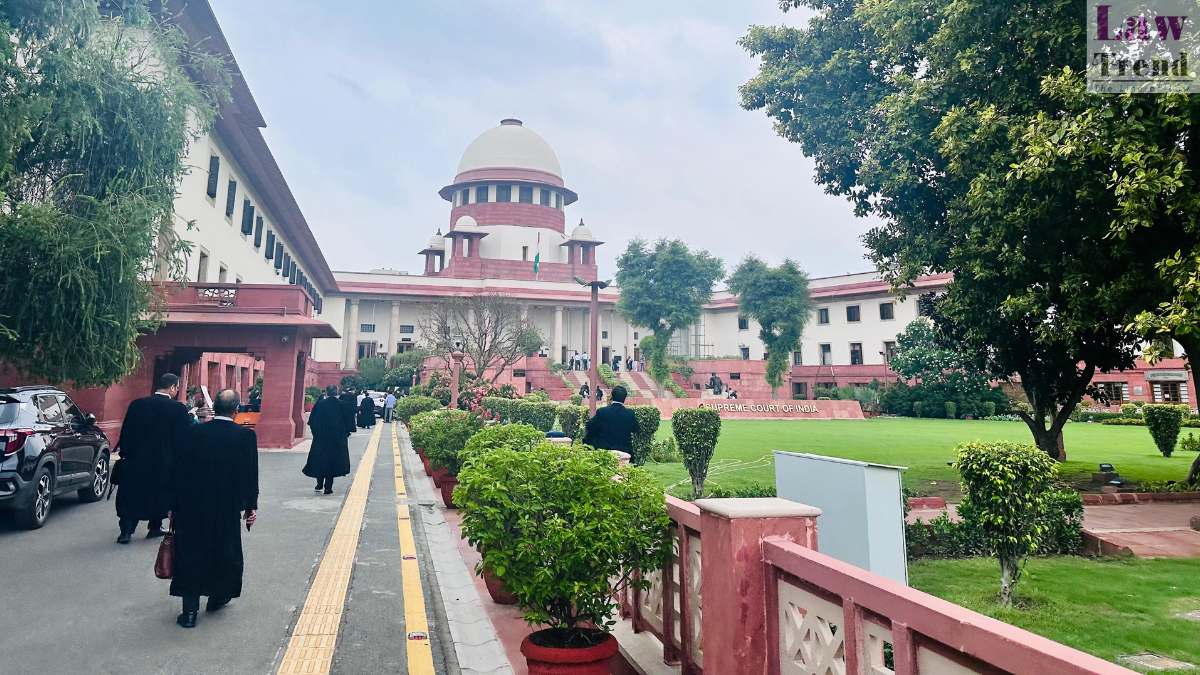
The Supreme Court of India has set aside an order of the Allahabad High Court (Lucknow Bench) that granted anticipatory bail to Monika Dwivedi, an accused in a large-scale financial and property fraud case in Lucknow. The division bench, comprising Justice Prashant Kumar Mishra and Justice N.V. Anjaria, observed that the High Court relied on peripheral civil aspects—such as the agreement being unregistered and the complainant seeking restitution—while overlooking critical criminal parameters like the fraudulent inducement of the buyer and the accused’s history of criminal antecedents. Consequently, the Supreme Court allowed the appeal and cancelled the anticipatory bail granted to the accused.
Background of the Case
The dispute arises from an FIR dated January 3, 2025, lodged by the complainant, Saurabh Agrawal, alleging financial fraud concerning a residential property situated at C-24, E-Park, Mahanagar Extension, Lucknow. The property was represented as being jointly owned by Respondent No. 2 (Monika Dwivedi), her son Abhishek Dwivedi, and her daughter Abhilasha Dwivedi.
Relying on this representation, the complainant entered into a notarized agreement to sell on January 8, 2024, for a total sale consideration of Rs. 4,30,00,000/-. The complainant paid Rs. 3,55,00,000/- in installments, which was acknowledged in the agreement. The accused represented that the formal sale deed would be executed once Respondent No. 2’s daughter returned from abroad, providing travel details to substantiate the delay.
However, despite receiving the substantial consideration, Respondent No. 2 and her son executed a sale deed on June 24, 2024, transferring the entire property to a third party, Pankaj Mohan Mishra. The complainant discovered that the daughter had no ownership interest in the property, proving the initial representation false. When the complainant demanded either the sale deed’s execution or a refund, he was allegedly threatened.
Initially registered as FIR No. 0333 of 2024 at Police Station Aliganj, Lucknow, the case was later transferred and re-registered as FIR No. 0002 of 2025 at Police Station Mahanagar under Sections 406, 420, 467, 468, 471, 506, 120-B, and 34 of the Indian Penal Code, 1860.
Prior Procedural History:
- Writ Petition for Quashing: Respondent No. 2 and her son sought to quash the FIR through Criminal Misc. Writ Petition No. 1688 of 2025. After an unsuccessful mediation referral, the High Court dismissed the petition on May 8, 2025, noting their criminal antecedents and the existence of a prima facie case of financial fraud.
- Sessions Court Bail Rejection: The Court of Sessions, Lucknow, rejected their anticipatory bail application on June 18, 2025, due to the gravity of the allegations and criminal antecedents.
- Coercive Steps: In a separate writ petition filed by the complainant seeking a fair investigation, the High Court noted on record that the accused were absconding and that the investigating agency was actively taking coercive steps to secure them.
- High Court Bail Grant: On October 6, 2025, the High Court of Judicature at Allahabad, Lucknow Bench, allowed the anticipatory bail application of Respondent No. 2, which led the complainant to appeal to the Supreme Court.
Arguments of the Parties
For the Appellant (Complainant): The appellant contended that the High Court failed to appreciate the seriousness of the allegations, the requirements of an investigation in an economic offence of this scale, and the established criminal antecedents of Respondent No. 2.
Reasoning Adopted by the High Court (Supporting Respondent No. 2): In granting anticipatory bail, the High Court had observed that:
- The agreement to sell was only notarized and not registered.
- The daughter of Respondent No. 2 was abroad at the time of execution, suggesting the agreement might not have been executed by all joint owners.
- Only a part of the total consideration (Rs. 3,55,00,000/- out of Rs. 4,30,00,000/-) was paid, and there was no averment showing the buyer’s readiness to pay the remaining balance.
- The complainant had requested a refund of the money in the FIR itself, which the High Court took as indicative of a dispute of a civil nature.
Court’s Analysis
The Supreme Court analyzed the grounds on which the High Court had granted protection and rejected each of them, stating that they did “not bear a direct nexus to the parameters governing the grant of anticipatory bail.”
On the Daughter Being Abroad & Lack of Joint Execution: The Supreme Court noted that this factor does not minimize the charge of deception. The Court observed:
“this circumstance, even if assumed to be correct, does not dilute the allegation of inducement. The gravamen of the accusation is that the complainant was led to believe that all necessary parties would join in the transaction and, acting on such representation, parted with a substantial sum. Whether or not all co-owners actually executed the agreement is a matter of evidence; at this stage, the focus is on the allegation of deception at the inception.”
On the Unregistered and Notarized Status of the Agreement: The Court rejected the notion that the form of the agreement diminished the alleged criminality, stating:
“The nature or form of the agreement does not, by itself, determine the existence or otherwise of a criminal offence. The allegation is not merely of breach of contract, but of fraudulent inducement and subsequent conduct inconsistent with the representations made. The absence of registration does not, therefore, neutralize the criminality alleged.”
On the Partial Payment and Readiness to Pay the Balance: The Bench ruled that contractual readiness is not the primary inquiry in bail considerations for fraud:
“[This] again, in our view, is not determinative at the stage of considering anticipatory bail. The material allegation is that a substantial amount was received by the accused persons and, thereafter, the property was alienated to a third party. The issue is not of contractual readiness alone, but of the conduct of the accused persons after receiving a significant portion of the consideration.”
On the Claim That the Dispute is Civil Because a Refund Was Sought: The Bench reiterated the independent nature of criminal proceedings alongside civil remedies:
“the observation of the High Court that the complainant has sought refund of the amount in the FIR, thereby indicating a civil dispute, cannot be accepted as a ground to dilute the criminal allegations. It is well settled that the existence of a civil remedy does not preclude criminal proceedings where the ingredients of a criminal offence are prima facie made out. The mere fact that the complainant seeks restitution of the amount paid does not efface the allegations of cheating or fraud.”
On the Omission of Criminal Antecedents: The Supreme Court strongly pointed out that the High Court completely omitted to look at the criminal history of the accused:
“Significantly, while dismissing the quashing plea… the High Court itself had recorded the existence of multiple criminal antecedents of a similar nature against the accused persons. The Sessions Court… had also taken note of such antecedents. Despite this, the impugned order of the High Court is completely silent on this aspect. The omission to consider such relevant factors, particularly in a case involving allegations of economic fraud, renders the exercise of discretion by the High Court unsustainable.”
Decision
The Supreme Court concluded that the High Court’s order lacked proper application of mind as it was guided by peripheral considerations rather than factors germane to the exercise of discretion in anticipatory bail.
Finding that the case involved a premeditated economic offence, a massive transaction value, and a situation where the accused were previously evading investigation, the Apex Court held:
“Having regard to the nature of the allegations, the magnitude of the transaction, the antecedents attributed to Respondent No. 2, and the requirements of a fair and effective investigation, we are of the considered view that the grant of anticipatory bail to Respondent No. 2 at this stage is not warranted.”
The Supreme Court allowed the appeal and set aside the High Court’s order. Consequently, the anticipatory bail granted to Respondent No. 2, Monika Dwivedi, was officially cancelled. The Court clarified that its observations are confined to the bail adjudication and shall not influence the subsequent trial on merits.
Case Details
- Case Title: Saurabh Agrawal v. State of Uttar Pradesh and Another
- Case No.: Criminal Appeal No. 2850 of 2026 (Arising out of S.L.P. (Criminal) No. 19112 of 2025)
- Bench: Justice Prashant Kumar Mishra and Justice N.V. Anjaria
- Date: May 26, 2026