

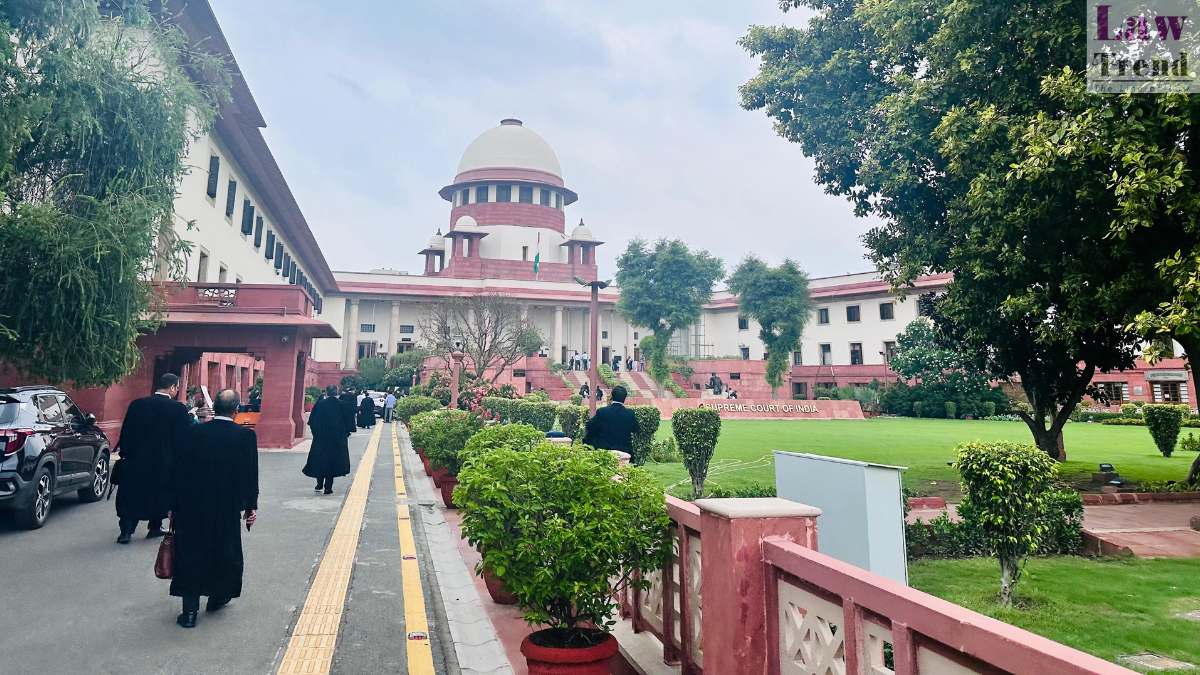
The Supreme Court of India has issued a stern warning regarding the alarming backlog of bail and anticipatory bail applications pending across various High Courts, remarking that it may be forced to step in and issue mandatory guidelines to ensure time-bound adjudication.
In a hearing on Wednesday that underscored the judiciary’s struggle with docket management, a Bench headed by Chief Justice of India (CJI) Surya Kant expressed deep disappointment over the “lax manner” in which matters concerning the personal liberty of citizens are being handled at the High Court level.
‘People are Languishing in Jail’
The observations came during the hearing of the case Sunny Chauhan vs State of Haryana, where the Bench, also comprising Justice Joymalya Bagchi and Justice Vipul Pancholi, scrutinized the situation at the Punjab and Haryana High Court.
During the proceedings, the counsel for the petitioner presented charts indicating that numerous bail pleas have been pending before the Punjab and Haryana High Court since May 2025, suffering repeated adjournments without a hearing.
Taking a grim view of the data, CJI Surya Kant emphasized that while courts deal with heavy dockets, the liberty of an individual must take precedence over other miscellaneous matters.
“We are extremely disappointed to see how the prayers pertaining to liberty of individuals are not being entertained. Dockets may be heavy and there may be matters requiring consideration, but among miscellaneous matters, there can be nothing more important than the prayer of grant or refuse bail,” CJI Kant observed.
Systemic Failure Flagged
The Apex Court noted that the issue is not isolated to a single High Court. The Bench pointed out that in the Patna High Court, the situation has deteriorated to the extent that litigants are filing separate petitions merely to complain about the non-listing of their bail applications.
The Court remarked that previous Supreme Court orders directing the speedy disposal of bail matters appear to have had “no real impact,” observing that High Courts have evidently failed to evolve their own internal mechanisms to ensure timely hearings.
Supreme Court May Override ‘Master of Roster’ Privilege
Significantly, the Bench addressed the administrative autonomy usually granted to High Court Chief Justices. While acknowledging that the listing of cases is the “exclusive prerogative” of the Chief Justice as the “master of the roster,” the Supreme Court stated it is under a “bounden duty” to intervene when citizens face uncertainty regarding their freedom.
“We are conscious of the fact that listing is the exclusive prerogative of the Chief Justices since they are the masters of the roster. The people are languishing in jail, and bail pleas are not heard and there is complete uncertainty as to when they will know the fate of their application. This court is under the bounden duty to issue certain mandatory guidelines,” the Bench asserted.
Data Sought from All High Courts
Before issuing any sweeping guidelines, the Supreme Court has directed the Registrar Generals of every High Court in the country to submit detailed data on all pending anticipatory and regular bail pleas.
The Court has expressed a clear expectation that High Court Chief Justices will take immediate remedial action to ensure pleas are decided within a reasonable time, rather than waiting for the Supreme Court to impose a rigid timetable.




