

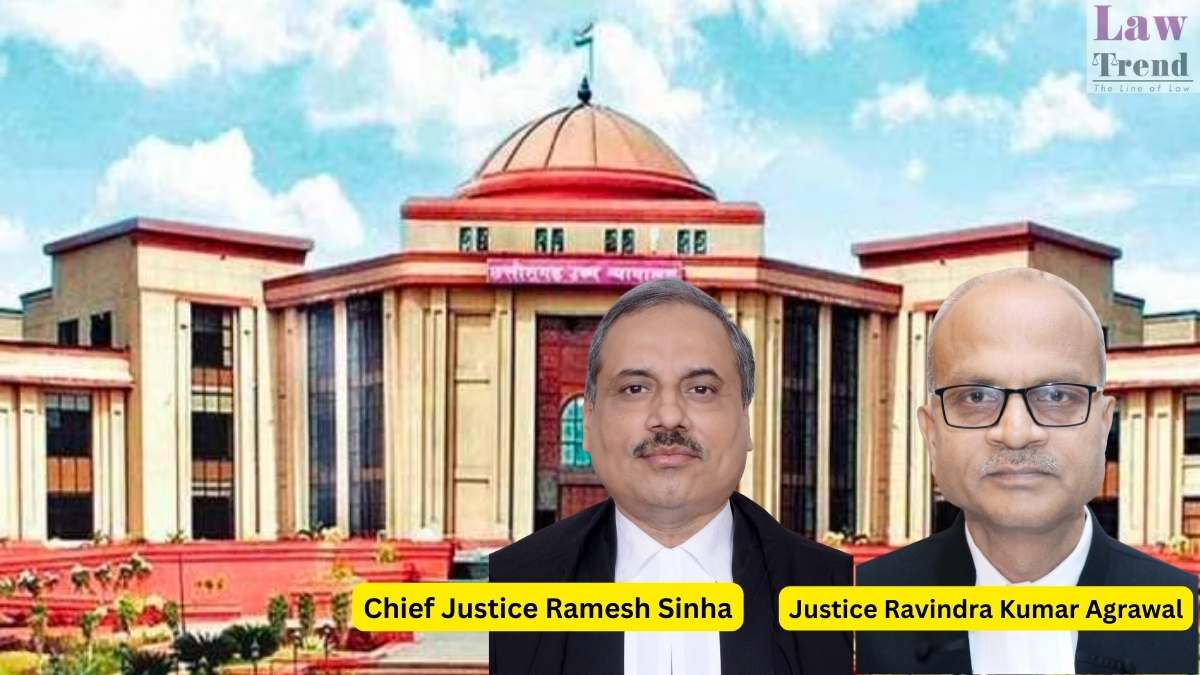
The High Court of Chhattisgarh at Bilaspur has held that procedural lapses, including non-compliance with Section 52-A of the Narcotic Drugs and Psychotropic Substances Act, 1985 (NDPS Act), do not automatically vitiate a trial or warrant acquittal if the overall evidence credibly establishes the recovery and possession of contraband.
A Division Bench comprising Chief Justice Ramesh Sinha and Justice Ravindra Kumar Agrawal delivered this ruling while dismissing appeals filed by three convicts (Vikash Kumar Ray, Amrit Kumar Sahu, and Sajan Yadav) and simultaneously dismissing an acquittal appeal filed by the Directorate of Revenue Intelligence (DRI) against a fourth individual (Pawan Yadav).
Background of the Case
The case originated from a secret information received by the DRI on November 11, 2020, regarding the illegal transportation of approximately 800 kgs of Ganja from Odisha to Uttar Pradesh via Raipur. A search party intercepted a container truck (CG 08 L 3166) near Abhanpur. Inside a specially constructed secret chamber behind the helper’s seat, officers recovered 155 packets containing 697.255 kgs of Ganja.
Three persons in the truck—Vikash Kumar Ray, Amrit Kumar Sahu, and Pankaj Kumar Ray (who died during trial)—were arrested. Subsequent investigation led to Sajan Yadav, the truck owner, and his brother Pawan Yadav. The trial court convicted the occupants and the owner but acquitted Pawan Yadav, leading to cross-appeals before the High Court.
Arguments of the Parties
For the Appellants (Convicts): Counsel for the appellants argued that there were material inconsistencies in the testimony of prosecution witnesses and that mandatory provisions of the NDPS Act, specifically Sections 42, 52-A, 55, and 57, were not complied with. They contended that the “conscious possession” of the Ganja was not proved, particularly for the driver, who claimed ignorance of the secret chamber. They further argued that statements recorded under Section 67 of the NDPS Act were inadmissible as per established law.
For the DRI (Respondent/Appellant in ACQA): The DRI maintained that the prosecution proved its case beyond reasonable doubt. Regarding the acquittal of Pawan Yadav, the DRI argued that he was running a Dhaba where the secret chamber was prepared and that Call Detail Records (CDR) linked him to the conspiracy.
Court’s Analysis
The Court meticulously examined the procedural requirements of the NDPS Act. Regarding the search and seizure, the Court noted that since the interception occurred in a “public place” or “in transit,” Section 43 applied rather than Section 42.
On the critical issue of Section 52-A (Inventory and sampling procedure), the Court referred to the recent Supreme Court decision in Bharat Aambale vs. The State of Chhattisgarh (2025). The High Court observed:
“Non-compliance or delayed compliance with the procedure prescribed under Section 52A of the NDPS Act… will not, by itself, be fatal to the case of the prosecution, unless there are discrepancies in the physical evidence which may not have been there had such compliance been done.”
The Court emphasized that Section 52-A is a procedural provision and doesn’t exhaustively lay down evidentiary rules. If other material on record “inspires confidence and satisfies the Court regarding both recovery and possession,” a conviction can be sustained notwithstanding procedural defects.
The Bench rejected the driver’s plea of ignorance regarding the secret chamber, noting:
“A driver is in control of the vehicle and is expected to be aware of its structural features and condition… It is difficult to accept that such a large modification in the cabin would go unnoticed by the driver who was operating the vehicle over a long distance.”
Regarding Pawan Yadav’s acquittal, the Court found that no contraband was seized from him or his premises. His implication was primarily based on statements of co-accused under Section 67, which “in absence of independent corroboration, cannot be made the sole basis for conviction.”
Decision
The High Court upheld the conviction and 10-year sentences of Vikash Kumar Ray, Amrit Kumar Sahu, and Sajan Yadav. It also upheld the acquittal of Pawan Yadav, citing the limited scope of interference in acquittal appeals unless the findings are “perverse” or “manifestly illegal.”
The Court concluded in its headnote:
“Non-compliance with Section 52-A of the NDPS Act is not per se fatal to the prosecution case, and conviction can be sustained if the overall evidence on record credibly establishes recovery and possession of contraband.”
Case Details:
- Case Titles: Vikash Kumar Ray & Anr. vs. Directorate of Revenue Intelligence (CRA No. 1495 of 2024)
- Directorate of Revenue Intelligence vs. Shri Pawan Yadav (ACQA No. 247 of 2025)
- Sajan Yadav vs. Directorate of Revenue Intelligence (CRA No. 2595 of 2025)
- Bench: Chief Justice Ramesh Sinha and Justice Ravindra Kumar Agrawal
- Date: March 24, 2026




