

The Supreme Court has held that the reopening of an income tax assessment does not amount to a “change of opinion” where the original assessment order reflects no opinion, expressly or by necessary implication, on the issue forming the basis of the reopening.
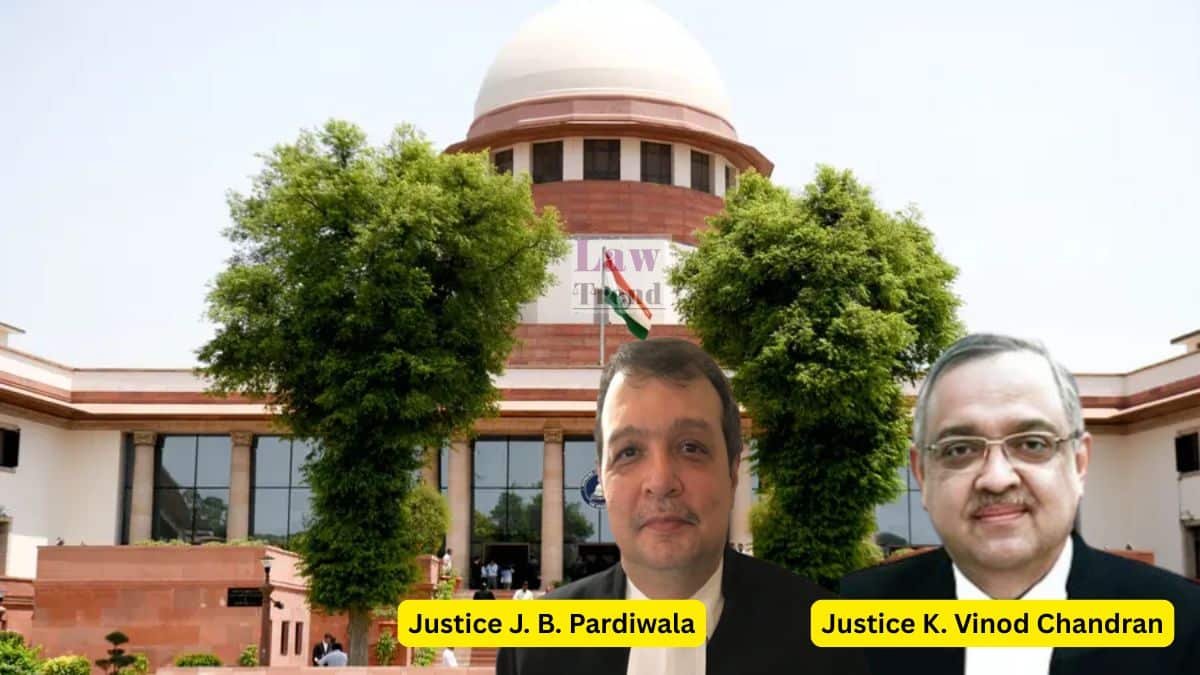
A Bench of Justice J.B. Pardiwala and Justice K. Vinod Chandran upheld the reassessment notices issued to brothers Chetan Sabharwal and Nitin Sabharwal for AY 2008-09 and AY 2009-10, finding that an investigation report showing overvaluation of shares they sold was tangible material for forming a “reason to believe” under Section 147 of the Income Tax Act, 1961.
Background
The brothers, along with two other shareholders, entered into Share Purchase Agreements dated October 19, 2007 with GYS Real Estate Pvt. Ltd. for the sale of shares of Pawan Impex (P.) Ltd. and SVIIT Software (P.) Ltd. for ₹195 crore and ₹60 crore respectively, with each seller entitled to a one-fourth share.
In his return for AY 2008-09, Chetan Sabharwal showed ₹37.64 crore received from the buyer under sundry credit. His assessment under Section 143(3) accepted the returned income in December 2010. The brothers later deposited capital gains in a Capital Gains Savings Bank Account, claimed deduction under Section 54F, and jointly bought a half share in a residential property in Delhi in April 2010.
After the assessment, the Investigation Unit, Noida, under the DGIT (Inv.), Lucknow, concluded prima facie that the shares were overvalued compared to the cost of the companies’ land and building, and that the sale proceeds were the major source of the property investment. Relying on this report, the Assessing Officer issued a notice under Section 148 on March 31, 2015. The Delhi High Court dismissed the challenge on August 6, 2019.
Arguments
Senior Advocate Mukul Rohatgi, appearing for the appellants, argued that overvaluation of shares cannot result in escapement of income in the hands of the seller, and that the transaction was fully disclosed and examined in scrutiny assessment. He contended that reopening beyond four years required a failure to disclose material facts, and that the reassessment was based on a mere change of opinion.
Senior counsel Nisha Bagchi, along with ASG K.M. Nataraj for the Revenue, submitted that the investigation report was specific, reliable and tangible material. They argued that the Section 143(3) order was non-speaking, so no opinion could be attributed to the Assessing Officer, and that Nitin Sabharwal’s returns were accepted only through an intimation under Section 143(1).
Court’s Findings
The Court set out non-exhaustive principles on “reason to believe” and “change of opinion”, reiterating that “a mere “change of opinion” cannot be a reason to reopen, as the AO has the power to reassess and not the power to review.”
It held that the reasons recorded had a live link with the belief formed, since they did not stop at valuation but also recorded the adjustment of gains to future years and the Section 54F claim. Distinguishing cases where an officer merely records that investigation is needed, the Court said “a conclusion that the truth of the alleged transactions needs to be investigated is not the same thing as having reasons, post investigation, to issue a notice.”
On change of opinion, the Court held that since Nitin Sabharwal’s returns were accepted through a Section 143(1) intimation, no assessment was framed and no opinion was ever formed. For Chetan Sabharwal, it found that the assessment orders reflected no opinion on the issues behind the reopening, noting that “The assessment order for AY 2008-09 in the present case is a bare acceptance of the returned income as it is.”
Outcome
Holding that the March 31, 2015 notice was valid and based on tangible material prepared after the assessment, the Supreme Court dismissed the appeals.
Case Title: Chetan Sabharwal v. Assistant Commissioner of Income Tax Circle 28(1), New Delhi
Case No.: Civil Appeal No. 13953 of 2026 (with connected appeals)
Bench: Justice J.B. Pardiwala and Justice K. Vinod Chandran
Date: October 28, 2026


