

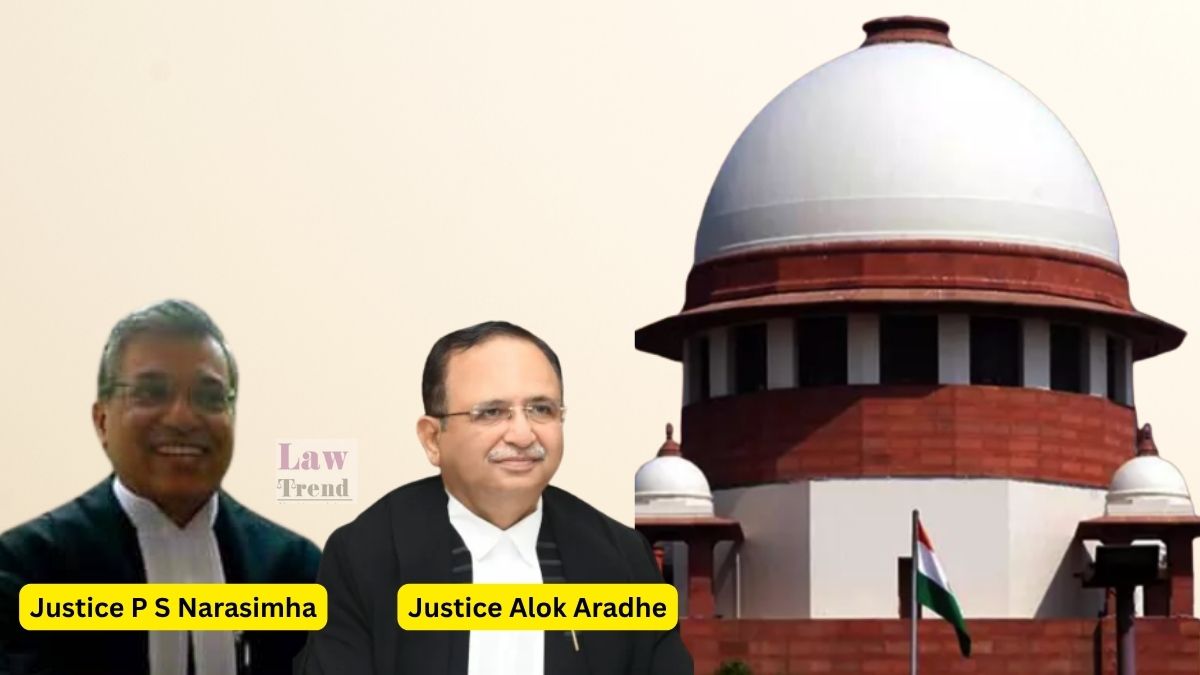
The Supreme Court of India has dismissed a Special Leave Petition filed by M/S Bharat Udyog Ltd., holding that an arbitral award is non-est and a nullity in the absence of a valid arbitration agreement or the informed consent of the parties. A Bench comprising Justice Pamidighantam Sri Narasimha and Justice Alok Aradhe upheld a Bombay High Court decision that had quashed an award concerning a dispute over octroi collection tender prices.
Background of the Case
The dispute originated in March 1994 when the Ambernath Municipal Council (the “Municipal Council”), constituted under the Maharashtra Municipal Councils, Nagar Panchayats and Industrial Townships Act, 1965, issued a tender for octroi collection. The tender set a minimum reserve price of Rs. 6,74,00,000/-. The petitioner, M/S Bharat Udyog Ltd., emerged as the successful bidder with an offer of Rs. 6,75,00,000/- and entered into an agreement on March 30, 1994.
Shortly after commencing work, the petitioner requested a reduction of the reserve price by over Rs. 40 lakh, claiming it was contrary to norms. This request was rejected by the Municipal Council. Following a withdrawn writ petition in the High Court, the petitioner approached the State Government’s Urban Development Department. On November 14, 1994, the State Government issued a Resolution appointing the Commissioner of the Konkan Division as an Arbitrator to resolve the dispute, purportedly under Section 143-A(3) of the 1965 Act.
The Arbitrator delivered an award on December 26, 1994, reducing the reserve price to Rs. 6,20,89,843/-. While a Civil Court initially made this award a rule of the court, the Bombay High Court later set it aside, prompting the petitioner to approach the Supreme Court.
Arguments of the Parties
For the Petitioner: Mr. P. B. Suresh, learned senior counsel, argued that the Municipal Council had waived its right to object by actively participating in the arbitral proceedings without demur. He contended that the case was one of “waiver and acquiescence,” relying on the decisions in N Chellappan v. Secretary, Kerala State Electricity Board and Inder Sain Mittal v. Housing Board, Haryana. He further submitted that the parties’ intention to refer the dispute to arbitration was evident, even if the word “arbitration” was not explicitly used in the contract.
For the Respondent: Mr. Vinay Navare, learned senior counsel for the Municipal Council, maintained that there was no arbitration agreement between the parties. He argued that the State Government had no jurisdiction to “foist” arbitration on a concluded contract and that the Municipal Council had raised jurisdictional challenges at the appropriate stage.
Court’s Analysis
The Supreme Court focused on whether a valid arbitration agreement existed under the Arbitration Act, 1940.
1. Statutory Power under Section 143A: The Court rejected the argument that the State Government could appoint an arbitrator under Section 143A(3). The Bench observed that this power relates only to “regulating the collection of octroi and the procedure that it may adopt” and does not extend to appointing an arbitrator unilaterally. The Court noted:
“Under no circumstances can such a power be extended to appoint an arbitrator unilaterally, notwithstanding the statutory or contractual relationship that may exist between the Municipal Council and its agent.”
2. Interpretation of Clause 22: The petitioner relied on Clause 22 of the contract, which provided for disputes to be referred to the Collector, with appeals to the Divisional Commissioner and the Urban Development Department. The Court held that this was a departmental dispute-resolution mechanism, not an arbitration agreement.
“A simple, plain reading of clause 22 would reveal that the parties have not agreed upon resolving the existing disputes between them through arbitration… In fact, clause 22 leaves no space for resolution of disputes through an alternative dispute resolution methodology.”
3. Waiver and Estoppel: The Court dismissed the plea of estoppel, noting that the Municipal Council was functioning under a government-appointed “Administrator” at the time and was essentially “forced into arbitration without consent.” The Bench held that participation in proceedings does not confer jurisdiction when the proceedings are inherently void.
Decision of the Court
The Supreme Court concluded that the entire arbitral process was a nullity (coram non judice). The Court summarized its findings as follows:
- Absence of Agreement: There was no written agreement to submit differences to arbitration as required by Section 2(a) of the 1940 Act.
- Lack of Jurisdiction: The State Government lacked authority to appoint an arbitrator, and the requirement of consensus ad idem (meeting of the minds) was absent.
- Nullity of Award: Because the Arbitrator lacked inherent jurisdiction, the award was “non-est.”
- Propriety of Proceedings: The Court agreed with the High Court that the proceedings were “perfunctory,” having started and concluded in a very short period (42 days).
The Special Leave Petition was dismissed, and the parties were ordered to bear their own costs.
Case Details
- Case Title: M/S Bharat Udyog Ltd. v. Ambernath Municipal Council Through Commissioner & Anr.
- Case Number: Special Leave Petition (C) No. 1127 of 2017
- Bench: Justice Pamidighantam Sri Narasimha and Justice Alok Aradhe
- Date of Judgment: March 24, 2026




