

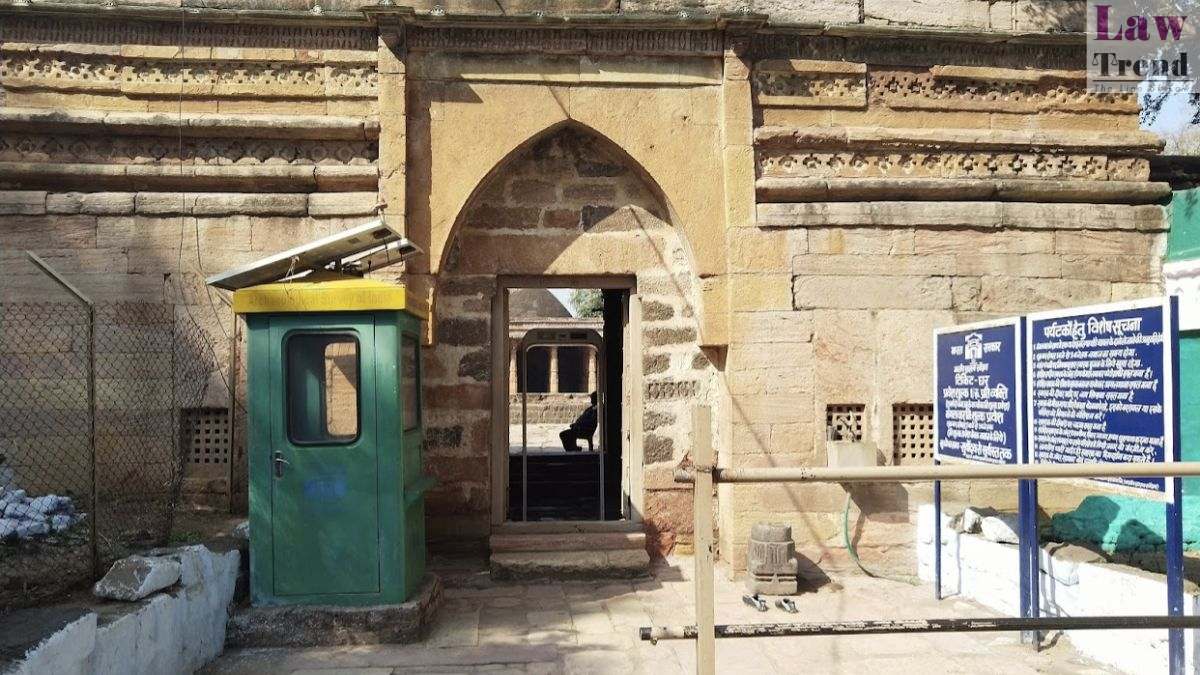
In a significant development in the ongoing Bhojshala complex dispute, the Madhya Pradesh High Court has directed the Archaeological Survey of India (ASI) to provide litigants access to the complete videographic records of its multi-day scientific survey.
A division bench comprising Justice Vijay Kumar Shukla and Justice Alok Awasthi issued the order while hearing multiple petitions concerning the religious identity of the disputed site in the Dhar district. The court has set a deadline of April 27 for the ASI to upload the footage to a secure digital platform.
The court’s intervention followed submissions by Senior Advocate Salman Khurshid, representing the Maulana Kamaluddin Welfare Society. Khurshid argued that access to the visual records is essential for the respondents to formulate potential objections to the ASI’s final survey report. He cited a Supreme Court directive suggesting that the High Court should consider objections arising from the videography.
The ASI’s counsel initially opposed the request, noting that the survey spanned 96 days and that sharing such a vast volume of footage would be “time-consuming.” The ASI further contended that the Supreme Court’s order intended for the High Court, rather than the litigants, to view the material.
However, the High Court rejected these arguments, mandating that the entire record be uploaded to a secure cloud service, such as Google Drive, to be accessible to both the court and the respondents’ legal teams.
Beyond the videography, the bench heard arguments regarding the maintainability of the original petition filed by the Hindu Front for Justice. Advocate Ashhar Warsi, appearing for an intervener, argued that the case involves contested ownership claims and complex evidence, making it a matter for a civil court or a Waqf tribunal rather than a writ court.
Warsi presented land revenue records dating back to 1925-26, which he claimed identify the property as a mosque. He further argued that under the Waqf Act, 1996, the one-year window for filing objections to the 1985 Waqf survey had long since expired.
The court is navigating two starkly different interpretations of the site’s history:
- The Hindu Perspective: Believers maintain the structure is the temple of Vagdevi (Goddess Saraswati). The ASI’s recent report concluded the existing structure was built using remains of a Hindu temple from the Parmar era.
- The Muslim Perspective: Litigants refer to it as the Kamal Maula mosque. Counsel argued that essential temple features like the shikhara (spire) and garbha griha (sanctum sanctorum) are absent, while mosque elements like the mihrab and qibla alignment are present.
The intervener also cited past decisions by the ASI Director, which permitted only Namaz at the site, and referenced British Museum documentation suggests the famous Vagdevi statue originated from a city palace, not the Bhojshala complex.
The main matter is scheduled for further hearing this coming Tuesday.


