

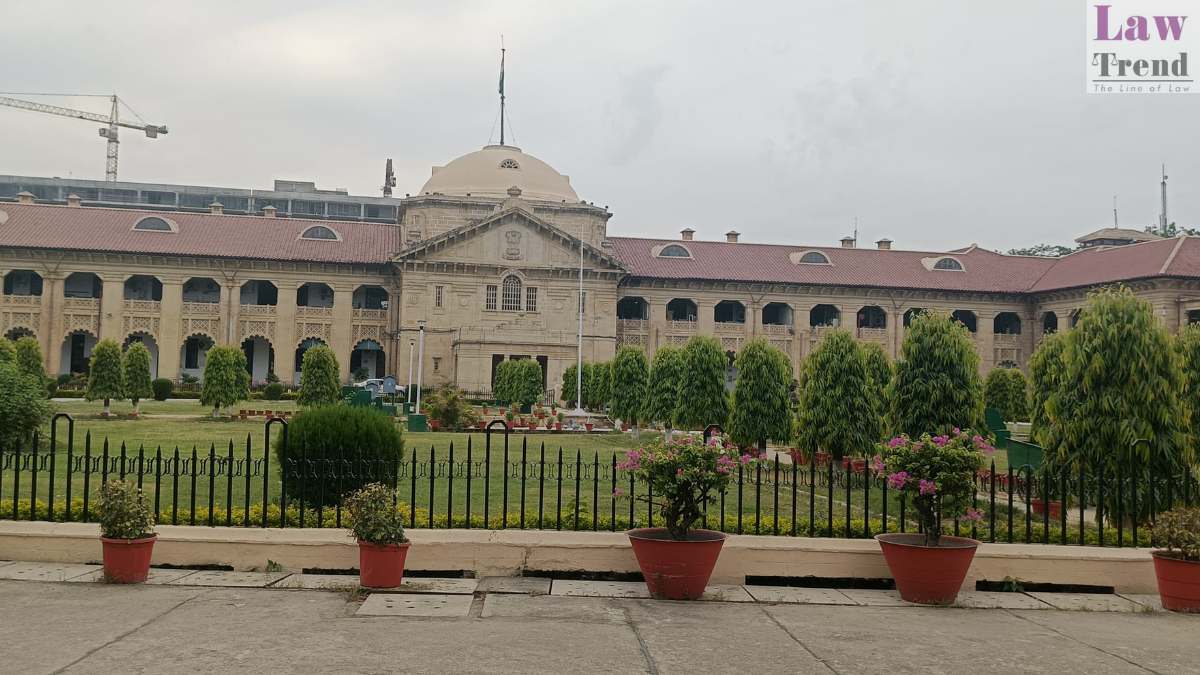
The Allahabad High Court has dismissed a 1989 criminal appeal and upheld the life sentence of a man convicted of stabbing a person to death over a land dispute in Bareilly. The Court held that differences between the FIR and the dying declaration about how the victim reached the hospital were minor and did not affect the consistent account naming the appellant as the attacker.
A Division Bench of Justice Siddhartha Varma and Justice Jai Krishna Upadhyay affirmed the conviction of Krishna Kumar @ Kumbh Karan under Section 302 IPC, recorded by the Additional Sessions Judge-9th, Bareilly, on July 31, 1989.
Background
According to the prosecution, deceased Bhim Singh had an ongoing land dispute with the accused. On the night of February 24, 1987, at about 11:15 p.m., when he reached his house at Nekpur, Madhinath, co-accused caught hold of him and instigated the appellant, who stabbed him in the stomach with a dagger (gupti).
The injured man reached the police station and lodged an FIR. His dying declaration was recorded at the District Hospital, Bareilly, by Executive Magistrate Leeladhar Nainwal after a doctor certified his fitness. He died at 7:45 a.m. on February 25, 1987.
The trial court convicted the appellant and sentenced him to life imprisonment with a fine of ₹100.
Arguments
Advocate Sikandar B. Kochar, appearing as Amicus Curiae for the appellant, argued that the FIR said the injured reached the police station in a rickshaw, the dying declaration said a traffic constable brought him to the hospital, and the bed-head ticket recorded that a named constable brought him. He submitted that these contradictions destroyed the credibility of the dying declaration.
He further contended that the second eyewitness turned hostile, the statement of the sole remaining eyewitness was recorded after a three-day delay, the weapon was not recovered, and the trial court ignored the appellant’s plea that the injury was caused accidentally in a scuffle while he was defending his father.
The Additional Government Advocate for the State argued that the fatal blow had been consistently attributed to the appellant across all statements, and that variations about the vehicle used were trivial peripheral details.
Court’s Findings on the Dying Declaration
Relying on the principles laid down by the Supreme Court in Abhishek Sharma v. State (Govt. of NCT of Delhi), the Court noted that only material inconsistencies shake the credibility of multiple dying declarations. It held:
“The core substratum of the prosecution case across all declarations, that appellant Krishna Kumar @ Kumbh Karan inflicted the fatal dagger/gupti blow into the abdomen of deceased Bhim Singh, remains unwavering.”
“The minor variance regarding the mode of conveyance does not destroy the consistent attribution of the fatal assault to the appellant,” the Bench added.
Noting that the doctor certified the deceased’s fitness both before and after the statement was recorded, the Court observed, “A joint and harmonious reading of PW-3 and PW-7 demonstrates that the dying declaration was recorded under rigorous medical oversight, free from any tutoring or fabrication.”
The Court found the declaration corroborated by eyewitness Sohan Lal, who identified the appellant under electric light. It pointed to four incised wounds on the deceased’s left hand as classic defence wounds and held, “This physical evidence falsifies the defence plea raised under Section 313 Cr.P.C. that the injury occurred accidentally during a scuffle over a weapon.”
On the delay in recording the eyewitness’s statement, the Court held that it was explained by the change of Investigating Officer, relying on Goutam Joardar v. State of W.B., Sunil Kumar v. State of Rajasthan and V.K. Mishra v. State of Uttarakhand.
Outcome
The Court dismissed the appeal, affirmed the conviction and sentence, and directed the appellant to surrender to serve the remaining sentence. It also separated the wrongly connected Government Appeal No. 1392 of 1989 for listing before the appropriate bench.
Recording its appreciation for the Amicus Curiae, the Court asked the Legal Services Authority to pay him legal aid fees of ₹30,000.
Case Title: Krishna Kumar v. State of U.P.
Case No.: Criminal Appeal No. 1697 of 1989
Bench: Justice Siddhartha Varma and Justice Jai Krishna Upadhyay
Date: October 16, 2026


