

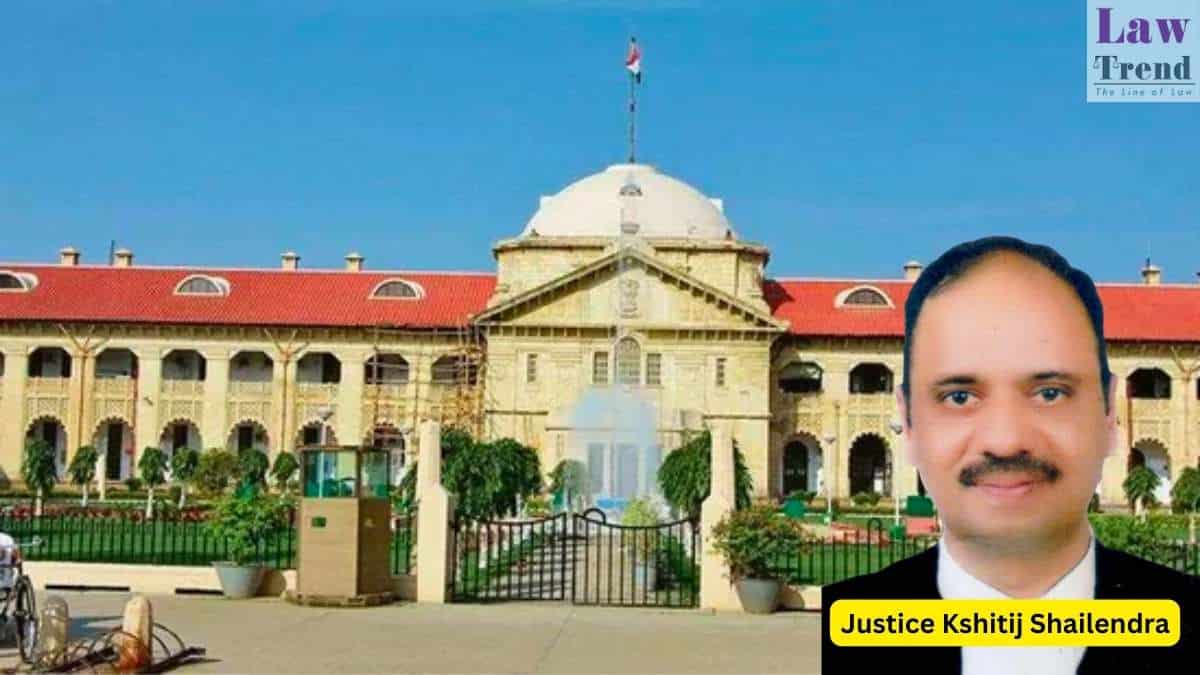
The High Court of Judicature at Allahabad has clarified the legal position regarding recovery proceedings against the legal representatives of a deceased defaulter under the Indian Stamp Act, 1899. Justice Kshitij Shailendra held that while recovery proceedings can continue against legal heirs, their liability is strictly limited to the extent of the property of the deceased that has come into their hands.
Background of the Case
The petitioners, Raj Kumar Verma and Deepak Soni, are the sons of late Rakesh Kumar Verma. In 2020, their father purchased agricultural plots via registered sale deeds. Subsequently, proceedings under Section 47-A of the Stamp Act were initiated against him, leading to an order dated May 12, 2022, by the Additional District Magistrate (Finance and Revenue), Agra, imposing deficiency and penalty amounting to ₹16,55,150/-.
A recovery certificate was issued in 2022. While a revision was pending before the Commissioner, Rakesh Kumar Verma passed away. The petitioners substituted themselves as revisionists to contest the matter on merits; however, the revision was dismissed on August 29, 2025, reviving the recovery proceedings. The petitioners approached the High Court seeking a mandamus to prevent coercive action and the attachment of their personal properties.
Arguments of the Parties
For the Petitioners: Learned Senior Counsel Shri Anupam Kulshreshtha argued that the petitioners could not be subjected to coercive action as they had not received any movable or immovable property, cash, or ornaments from their father. They filed separate affidavits to this effect. It was further contended that the underlying sale deeds were declared null and void by a civil court on October 28, 2024 (Original Suit No. 896 of 2022), meaning no property actually stood transferred to their father.
The petitioners suggested that the respondents could sell the property covered by the sale deeds or target the late father’s personal funds, but not the petitioners’ personal assets.
For the State-Respondents: The Standing Counsel argued that the petition was not maintainable as the orders imposing the deficiency were not challenged. They maintained that the death of the father does not absolve the heirs of liability and that the State is competent to adopt any mode of recovery prescribed by law. The State also questioned the petitioners’ claim of not inheriting anything, noting they had voluntarily substituted themselves in the revision proceedings.
Court’s Analysis
The Court examined the interplay between Section 48 of the Stamp Act and the U.P. Revenue Code, 2006 (which replaced the Act of 1950).
On the Nullity of Sale Deeds: The Court observed that under Section 2(14) of the Stamp Act, an “instrument” includes documents where a right or liability “purports to be created.” Referring to Kunwarpal Sharma v. State of U.P. (2003), the Court held that a subsequent civil court declaration of nullity is “wholly irrelevant for the purposes of determining the liability in the proceedings under the Stamp Act.”
On the Status of Legal Representatives: The Court noted that the petitioners, by substituting themselves in the revision, acknowledged their status as “legal representatives” under Section 2(11) of the C.P.C. The Court emphasized Section 181 of the U.P. Revenue Code, 2006, which allows recovery proceedings to continue against legal representatives “as if the legal representatives were themselves the defaulter.”
However, the Court highlighted a critical limitation:
“The proviso to sub-Section (1) of Section 181 clearly provides that the legal representatives shall be liable only to the extent of the property of the deceased which has come to their hands.”
On Modes of Recovery: The Court noted that while Section 170 of the Code allows for multiple processes (attachment of bank accounts, sale of property, etc.) to be enforced simultaneously, these must be applied against the legal heirs only within the “rider” of Section 181.
The Decision
The High Court disposed of the petition with the following directions:
- Liberty to Object: Petitioners may file objections before the Collector, Agra, within one month, supported by their father’s ITRs (3 years prior to death) and their own current ITRs.
- Inquiry by Collector: The Collector must conduct an inquiry to verify the extent of the inherited estate and decide the objections within four months via a reasoned order.
- Limited Liability: If liability is found, the Collector shall proceed under Section 170(1) of the Code, but only to the extent of the deceased’s property held by the heirs.
- Interim Protection: No coercive action (arrest or detention) shall be taken against the petitioners for four months or until the objections are decided.
- Asset Injunction: To protect public money, the petitioners are restrained from creating third-party rights on their properties and must maintain a bank balance equivalent to the levy until the Collector decides the matter.
Case Details:
- Case Title: Raj Kumar Verma and another v. The State of U.P. and 4 others
- Case No.: WRIT-C No. 10589 of 2026
- Bench: Justice Kshitij Shailendra
- Date of Judgment: March 25, 2026




