

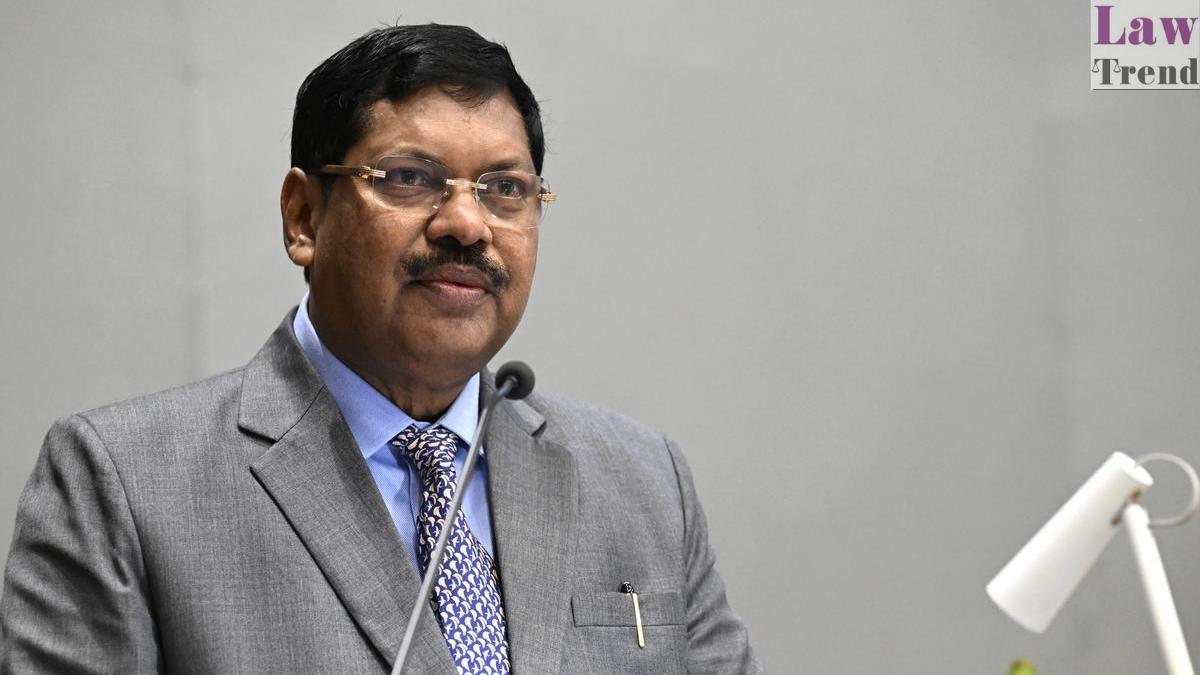
Chief Justice of India B.R. Gavai on Sunday underscored that legal aid must be treated not as an act of benevolence but as a moral and constitutional obligation. Speaking at the valedictory function of the national conference on ‘Strengthening Legal Aid Delivery Mechanisms’ and the celebration of ‘Legal Services Day’, the Chief Justice said those working in the legal aid movement should view their roles with “administrative imagination” to ensure that justice truly reaches the most marginalized.
Legal Aid as a Governance Responsibility
“Legal aid is not merely an act of charity but a moral duty. It is an exercise in governance, in ensuring that the rule of law extends to every corner of our country,” CJI Gavai said, urging legal aid officers, administrators, and volunteers to think like “administrators of justice.”
He emphasized that every effort, resource, and initiative must be designed to uplift individuals in need, stating that the system should ensure “every rupee spent, every visit made, and every intervention carried out truly uplifts someone in need.”
Proposal for Advisory Committees at NALSA and SLSAs
To strengthen institutional continuity, CJI Gavai proposed the creation of an advisory committee at both the National Legal Services Authority (NALSA) and State Legal Services Authorities (SLSAs). These committees, he suggested, should comprise current and future executive chairpersons to maintain consistency in long-term projects and policies.
He explained that while individual executive chairpersons bring diversity of ideas, their limited tenure often hinders sustained implementation of policies. “To address this, I suggest an advisory committee… comprising the current executive chairpersons and two or three future or incoming executive chairpersons. This committee could meet quarterly or every six months to discuss and oversee projects with a long-term perspective,” he said.
Strengthening Institutional Continuity and Collaboration
CJI Gavai reflected on his time as NALSA’s executive chairman, recalling how he worked closely with Justices Surya Kant and Vikram Nath across various states. He said such teamwork should become an institutional model to promote continuity and shared accountability.
“Such an arrangement would help institutionalise vision-based planning and ensure that key programmes—whether related to access to justice, awareness, or digital transformation—are carried forward consistently, regardless of administrative changes,” he added.
‘Empathy Must Guide Legal Aid Officers’
As he prepares to demit office on November 23, the CJI left a message for judicial officers serving in legal services institutions, urging them to combine empathy with efficiency. “Judicial training often teaches us to maintain a certain distance… But the work of legal aid demands the opposite sensibility: it requires empathy, collaboration, and the ability to see beyond procedure into the conditions that produce injustice,” he observed.
He highlighted that legal aid officers must engage actively with government departments, civil society organisations, and citizens, adding that many government officials across states have shown strong cooperation in ensuring benefits reach the needy.
Recognising the Role of Volunteers
CJI Gavai called for greater respect and recognition for volunteers and legal aid counsel, calling them “the backbone” of the movement. “The sustainability and success of the legal aid movement depend on these dedicated individuals,” he said.
‘When Compassion Meets Commitment, Real Transformation Happens’
Marking NALSA’s 30th anniversary, CJI Gavai reflected on the journey of India’s legal aid system and the challenges ahead. “The past three decades have shown that when compassion meets commitment, and when law meets human experience, real transformation becomes possible. Yet, this journey is far from complete,” he said.
He concluded by calling for deeper collaboration between the judiciary, executive, and civil society, integration of technology with human sensitivity, and a focus on restoring dignity rather than chasing numerical targets.
“The legal aid movement stands as one of the finest expressions of our Constitution’s soul—as a bridge between the letter of law and the lived realities of people,” the Chief Justice said.
The event, organised by NALSA, was attended by CJI-designate Justice Surya Kant, Justice Vikram Nath, and other judges of the Supreme Court and various High Courts.


