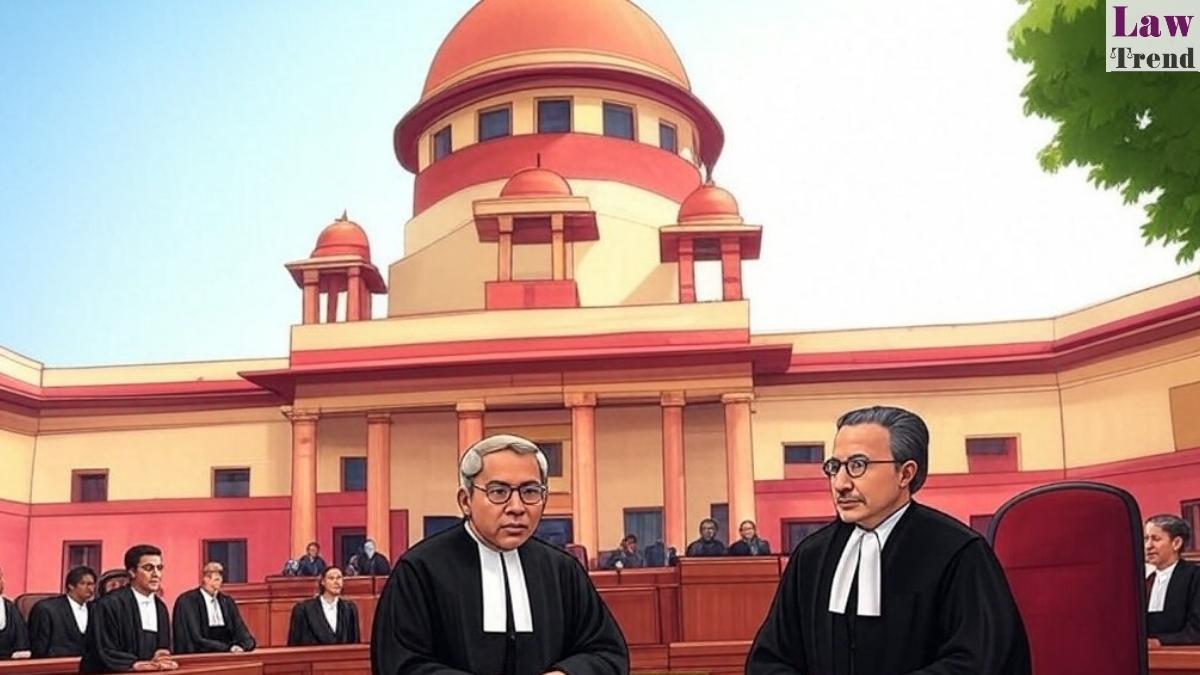
The Supreme Court of India has dismissed an appeal challenging the acquittal of a couple accused of murdering the man’s parents by setting their house on fire. In a scathing judgment highlighting severe investigative and procedural flaws, a bench comprising Justice Sanjay Kumar and Justice K. Vinod Chandran affirmed the High Court’s order of acquittal, noting that “truth was sacrificed at the altar of perceived vengeance.”
The Court heavily criticized the “overzealous” yet “careless” investigation and the Trial Court’s failure to properly examine the accused under Section 313 of the Code of Criminal Procedure (Cr.P.C.).
Background of the Case
The tragic incident occurred in the early hours of November 23, 2016, in Mahadeopur village, Bihar. A shanty housing a lawyer, Sarangdhar Singh, and his wife, Kamla Devi, was gutted in a fire. The husband died immediately, and the wife succumbed to 60% burn injuries two days later in a Patna hospital.
The younger son and his wife (the daughter-in-law) were accused of torching the hut with the intent to murder the parents, allegedly driven by a property dispute. The Trial Court convicted the accused based on multiple dying declarations and the alleged motive. However, the High Court overturned the conviction, expressing reasonable doubt and acquitting the couple. The elder brother of the accused, Sanjay Kumar Sharma, subsequently filed an appeal before the Supreme Court challenging the acquittal.
Arguments of the Parties
Appellant (Elder Son): The counsel for the appellant argued that the High Court completely lost sight of the evidence and erroneously ignored the dying declarations. The appellant relied on the First Information Statement (FIS), a statement recorded by a Block Development Officer (BDO), and oral testimonies of villagers (PW1 to PW3, 5, and 6) to establish that the deceased mother explicitly named the younger son and daughter-in-law as the perpetrators. The appellant asserted that a dying declaration, corroborated by medical evidence and proven motive, can be solely relied upon to enter a conviction.
The State: Supporting the Trial Court’s conviction, the State argued that the “dastardly crime,” along with the testimonies of witnesses, the dying declarations, and the proven motive, ought to have convinced the High Court of the accused’s culpability.
Defense (Accused): Senior Counsel for the accused pointed out glaring lapses in the investigation, alleging a “concerted effort to somehow punish the accused, by manufacturing evidence.” The defense highlighted inconsistent dying declarations and interested testimonies, suggesting that the elder son and a neighbor managing the properties had colluded to frame the younger son to exclude him from his inheritance. The defense also raised the possibility of an accidental fire caused by a bursting cooking gas cylinder. Furthermore, it was argued that the Trial Court proceeded on surmises and completely failed to put the incriminating circumstances to the accused under Section 313 of the Cr.P.C.
The Court’s Analysis
Justice K. Vinod Chandran, authoring the judgment, meticulously examined the evidence, particularly the multiple dying declarations. The Court reviewed several landmark precedents on dying declarations, including Laxman v. State of Maharashtra, Sher Singh and Another v. State of Punjab, Atbir v. Government of NCT of Delhi, Bhajju Karan Singh v. State of Madhya Pradesh, Ashabai v. State of Maharashtra, Satish Chandra v. State of M.P., Amol Singh v. State of M.P., and Lakhan v. State of M.P. The Supreme Court found that both the written and oral dying declarations in this case did not inspire confidence. The Court noted that the First Information Statement (FIS) contained a long narrative of family history, which was “highly improbable from a lady burned seriously.” It was also recorded while villagers and relatives were gathered around, raising suspicions of tutoring or prompting. A second declaration recorded by an Executive Magistrate lacked medical certification of the victim’s physical and mental state.
“The burn injuries, pertinently are not confined to the lower body… even a medical expert examining the cadaver cannot come to the conclusion that, when alive the deceased was in a fit state of mind to give a dying declaration,” the Court observed regarding the 60% burns sustained by the deceased wife.
The Court strongly rebuked the police investigation, pointing out the failure to draw up a scene mahazar, the lack of forensic examination to determine if the fire was arson or accidental, and the deliberate non-examination of independent witnesses—specifically, a woman whose shouts first alerted the village to the fire.
“Overzealous investigation is as fatal to prosecution as are the lethargic and the tardy. Framing a case on public perceptions and personal predilections ends up in a mess, often putting to peril an innocent and always letting free the perpetrator,” the Court stated. It further concluded: “The investigation, according to us was a sham and was pre-meditated, throwing to the winds every tenet of criminal jurisprudence informed by due procedure.”
The Supreme Court also expressed “anguish” at the Trial Court’s handling of the Section 313 Cr.P.C. examination. The Trial Court asked only four generic questions, completely omitting specific incriminating evidence such as the motive, previous complaints, and the dying declarations. Relying on earlier judgments like Ashok vs. State of Uttar Pradesh and Shivaji Sahabrao Bobade vs. State of Maharashtra, the Court ruled that “incurable injustice was done to the appellants in the course of their examination under Sections 313 of the Code, as no specific questions were put to them apropos each piece of incriminating evidence adduced against them.” Citing Sarwan Singh v. State of Punjab, the Court reiterated that prosecution evidence must travel the distance from “maybe true” to “must be true.”
Decision
The Supreme Court dismissed the appeal and affirmed the High Court’s acquittal of the accused. The Court declined to remand the matter for fresh Section 313 questioning, reasoning that the prosecution evidence inherently fell short of the required standard of beyond all reasonable doubt.
In its concluding remarks, the Court cautioned investigators and lower courts, noting the lasting impact of such legal battles: “A couple, at the fag end of their lives were burnt to death and the cause, whether it’s a homicide or accidental death, eludes civil society and throws a pall of suspicion on their own son and his family, who will always carry the yoke of dishonour. The trauma of arrest, incarceration and trial will always scar the couple and more so their children who were left orphaned…”
Case Details
- Court: Supreme Court of India
- Case Title: Sanjay Kumar Sharma v. State of Bihar & Ors.
- Citation/Case Number: 2026 INSC 223 / Criminal Appeal No…. of 2026 [@Special Leave Petition (Crl.) No. 15378 of 2024]
- Bench: Justice Sanjay Kumar, Justice K. Vinod Chandran
- Date of Judgment: March 11, 2026