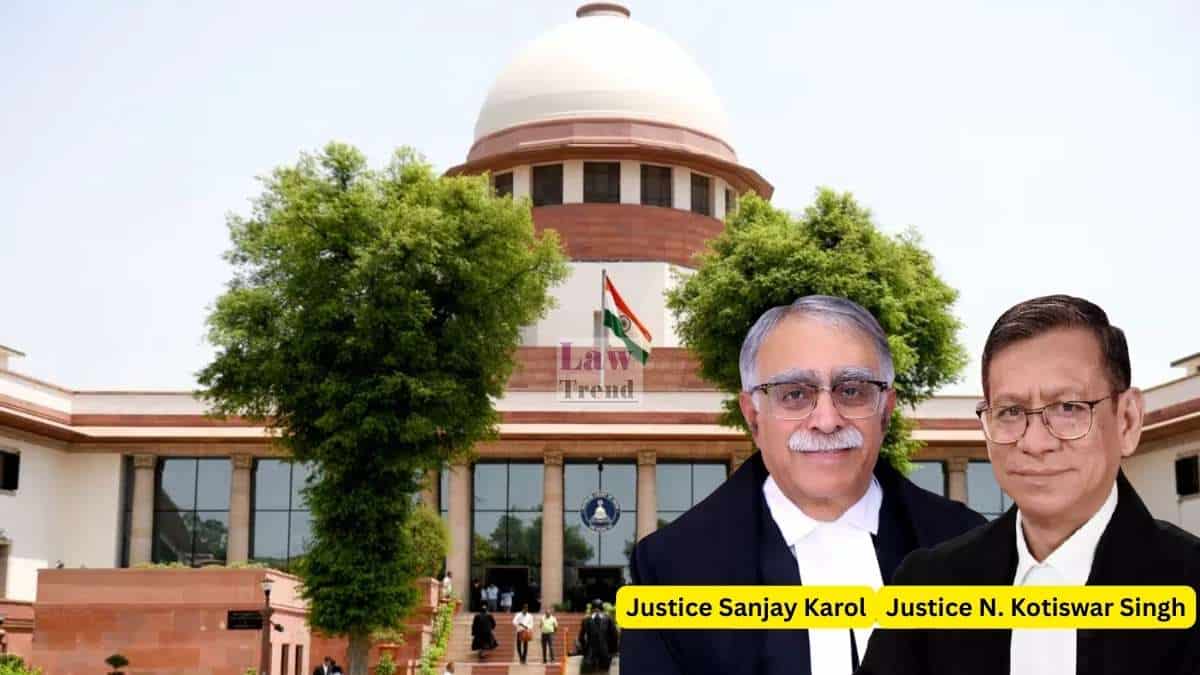
In a landmark judgment recognizing the invaluable role of homemakers, the Supreme Court of India has ruled that homemakers are “nation builders” whose unpaid labor must be properly quantified in motor accident compensation claims. A division bench comprising Justice Sanjay Karol and Justice N. Kotiswar Singh enhanced the compensation awarded to the legal heirs of a deceased homemaker to ₹62,77,900/-, significantly increasing it from the ₹8,43,400/- ordered by the High Court. The Court also introduced a new compensation head, ‘loss of domestic care’, to overcome the systemic undervaluing of domestic caregiving, while addressing the “unhappy” and “vexing” issue of inordinate delays in motor accident claim adjudications.
Background of the Case
The case dates back to November 25, 2001, when the deceased (the wife of the claimant) was killed in a motor accident while traveling from Sirsa to Fatehabad due to the rash and negligent driving of the offending vehicle’s driver.
The Motor Accident Claims Tribunal (MACT), Sirsa, allowed the claim petition on December 18, 2003, awarding a sum of ₹2,42,000/-. Seeking an enhancement of this amount, the claimants approached the Punjab and Haryana High Court.
Due to a tragic fire incident in 2011 that partially burnt or completely destroyed thousands of files, the case remained pending for two decades. The Punjab and Haryana High Court finally decided the appeal on December 11, 2024, enhancing the compensation to ₹8,43,400/- with interest. Still dissatisfied with this conservative valuation, the claimants approached the Supreme Court.
The Problem of Inordinate Delay
The Supreme Court took serious note of the fact that the litigation had dragged on for twenty-five years. It noted that the file destruction in 2011 did not justify a 14-year delay in reconstructing and deciding the case.
Analyzing data across 123 appeals adjudicated by benches presided over by Justice Karol, the Court revealed a troubling systemic issue: the average pendency of motor accident claims is approximately 8 years in High Courts and 6 years in Tribunals. The bench observed:
“Although it is never possible to fully compensate for the loss of a person who has been an integral part of a person’s family, the idea of ‘just and fair’ compensation requires that an amount of money be paid to the claimants that would, as far as possible, place them in a position as if the unfortunate incident of the death of their loved one had not taken place. For whatever reason, when this takes twenty years, the suffering is only compounded further.”
Court’s Analysis: The Homemaker as a ‘Nation Builder’
The Court engaged in an extensive analysis of the economic, social, and psychological contributions of homemakers, challenging long-held patriarchal stereotypes. Justice Karol, writing for the bench, questioned the historical hesitation of courts to fully value domestic work:
“when in Indian society, the ‘woman of the house’ is called the ‘grihaswamini’, then why n are we still groping in the dark about the questions such as the one present in this case.”
The Court criticized the conventional assumption that homemakers are mere “dependants” on earning members of the family, stating:
“In our view, it is ironic to describe a homemaker as dependant on earning members, when, in reality the household’s functioning depends substantially on the homemaker. The earning members are in fact solely dependent on the homemaker but alas, this reality does not receive the acknowledgment it deserves.”
Referencing the work of economist Sir Cecil Pigou and the 1991 recommendations of the Committee on the Elimination of Discrimination against Women (CEDAW), the Court emphasized that unpaid care work directly sustains the economic productivity of the paid workforce. The Court remarked:
“The ‘homemakers’, to put it directly, actually are the ‘nation builders’ and they ought to be recognised as such.”
The bench further observed that domestic labor goes far beyond basic chores, encompassing the preparation of “human capital” and providing vital emotional, social, and psychological stability to the household.
“It is high time now that the invisible is made visible or the veil is pierced to make what can be partially seen come out in the open.”
Review of Judicial Precedents
The Court examined various judicial milestones concerning the valuation of homemakers’ contributions:
- Lata Wadhwa v. State of Bihar (2001): Where a three-judge bench approved a multiplier method using ₹3,000/- per month as a notional income for deceased housewives in the 34–59 age bracket.
- Arun Kumar Agrawal v. National Insurance Co. Ltd. (2010): Which ruled that a wife’s selfless services cannot be equated to those of a housekeeper or servant.
- Rajendra Singh v. National Insurance Co. Ltd. (2020) and Kirti v. Oriental Insurance Co. Ltd. (2021): Which highlighted gender disparities in unpaid domestic work using the 2019 Time Use Survey.
- Arvind Kumar Pandey v. Girish Pandey (2025): Which affirmed that a homemaker’s contribution is of a high order and invaluable.
The Court concluded that relying on outdated, highly conservative notional incomes frozen at the time of death grossly undervalues the homemaker, as the standard “loss of consortium” head does not address the economic reality of losing a home manager.
The New ‘Loss of Domestic Care’ Head
To remedy this systemic disadvantage, the Supreme Court directed the implementation of a new composite compensation head:
“for the three major heads (the homemaker’s contribution towards smooth functioning of the household, the loss of maternal support for children and loss of spousal support/the support and care of their child who is an adult, for the parents of the deceased) discussed in the foregoing paragraphs, a composite sum of Rs.30,000/- shall be added under the head of ‘loss of domestic care’, provided that all three of these heads are met in the given case.”
This ₹30,000/- monthly figure will act as a baseline “stand-in” monthly income for non-earning homemakers, and will be awarded in addition to actual income for homemakers who are part of the active workforce. This value will be cumulatively enhanced by 10% every three years.
Distinguishing this from the “loss of consortium” defined in National Insurance Co. Ltd. v. Pranay Sethi (2017), Rajesh v. Rajbir Singh (2013), and Magma General Insurance Co. Ltd. v. Nanu Ram (2018), the Court noted that consortium addresses emotional loss, whereas ‘loss of domestic care’ addresses the systematic economic undervaluing of domestic work.
The Decision
Applying these principles to the facts of the case, the Court computed the compensation by treating the ₹30,000/- “loss of domestic care” as the baseline monthly income (amounting to ₹3,60,000/- annually).
With a 40% addition for future prospects (₹1,44,000/-), a multiplier of 16, a one-fourth deduction for personal expenses, and standard additions for loss of consortium (₹1,93,600/-), loss of estate (₹18,150/-), and funeral expenses (₹18,150/-), the Court calculated the total fair compensation to be ₹62,77,900/-.
The Court directed the respondent-Insurance Company to pay this enhanced amount under the interest rates and conditions previously stipulated by the High Court.
Directives for High Courts and Tribunals
To prevent long pendency and expedite justice, the Supreme Court issued the following guidelines:
- Mandatory Documentation: Claimants must annex official proof of Date of Birth (excluding Aadhaar Card), medical disability certificates with functional disability opinions, Income Tax Returns (ITRs) or stamped salary slips, attested medical bills, and notarized affidavits for attendant charges.
- Prioritization of Old Cases: Chief Justices of High Courts are requested to issue directions to list motor accident appeals pending over four years based on their date of institution, and to determine if additional MACT roster benches are required.
- Summary Procedures: Tribunals must record reasons if they choose not to adopt the “summary procedure” permitted under Section 169 of the Motor Vehicles Act, 1988.
- Terminology Shift: The Court expressed its hope that the word “housewife/homemaker” will henceforth be replaced by the term “Nation Builder” in recognition of their societal contribution.
Case Details
Case Title: Shishu Pal @ Shish Ram & Ors. v. Surjeet & Ors.
Case No.: Civil Appeal No. of 2026 (Arising out of SLP(C) No. 33915 of 2025)
Bench: Justice Sanjay Karol, Justice N Kotiswar Singh
Date: June 11, 2026