

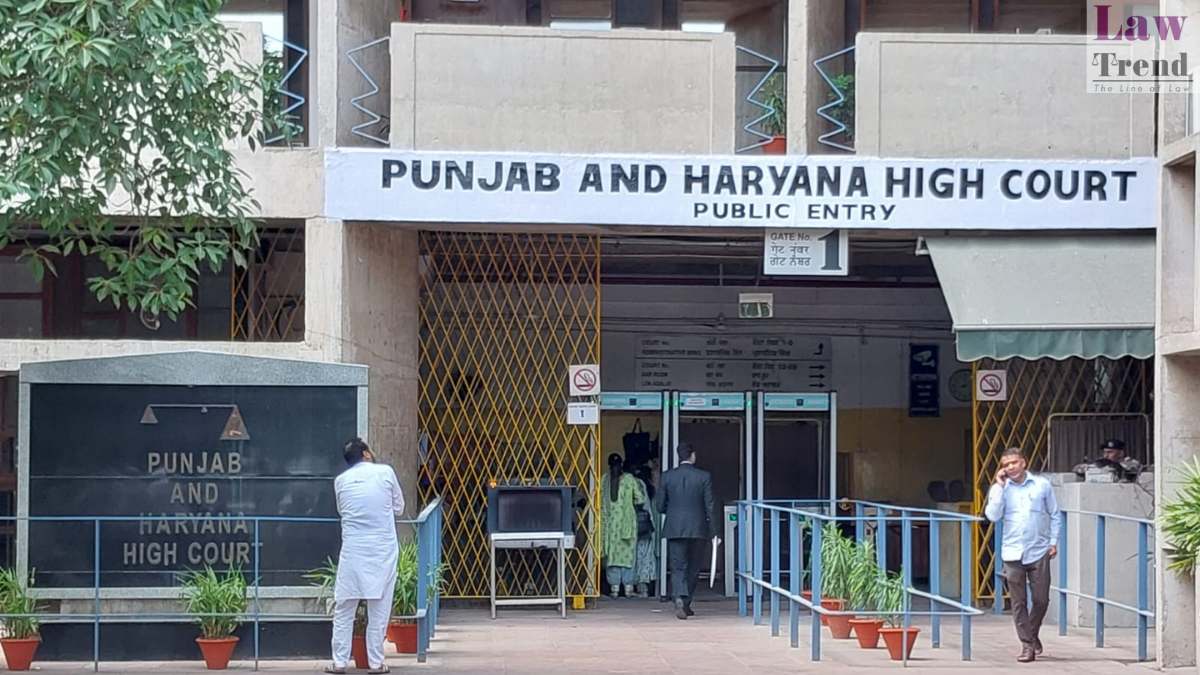
The Punjab and Haryana High Court on Thursday stayed the implementation of the Haryana government’s controversial ‘stilt-plus-four floors’ (S+4) policy for residential plots. The court observed that the state appeared to have prioritized revenue generation over the safety and security of the general public.
The interim order, passed by a division bench of Chief Justice Sheel Nagu and Justice Sanjiv Berry, effectively halts the operation of the July 2, 2024, notification issued by the Additional Chief Secretary of the Town and Country Planning Department. This notification had expanded the construction limit from three to four floors and introduced a composition mechanism for unapproved building plans.
In a stinging critique of the state’s approach, the division bench noted that the government seemed to have “abdicated its constitutional duty” to provide a healthy urban environment.
“It appears that the State of Haryana merely to earn more revenue has put the safety and security of members of general public at stake,” the court observed.
The bench further highlighted that the state and its functionaries had turned a “Nelson’s eye” to the severe infrastructure deficits in Gurugram. The court pointed out that the government failed to conduct a mandatory ‘Infrastructure Capacity Audit’ before rolling out the S+4 policy.
The court’s decision was heavily influenced by a physical inspection of Sector 28, DLF Phase-I in Gurugram. While official records claimed internal roads were 10 to 12 meters wide, a court-appointed commission found that the actual motorable space for vehicles and pedestrians was a mere 3.9 to 4.8 meters.
This “shrinkage” of public space was attributed to several factors:
- Inadequate sanitation and sewerage systems.
- Overpopulation and defective town planning.
- Indiscriminate paving of roads blocking aquifers.
- Rampant construction preventing groundwater recharge.
The petitioner argued that the government ignored the findings of an expert committee led by P. Raghavendra Rao, Chairman of the Haryana Pollution Control Board. That committee had explicitly recommended that a Standard Operating Procedure (SOP) for an infrastructure audit be prepared before implementing such a policy.
The High Court echoed these concerns, noting that Gurugram’s civic systems—including drainage and sewage treatment—are already under extreme stress. The bench observed that traffic congestion and flooding in low-lying areas have become commonplace due to unregulated vertical growth.
Given that legal arguments are expected to continue for some time, the court deemed it necessary to restrain the state from proceeding with the policy until the next date of hearing.
“Since the arguments are taking long time to conclude… it is deemed appropriate by this Court, at this stage, without commenting on the validity of the impugned order… to restrain the State from going ahead with the ‘stilt + 4 floor policy’,” the order concluded.




